President Trump and Chinese President Xi Jinping wrapped up a state visit Friday afternoon with another round of events high on choreography but low on progress on trade and artificial intelligence.
Perhaps the most direct takeaway came in the form of two new dates to circle on the calendar.
On AI, a summit in Shenzhen, China, in November was announced to discuss issues like AI safety, which saw little progress this week. Trump posted Friday that he would meet with XI at that summit and said, “Much has been, and will be, accomplished.”
On tariffs, an existing trade truce, which was set to expire in November, got a short-term extension to Jan. 10, 2027.
Both moves marked a delay from the US and China in confronting these fundamental issues and came as the two leaders went out of their way to underline the positive relationship between the world’s two largest economies.
Trump repeatedly offered lavish praise and said during a tea in the White House’s Red Room that it had been “a tremendous visit [with] great strides, very positive, for both countries.”
 President Trump speaks during a tea ceremony with Chinese President Xi Jinping and others in the Red Room of the White House on Sept. 25. (Andrew Harnik/Getty Images) · Andrew Harnik via Getty Images
The Chinese leader reciprocated with talk of a friendship between the two nations as the visit ended on Friday at the US National Archives, where Trump and Xi viewed the Declaration of Independence and the US Constitution before saying their goodbyes.
Yet the lack of specifics left many policy experts wanting.
Capital Economics wrote in an analysis that, on substantive issues, the visit had offered “little beyond a short reprieve.”
“The elaborate welcome and ceremony surrounding President Xi’s state visit to the US could not hide the lack of substantive progress,” the report said, describing the dynamic underneath the pageantry as “mutual suspicion.”
On tariffs, a pause to assess ‘whether or not to continue this period of relative peace’
The key headline from the summit for tariff watchers was an announcement on Wednesday that the US and China would extend their current trade truce by two months, with a new early 2027 deadline for trade talks.
US Trade Representative Jamieson Greer told CNBC on Friday that the US and China had also reached agreements to reduce tariffs on a “subset” of nonsensitive goods and that those details would be released on Monday.
Trump’s team has said that the coming months could yield a “bigger deal,” even as Greer made clear that trade tensions could quickly re-emerge. He described the coming months as a time “to reassess and determine whether or not to continue this period of relative peace on the economic front with the Chinese.”
First lady Peng Liyuan and President Xi Jinping of China wave as they board a plane to return to China following a state visit to Washington on Sept. 25. (Alex Wong/Getty Images) · Alex Wong via Getty Images
Trump’s team is currently considering new 7.5% tariffs on China around the issue of overcapacity. Though an investigation this summer means the new levies could be imposed quickly, they have been delayed — likely until after the midterm elections if not further — in part due to withering US public opinion on tariffs.
Xi, in his remarks, underlined the tenuous nature of the truce. He said he wanted to increase cooperation and trade with the US, but only if “two sides uphold the spirit of equality, mutual respect, and mutual benefit.”
The truce, first announced in South Korea last October, included provisions suspending some tariffs and promises from the Chinese government regarding rare earth exports.
AI safety summit later this fall
The main advancement in AI took the form of plans for a “notification mechanism” to increase communication between two nations in the event of AI incidents.
The Chinese have been silent on whether they will embrace the idea, but US Ambassador to China David Perdue said on Fox News on Friday that this new channel of communication was moving forward and would be significant even amid questions about how it would work.
“We have a crisis mechanism that’s been established and an AI dialogue that has been established as well,” he said. “That’s going to be a platform that we can move forward on.”
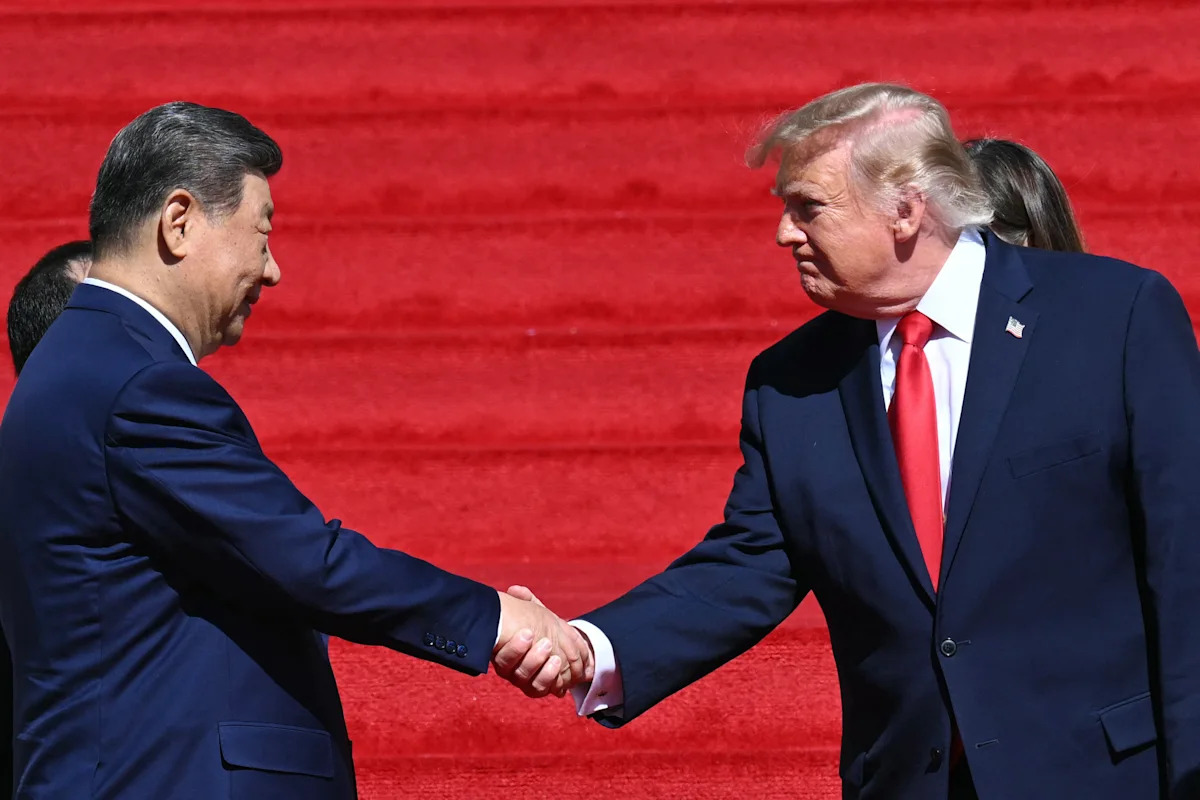
President Trump shakes hands with China’s President Xi Jinping on Friday at the end of the three-day visit to Washington. (Saul Loeb/AFP via Getty Images) · SAUL LOEB via Getty Images
Yet, while observers were quick to note that increased communication could pay dividends down the road, it was equally clear that the search for more substantive agreements on issues like AI safety would wait until late fall.
Both the US and China have shown little interest in pursuing wide-ranging moves to rein in AI, such as regulating frontier models.
Trump underlined that stance in a Truth Social post, saying he wants to leave the overall sector “exactly where it is [and] that is China’s position also.”
Ben Werschkul is a Washington correspondent for Yahoo Finance.
Read the latest financial and business news from Yahoo Finance