US stock futures rallied Monday, offering investors a chance to recover some of last week’s steep losses even as Asian markets remained under pressure and concerns about the AI boom deepened.
Nasdaq futures rose 3%, while S&P 500 futures gained 2% on Monday at 12:09 a.m. ET. Dow futures were also 2% higher.
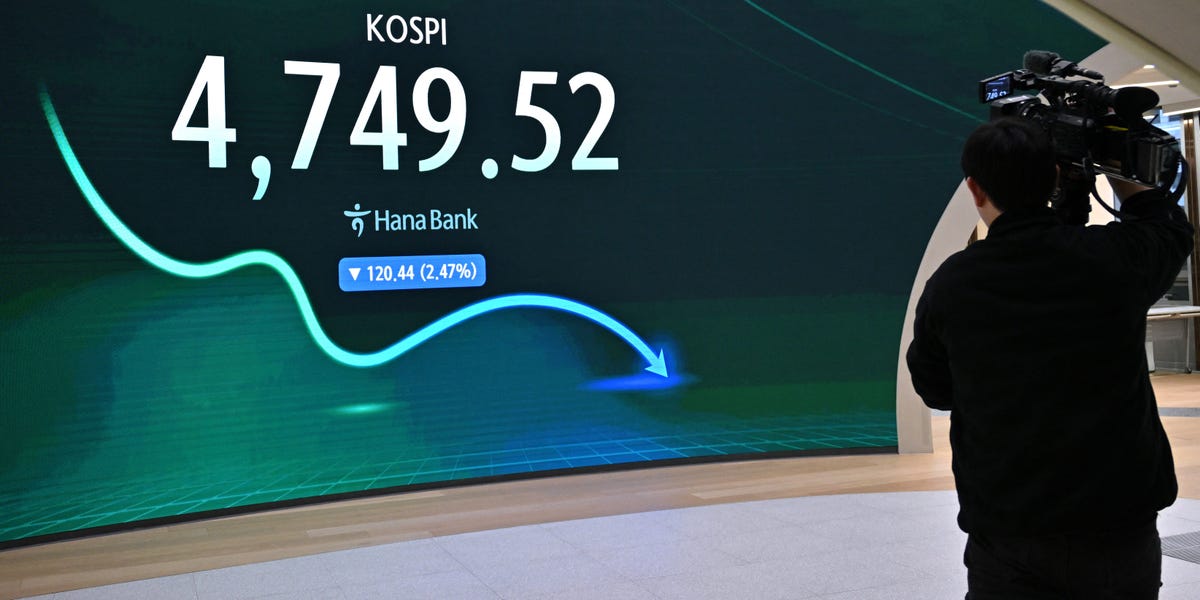
South Korea’s Kospi fell as much as 6%, before paring losses. Index heavyweights Samsung Electronics and SK Hynix both dropped as much as 6%.
Trading on Taiwan’s Taiex was choppy, as the benchmark index fell as much as 2% before reversing into the positive zone in the late morning.
Meanwhile, Hong Kong’s Hang Seng Index declined as much as 2% before paring losses.
Japan’s markets were closed for a holiday.
The contrasting moves followed a punishing week for US technology stocks. The Nasdaq lost about 10%, its worst weekly performance since March 2020, as investors questioned whether the enormous sums being poured into AI could generate the profits needed to justify them.
Semiconductor stocks have taken an even bigger hit. The Philadelphia Semiconductor Index and Taiwan’s chip-heavy Taiex both lost 17% last week.
The losses have prompted Asian authorities to act.
Want more Business Insider in your news feed?
Add BI in Google so our reporting is easier to find when you’re searching for what matters.
Taiwan tightened short-selling restrictions and deployed its market-stabilization fund. South Korea is preparing a fund for possible deployment and eased rules on corporate share buybacks.
The “Bank of Jensen” faces a reckoning
The financial arrangements that helped power the AI boom could become another source of trouble for investors.
Jensen Huang’s departure as Nvidia CEO has raised questions about whether the chipmaker will continue providing generous financial support to other AI companies, wrote Vishnu Varathan, the Asia Pacific head of macro strategy at Mizuho, on Monday.
“Without the ‘Bank of Jensen’ there is a non-negligible risk that cashflow crunch can hit valuations hard and fast,” Varathan wrote.
If that funding dries up, companies building AI infrastructure could find themselves short of cash and paying more to borrow, putting further pressure on their stock prices.
Varathan also warned that the resulting slowdown might not be enough to persuade the Federal Reserve to soften its stance on interest rates.
Yet the same forces that have driven stocks sharply lower could also help power a rebound.
Investors have been paying unusually high prices to protect against further stock market losses, with options betting on declines commanding a substantial premium over those betting on gains, Chris Weston, the head of research at Pepperstone, wrote.
If investors reduce their bets against further losses, it could help drive a sharp rebound in stocks, even if concerns about AI spending and future profits remain.
“It wouldn’t surprise me to see an aggressive snapback in US equities. But the strength of that rally shouldn’t be confused with evidence that the fundamental concerns have disappeared,” Weston wrote.