
Microsoft opened Ignite 2026 on November 17 in San Francisco with one message: AI needs context, choice, control and a bill you can read. Satya Nadella called Copilot “the new OS for work,” then spent the keynote on four layers under it: models, enterprise context, agent governance and security.
Update (November 20, 2026, 23:05 UTC): Ignite 2026 ended — live coverage closed
Microsoft’s Ignite live blog still shows November 17–20, 2026 as the event window and reports 0 new updates on the final check this evening. The keynote wrap message and Book of News links are unchanged from the 16:10 UTC note below. We will not add further live rows unless Microsoft changes a status in the Book of News.
This hub remains a frozen index for Ignite week. Day-by-day deep dives stay in Related reading.
Update (November 20, 2026, 16:10 UTC): Ignite keynote closed; event ends today
Microsoft’s Ignite live blog posted “That’s a wrap on our Ignite keynote” on the final conference day, November 20, 2026. The page still lists the event as November 17–20 in San Francisco and online, with links to the Book of News and the official recap blog. Per the live blog through conference close, no new product announcements appeared after the 14:15 UTC Office Watch availability tally in the changelog below.
Treat this hub as a frozen index for Ignite week unless Microsoft changes a status in the Book of News. For day-two and day-three breakdowns, use the linked posts in Related reading. This live thread ends with today’s conference close.
This page is the single index. It sorts the Ignite 2026 announcements by status (generally available, Frontier, preview) because Microsoft’s own wording blurs them, and it links to our deeper posts on each piece. Facts come from Microsoft’s live blog, official blog post and Book of News.
TL;DR: what shipped and what is still preview
AnnouncementStatus (per Book of News)What it doesHome and Office in CopilotGAChat and Cowork in one home; Word, Excel, PowerPoint inside CopilotCopilot Managed RuntimeGASecure hosting for agents and workflows you buildCopilot Code, Autopilot, WorkspacesFrontierPlain-language app building, a persistent agent, a shared team spaceCopilot Today (Brief and Feed)Private previewMorning briefing that refreshes through the dayMAI Code 2 and Code 2 FlashGA in GitHub CopilotAgentic coding models; Flash is the high-volume tierMicrosoft-Decision-1.1GACheap model for routing, classification and verificationMAI Cyber 2 FlashPreview (Codename MDASH)Security model with 12B active parametersAgent 365 Business AnalyticsFrontierAI spend, adoption and outcomes in one viewAgent 365 Cost ManagementPreviewSpend policies, limits and alerts for adminsMicrosoft IQGA, no new SKUContext layer: Work IQ, Fabric IQ, Foundry IQ, Web IQPerceptionGARed, blue and green security agents driven by playbooksSalesforce in CopilotPreview38+ sales skills via Salesforce MCP accessCobalt 200 VMsGAUp to 50% faster than Cobalt 100
Update (November 20, 2026, 14:15 UTC): how many Ignite features are usable today
Office Watch counted the features in Microsoft’s Book of News and reported on November 18 that 215 separate features sit inside the 59 announcements. Of those, 76 (35%) are generally available, and 8 more are usable at extra cost, so 84 (39%) work today. Another 109 are preview or Frontier only: 87 public previews, 9 private previews, 11 Frontier-only features and 2 pilot programs. Eight have a date for later and 14 have no date.
The outlet notes that most generally available items are for Azure, Fabric, Foundry, GitHub and Microsoft IQ, not Word, Excel or Outlook. Autopilot, Copilot Workspaces and Copilot Code remain Frontier-only, with Copilot Code promised for general availability in December. The Agent 365 action center is in private preview with a December target. Treat the counts as the outlet’s tally of Microsoft’s own list, not a Microsoft figure. The event ends today, November 20; check the Book of News for status changes.
Update (November 19, 2026, 21:10 UTC): NVIDIA and Microsoft items for Azure, Foundry and Windows
NVIDIA’s Ignite partnership post, published November 19, adds infrastructure and model items this page had not indexed. Statuses are as NVIDIA states them.
AnnouncementStatusWhat it doesVera Rubin NVL72 on AzureRunning in Azure data centers; VM access expanding (preview, per NVIDIA)Rack-scale systems for reasoning, agents and large training and inferenceNemotron 3.5 on Foundry Managed ComputeAvailable, per NVIDIASuper, Lightning, Embed, Rerank, Parse and Content Safety; Bolt and Transcribe coming soonProgrammed Training and custom weightsOffered, per NVIDIAServerless post-training in Foundry; deploy your own model weights on Managed ComputeAzure Local with RTX PRO 6000, Jetson Thor and OrinExpandingOn-premises and edge AI, including machine vision and roboticsWindows 365 Direct StreamLimited preview; public preview planned for early 2027Up to two 4K streams at 60 fps on GPU Cloud PCs
Microsoft’s own Azure infrastructure post says it brought up Vera Rubin NVL72 for validation in March and delivered its first production systems in August, but it does not describe VM availability, so the VM preview rests on NVIDIA’s account. NVIDIA also reports an EY result (55% better accuracy and 15x lower cost than proprietary frontier models on a purchasing-record task) with no published method. Details are in our NVIDIA and Microsoft Ignite post.
Update (November 19, 2026, 10:10 UTC): Defender and Sentinel items not in the table above
Microsoft’s Defender and Sentinel post for Ignite 2026, published November 17, lists security items that this page had not indexed. Statuses are as Microsoft states them.
AnnouncementStatusWhat it doesIntegrated SOC core in DefenderGACase management, playbooks, workbooks and UEBA, plus workspace creation and third-party ingestionFull SIEM breadth, 90 days of built-in Defender data retention, detections as codePreviewExisting Sentinel customers can opt in to the integrated SOCIngest-time normalizationPreviewStandardizes security data as it arrives so queries and detections can be reusedVulnerability shieldingPreviewAI-based, on by default; applies narrow, temporary controls to exposed systems before and during attacks while teams patchPosture assessment for agents on other platformsPreviewCovers agents built on Amazon Bedrock, Google Gemini, Google Vertex AI and Anthropic Claude, in the same inventory as Copilot Studio and Foundry agentsIdentity-attack detections for agentsNew detectionsSpots device-code phishing against a developer’s GitHub account and can disable the account and revoke sessionsClickFix detection and blockingNewTargets malicious copy-and-paste attacks, which Microsoft says were 12.8% of intrusions it observed this yearQR-code and deepfake protection in TeamsPublic previewDetects malicious URLs hidden in QR codes in chats and expands detection for meetings
The runtime protection for local agents on Windows (generally available) is already in the Perception section below. Microsoft’s post adds that in Block mode Defender also stops the action and notifies the user, and that each detection raises an alert with agent and session context.
One number in the post deserves a caveat. Microsoft says October 2026 saw 1,413 CVEs disclosed, “the largest Patch Tuesday on record,” and uses it to argue that attackers exploit flaws within hours while patching takes days or weeks. That is Microsoft’s own count and framing, and we have not checked it against the MSRC release notes. Vulnerability shielding is a preview feature, so treat it as a stopgap to test, not a replacement for patching. The footnote marker on the “generally available” runtime protection claim means conditions apply, so read Microsoft’s linked supported-agent list before you rely on it.
Update (November 19, 2026, 07:00 UTC): Azure data and operations announcements
Microsoft’s Azure blog post for Ignite 2026, written by Azure EVP Arun Ulag, lists several items that the table above does not cover. Statuses below are as Microsoft states them.
AnnouncementStatusWhat it doesAzure CatalystNewOne experience for agentic modernization: discovery, planning, migration and code intelligence, with GitHub Copilot modernization carrying the plan into codeFabric appsGABackend services plus trusted Fabric data and governance for apps built in code or in conversationFabric HorizonDBPublic previewServerless, Fabric-native PostgreSQL; also the backend for Fabric appsDatabase Hub in FabricGAOne view to discover and manage databases across Azure, on-premises and FabricMicrosoft Copilot integration with Fabric appsFrontier public previewDescribe an app in Copilot and use Fabric as its data backendCopilot Credits for FabricNew billing optionUsage-based billing next to capacity-based optionsAgentic app creation in Power BI DesktopPreviewTurn semantic models into interactive apps that capture input and update dataAzure Copilot deployment agentGANatural-language requirements to deployed cloud workloadsAzure Monitor health modelsGAGives agents a real-time view of app architecture and business prioritiesAzure SRE Agent enterprise controlsPreviewAgentic operations in secure production environmentsAzure Workload CenterLimited previewExtends agentic operations to Oracle and SAP
Two details are worth noting. First, Microsoft says Azure Catalyst works with Microsoft Security, where Perception and MDASH rank vulnerabilities across your estate and code. That ties the security announcements below to the app-modernization story. Second, Fabric HorizonDB is a different product from Azure HorizonDB: the Azure post attaches the vector indexing and millisecond latency claims to Azure HorizonDB, and lists the Fabric version as a serverless, Fabric-native PostgreSQL experience in public preview. The 8X claim covered later remains Microsoft’s own number. Our HorizonDB deep dive explains what to test.
Daily briefFrom Yash · 350K+ students taught
Catch up on AI
One AI story explained in plain English, plus one thing to try. Every day, free. Unsubscribe anytime.
What is the new Copilot, and who gets it today?
Microsoft split the release in two. The surfaces a normal Microsoft 365 tenant can switch on now are Home, where Chat and Cowork meet, and Office in Copilot, which puts Word, Excel and PowerPoint beside the chat. Both are generally available. Copilot Managed Runtime, which hosts what you build, is also generally available.
Satya Nadella’s Ignite demo of Copilot Workspaces, from his X thread.
The agent-heavy parts sit behind the Frontier program. Code turns plain language into working apps and dashboards. Autopilot is a persistent agent with its own agent ID and memory that you can @mention in Teams. Workspaces is Nadella’s “multiplayer form factor, where people, their agents and other people” share context. Copilot Code reaches general availability in December, according to the Book of News.
Copilot Today is the most limited. The Today Brief ships with a Microsoft 365 Copilot license, but the Today Feed needs Copilot credits, and the whole experience is in private preview in Outlook and the Copilot app.
Our deeper reads: Copilot Today, Pages and Workspaces and Autopilot and the Frontier rollout.
Which models did Microsoft ship, and what do they cost?
The model story is cost per task, not a new leaderboard. Nadella described the goal as “the most intelligence out of every model, for every task, at the best possible price,” with three purpose-built areas.
Coding: MAI Code 2 targets complex, long-horizon, multi-file work and repo-wide reasoning. It is generally available in the GitHub Copilot model picker and in Copilot Fusion. MAI Code 2 Flash is the fast, high-volume tier.
Cybersecurity: MAI Cyber 2 Flash has 12 billion active parameters. Microsoft says it lands within a few points of larger cyber models at a fraction of the price. The Book of News lists it as preview only in Codename MDASH.
Decisions: Microsoft-Decision-1.1 is generally available in Foundry, OpenRouter and Vercel. The Book of News says it is built on Gemma 4 26B A4B, adds image input, and scores 68 on the Artificial Analysis Decision Index v2.1, up six points from the first model. More than 4,000 customers already use the first version.
No source gives token prices for the MAI models. Benchmark and price-ratio claims in the press come from Microsoft and have not been independently reproduced. We cover the numbers and the caveats in MAI Code 2 and the six specialist models.
Mustafa Suleyman framed the family as “frontier-level capability at a price organizations can afford to run at scale.” Jay Parikh added the routing side: Microsoft Foundry now lists more than 11,000 models, and its model router expanded to the top 50. Auto routing in Copilot picks the model per task, trading quality against cost on every request. GPT 6.2 and Meta’s latest models are listed as coming to Foundry with no date; see GPT-6.2 Astra Sol launch pricing and benchmarks for the OpenAI side.
What is Agent 365 Business Analytics?
This was the most practical announcement for finance and IT leads. Microsoft cited a study claiming AI spending can nearly quadruple as organizations move to enterprise-wide adoption, and that 93% report exceeding their AI budgets. That is a vendor-cited figure, so treat it as directional.
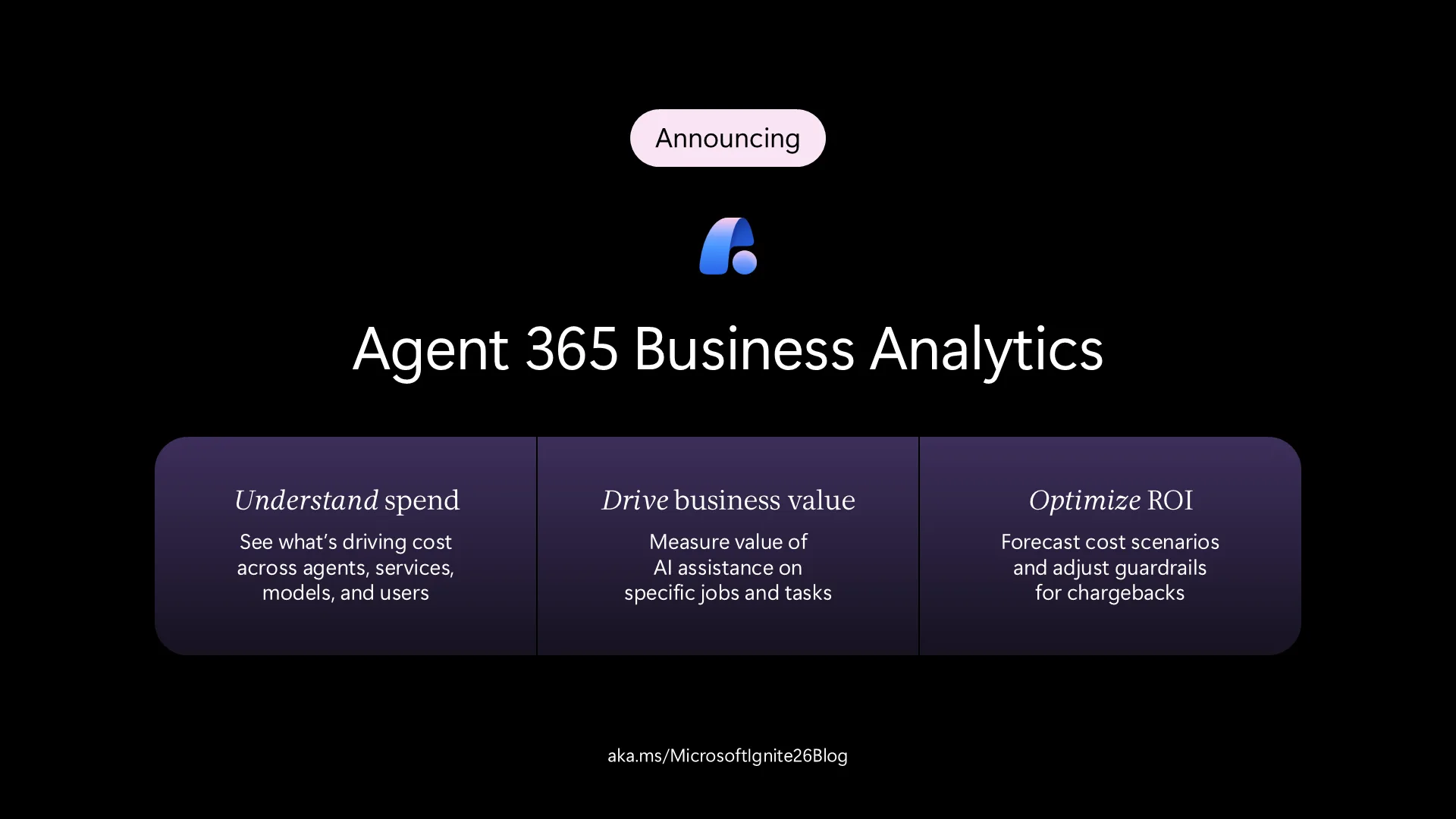 Agent 365 Business Analytics slide from Microsoft Ignite 2026
Agent 365 Business Analytics, as shown in Nadella’s X thread.
Agent 365 splits the problem in two.
LayerAudienceStatusWhat it showsBusiness AnalyticsBusiness leadersFrontierSpend, adoption, success rate, user satisfaction, assisted hoursCost ManagementIT adminsPreviewSpend by user, agent and model; policies, limits, alerts; Fabric chargeback
Nadella’s line was that Business Analytics is “your ERP system for AI usage.” Leaders can ask questions through agentic Q&A, build custom reports and push data into existing reporting tools and data lakes. Charles Lamanna’s pitch was measuring “the work AI helps complete, not just the tokens it consumes.”
Licensing is where the fine print lives. Insights on Microsoft services need at least one Microsoft 365 Copilot license. Insights on non-Microsoft services need an Agent 365 license. Forecasting and optimization recommendations reach the Frontier program “this month,” and value insights across Microsoft and non-Microsoft agents arrive in December.
What is Microsoft IQ, and does it need a new license?
Microsoft IQ is an enterprise context layer. It combines Work IQ, Fabric IQ, Foundry IQ and Web IQ with more than 350 third-party connectors, so an agent starts with a governed picture of how your business works instead of a blank prompt.
Per the Book of News, it is generally available across Microsoft Copilot, GitHub Copilot, Foundry and MCP-compatible harnesses, with no new SKU. The unit you build is a business plugin that captures know-how, skills and tools. Business plugins themselves are in the Frontier program.
IQ layerStatus highlightsWork IQMemory and longer workflows GA; Listen (event-triggered agents) and granular approvals in preview; OpenAI integration GA, Anthropic “coming soon”Fabric IQCopilot and Fabric app integration GA; ChatGPT and Claude connectors in previewFoundry IQSharePoint knowledge source GA; knowledge graphs and Microsoft-Retriever-1 in previewWeb IQGA for all Azure customers at a lower price (no figure given); Places covers 207.5M entities
If you build agents, the practical point is that context ships as portable plugins over MCP and agent skills rather than as per-agent prompt files. The related Power BI path is covered in Power BI authoring plugin and Fabric agents.
What is Copilotforce, the Salesforce tie-up?
Nadella announced integrations of Salesforce across Copilot, Teams and Fabric. Microsoft’s own page references it as “CopilotForce”; the live blog spells it “Copilotforce.”
Salesforce in Copilot is in preview. It ships 38+ prebuilt sales skills and uses authenticated Salesforce MCP access, so sellers act inside their existing Salesforce permissions.
Sales Cloud in Teams is in pilot.
Data Federation between Salesforce Data 360 and Fabric OneLake is generally available, as is the Salesforce CRM migration experience.
Salesforce’s Rohan Kumar and Accenture CIO Tony Leraris joined Judson Althoff on stage. Microsoft also made its own Dynamics 365 Sales and ERP apps plugins generally available, so the message is “bring your CRM, we will meet it.”
How does Perception change security work?
Perception is now generally available. Microsoft describes a three-layer cyber stack: signals, sensors and actuators; context; and agents, harnesses and models. Perception sits at the top. It runs blue, red and green team agents through playbooks, in a closed loop, with guardrails and human sign-off for high-impact actions.
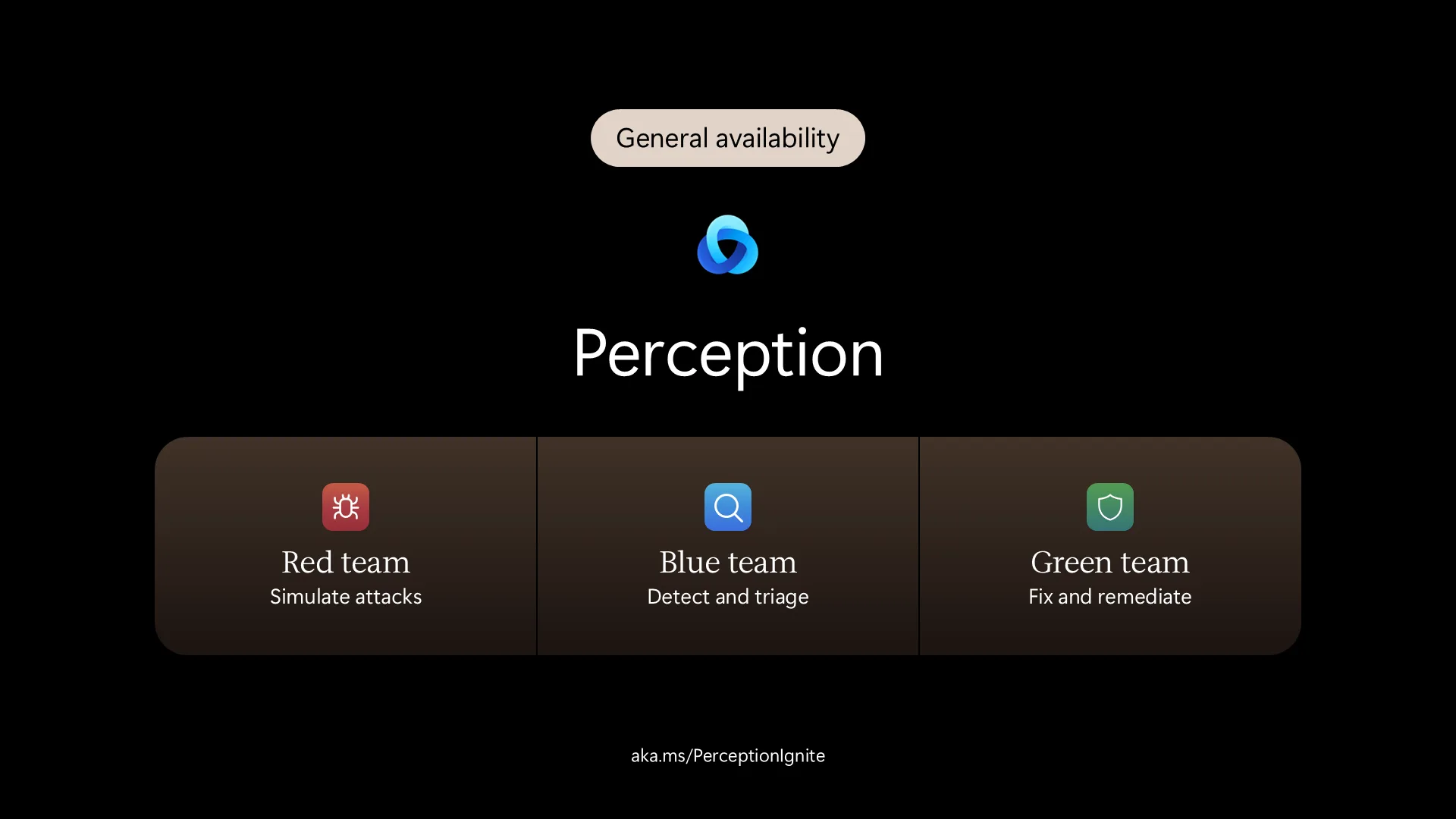 Microsoft Perception slide showing red, blue and green security agents
Microsoft Perception, as shown in Nadella’s X thread.
Key details from the Book of News:
The Triage Agent covers about 80% of alerts in a typical Defender queue and now handles AWS and Salesforce signals.
The Web App Pen Test Agent and the Reduce exposure risk playbook are in preview. Secure AI agents playbooks are in private preview.
Codename MDASH, in preview, runs 100+ specialized agents in a four-stage pipeline. It supports MAI Cyber 1.1 Flash now, with MAI-Cyber-2 after evaluation.
Defender runtime protection for local agents is generally available on Windows and covers Claude Code, GitHub Copilot CLI and VS Code extensions. It needs Defender for Endpoint P2.
Entra Agent ID for local agents such as GitHub Copilot CLI and Claude Code is in preview.
Microsoft also launched the AI Transparency Initiative, an industry effort to set a common approach to AI transparency, security and governance across models and providers. Details are in our AI Transparency Initiative post. Nadella’s framing, “These nested black boxes are simply unacceptable,” matches his earlier emergency-brake argument on compromised models.
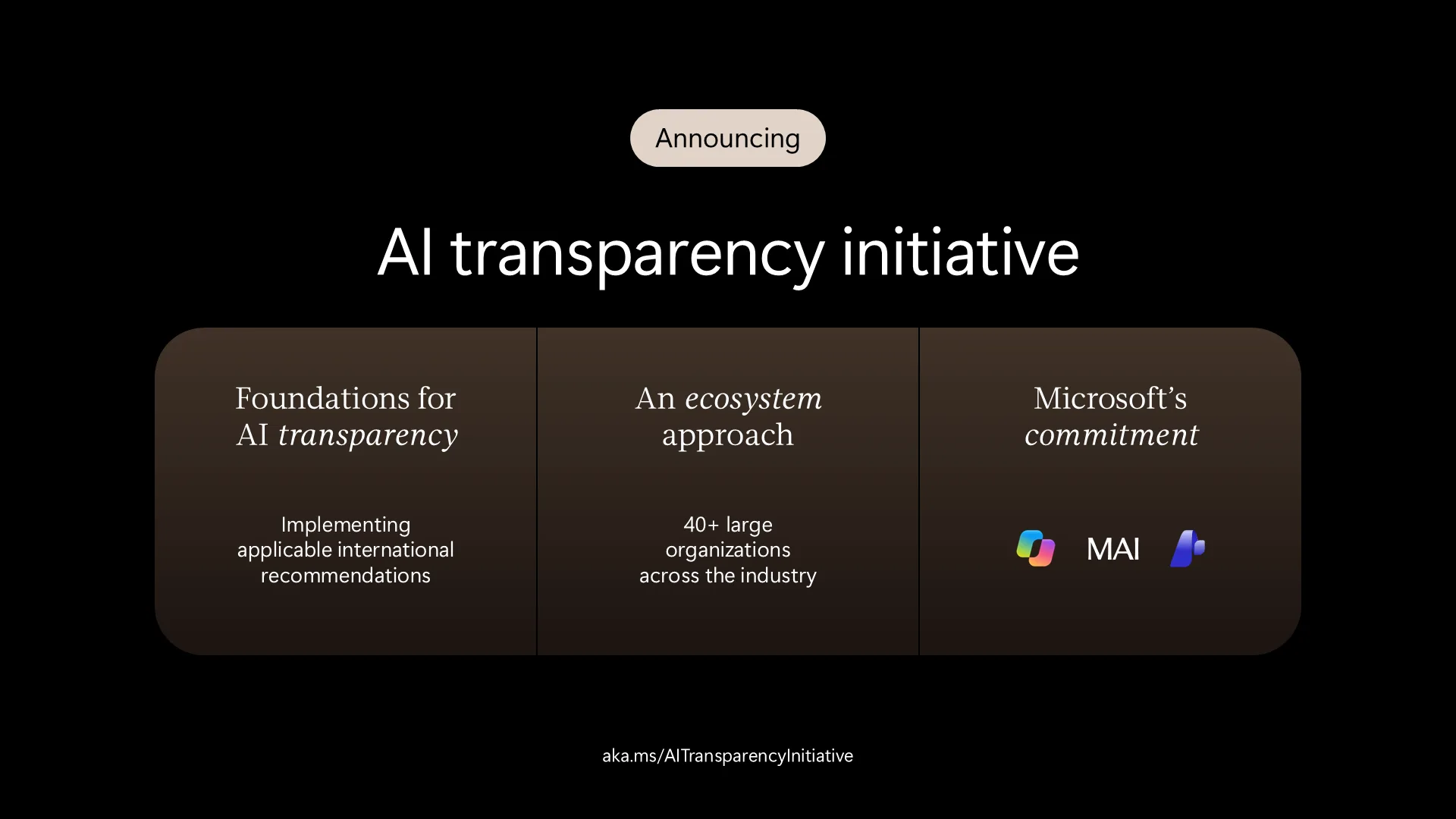 Microsoft AI Transparency Initiative slide
The AI Transparency Initiative, as shown in Nadella’s X thread. Nadella said Microsoft is working with 40+ organizations on open standards.
For teams already running coding agents on laptops, the actionable item is discovery: Intune can now mark devices with unapproved local agents as noncompliant. Pair platform controls with runtime checks on what an agent is allowed to do (see our Perception vs AgentBeam comparison); AgentBeam is the agent security platform from the explainx.ai team for that second layer. The supply-chain risk is real: see the Microsoft Agent Framework PyPI credential stealer from the same week.
HorizonDB is Microsoft’s distributed PostgreSQL database. Nadella said it is now generally available in Azure with up to 8X the performance of self-managed Postgres, and that bringing it into Fabric will let agents reason over live transactions alongside petabytes of historical data. He also said Microsoft is rearchitecting core compute, storage and networking primitives in Azure to run, connect and share context at agent scale. The 8X figure is Microsoft’s own claim; we have not seen an independent benchmark. Our HorizonDB deep dive covers what to test.
 HorizonDB slide from Microsoft Ignite 2026
HorizonDB, as shown in Nadella’s X thread.
Cobalt 200 VMs are generally available, with up to 50% better performance than Cobalt 100. Microsoft says customers like Databricks, OpenAI and Snowflake use them. Regional counts differ: the live blog says 23 regions by year end, while the Book of News says 24 on top of 11 existing. We use “23 to 24” until Microsoft reconciles them.
Maia 300 was cited at 40% more tokens per watt than leading GPU-based systems; see our Maia 300 analysis.
Copilot SDK 2.0 is generally available with a native Rust runtime and six languages. Model choices in GitHub Copilot are covered in Copilot Fusion.
Windows Server 2028 is in preview through the Insider Program, and Windows 365 for Agents is eligible for Copilot Credits.
Foundry made multi-turn evaluation, production insights and Agent Optimizer generally available.
Third-party models in Foundry: In his X thread, Nadella said OpenAI’s GPT-6.2 is coming to Foundry and that Meta’s latest models are all coming to Foundry too. He gave no dates. Treat both as announcements until Foundry’s model catalog lists them.
Customers named by Nadella: Alaska Air, AT&T, BlackRock, BNY, Chevron, Epic, Publicis Groupe, Salesforce and Unilever. Naming a customer does not say which products each one uses.
What should builders and buyers do this week?
Check your tenant. Home and Office in Copilot are GA; everything agentic is Frontier. Ask your admin whether the tenant is enrolled before planning pilots.
Price the licenses, not the demo. Business Analytics, Agent 365 and the Today Feed each carry a different license or credit requirement.
Test the cheaper models on your own tasks. MAI Code 2 Flash and Decision-1.1 are claimed as cost levers. Run them on a real repo and a real routing task before you move traffic.
Inventory local agents. Defender and Intune can now see Claude Code, Copilot CLI and others; decide your allow-list first.
Wait on preview items. Perception playbooks, Dynamic Agent Risk and MDASH are not production commitments yet.
Changelog
Each entry below is dated, so you can see when a status or announcement changed.
Nov 20, 2026 (23:05 UTC): Final live check before event close; live blog counter still 0 new updates; live coverage on this hub ends.
Nov 20, 2026 (16:10 UTC): Live blog marked the keynote finished on the final event day; no further announcements indexed here.
Nov 20, 2026 (14:15 UTC): Added Office Watch’s tally: 76 of 215 features generally available, 84 usable today, 109 preview or Frontier only.
Nov 19, 2026 (21:10 UTC): Added the NVIDIA and Microsoft items: Vera Rubin NVL72 on Azure, Nemotron 3.5 on Foundry, Programmed Training, Azure Local edge hardware and Windows 365 Direct Stream.
Nov 19, 2026 (10:10 UTC): Added the Defender and Sentinel announcements from Microsoft’s Ignite security post: integrated SOC GA, vulnerability shielding preview, third-party agent posture preview, ClickFix and Teams QR protections.
Nov 19, 2026 (07:00 UTC): Added the Azure data and operations announcements from Microsoft’s Azure Ignite post: Azure Catalyst, Fabric apps GA, Fabric HorizonDB preview, Azure Copilot deployment agent GA, Azure Monitor health models GA and Azure Workload Center limited preview.
Nov 18, 2026 (update 2): Added standalone posts on Perception vs AgentBeam and HorizonDB.
Nov 18, 2026 (update): Added Nadella’s X thread: the Copilot Workspaces demo video and slides for Agent 365 analytics, Perception, the AI Transparency Initiative and HorizonDB. Added HorizonDB GA, GPT-6.2 coming to Foundry, Meta’s latest models coming to Foundry, and the customers Nadella named.
Nov 18, 2026: First version, built from the live blog, official blog and Book of News.
Status labels follow Microsoft’s Book of News as of November 18, 2026 and may change during Ignite week.