
 Credit: Created using Microsoft Copilot
Every company wants to become AI-native, and the pressure is real. Microsoft’s 2026 Work Trend Index finds that 65 percent of AI users fear falling behind if they don’t adapt quickly. But knowing you need to transform and knowing how to do it are two entirely different problems.
One of the most practical places to start is close to home: look inside your own organization. Somewhere in your workforce, there are people already doing the thing you’re trying to build towards—using AI not just to move faster, but to work in fundamentally different ways. They’re redesigning workflows, orchestrating agents across multi-step tasks, and building repeatable practices that others can follow. Microsoft calls these workers Frontier Professionals.
There’s just one thing: Identifying them is about as likely as spotting a unicorn.
Jared Spataro, Microsoft’s chief marketing officer for AI at work, argues that the real work for leaders isn’t just deploying AI—it’s redesigning how work gets done around it. To help leaders think through that, he outlines four patterns of human-agent collaboration that are becoming more prevalent across the enterprise: author, reviewer, director, and orchestrator.
In the first, the employee produces the work and calls on AI for assistance as needed. In the second, the employee sets the intent and AI generates the first draft for review and approval. The third is when the worker hands off entire tasks to the AI, which executes them in the background. Finally, the orchestrator designs a system in which multiple agents run in parallel within a workflow, with the human only stepping in to handle exceptions and escalations.
Spataro’s point isn’t that every worker needs to reach orchestrator mode. It’s that leaders need to develop clarity around which pattern fits which type of work—and build their organizations accordingly. The Frontier Professionals are the ones already doing exactly that on their own. They have naturally developed the judgment to move across all four modes without being told.
That said, this year’s Work Trend Index surveyed 20,000 AI users across the U.S., UK, Netherlands, Japan, Italy, India, Germany, France, Brazil, and Australia. Moreover, in a first for the study, Microsoft also leveraged “trillions” of anonymized Microsoft 365 productivity signals. What it revealed is that, despite the presence of these highly advanced AI users, Frontier Professionals account for only 16 percent of AI users.
While that number might sound discouraging, Matt Firestone, Microsoft’s Frontier Firm general manager, offers a more positive perspective. He sees it as a “progression marker”—evidence that advanced AI work is actually happening within organizations and that the path forward is to learn to recognize and scale it.
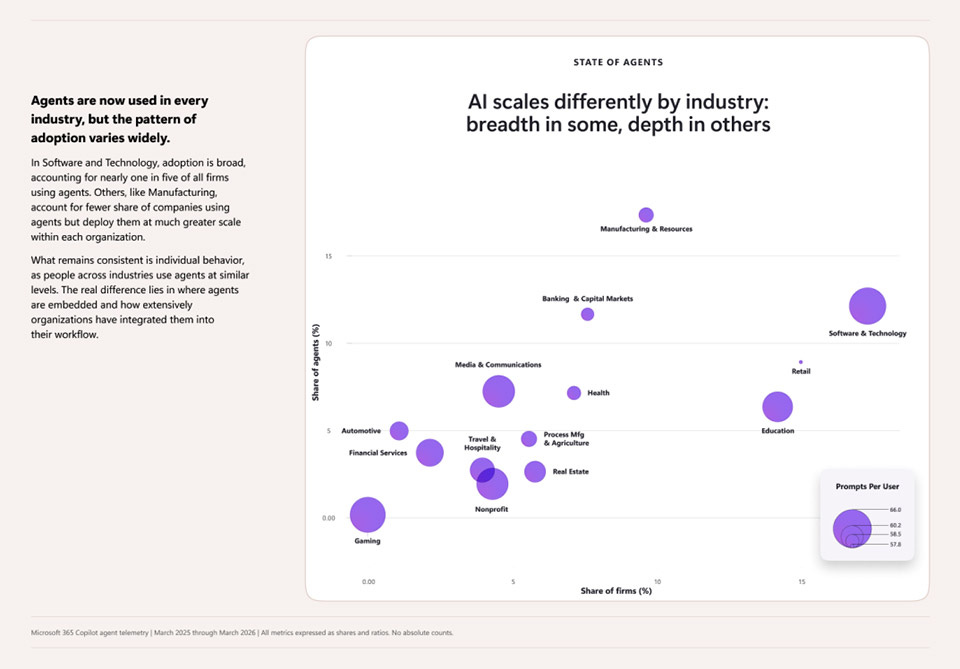 Agents are now used in every industry, but the pattern of adoption varies widely. Credit: Microsoft
To understand Frontier Professionals, it helps to first revisit a concept Microsoft introduced last year. Frontier Firms are organizations that have moved beyond AI experimentation into system-wide deployment, with agents at the center of how work gets done and a clear-eyed view of AI as a core driver of business value. Frontier Professionals share the same orientation, but they operate at the individual level and don’t necessarily work at a Frontier Firm.
That report was aimed squarely at the top—giving CEOs and executives a roadmap for transforming their organizations. This year, Microsoft turns the lens inward. “The biggest difference this year, based on telemetry and survey data, is that actually the individual people in a company are doing really well,” Firestone says. “The message to leaders is that your team is already there, your people are already there. It’s actually up to you to change processes and culture and unlock the capacity of your workers that you can have diffused through the company.”
As enterprise AI usage ticks upward, it’s generating results. The Work Trend Index finds that 66 percent of AI users say AI has allowed them to spend more time on high-value work, while 58 percent say they’re producing work they couldn’t have done a year ago. Among Frontier Professionals, that second number jumps to 80 percent.
So who exactly are these highly advanced AI users? Firestone describes them as the person on the team who’s “building every weekend, coming in and prototyping, and suggesting new ways.” According to Microsoft, in order to qualify as a Frontier Professional, a worker has to show they’re using AI agents to handle complex, multi-step work, they’re constantly asking where AI can take something off their plate or do it better, and they’re not keeping what they learn to themselves—they want to set the standard for how the whole team works with AI.
Out of the 20,000 AI users surveyed, 3,233 qualified as Frontier Professionals. The profile that emerges is fairly consistent: they skew heavily toward people managers (74 percent) and tend to work in tech (35 percent) or financial services (12 percent), with roles concentrated in IT (36 percent) or finance and accounting (11 percent). More than half work at companies with over 500 employees. Generationally, they’re predominantly millennials (50 percent), followed by Gen X (23 percent) and Gen Z (22 percent), with Boomers making up just four percent.
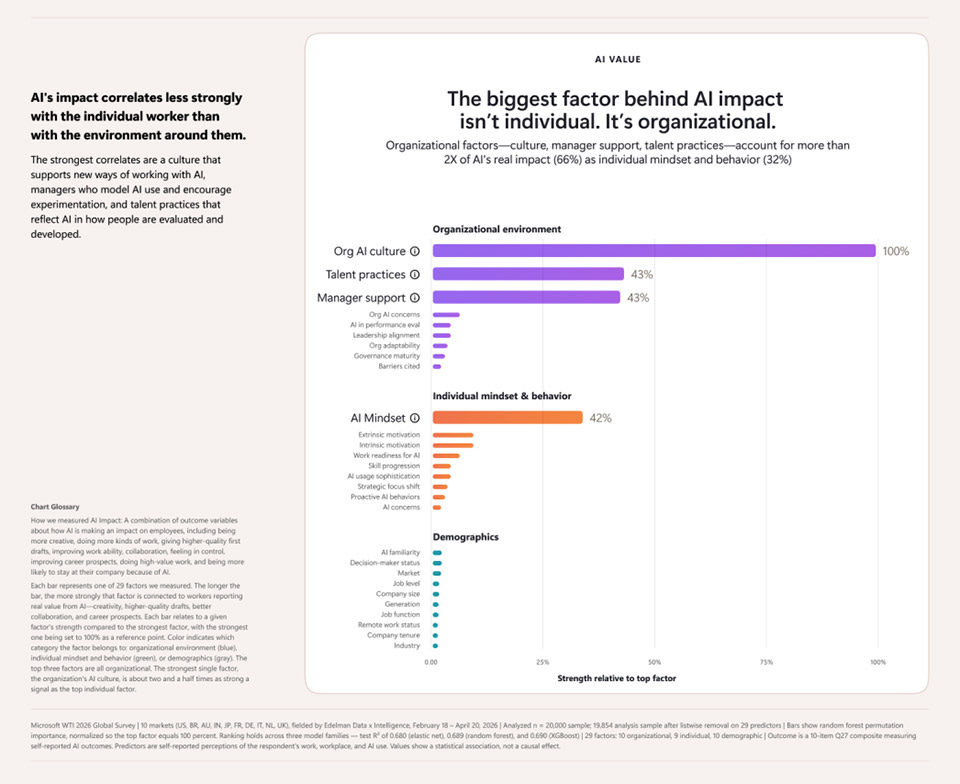 AI’s impact correlates less strongly with the individual worker than with the environment around them. Credit: Microsoft
It’s a small group—just 16 percent of AI users, remember—but they’re especially clear-eyed about the role human judgment plays when working with AI. The data backs that up. When comparing Frontier Professionals to their non-Frontier peers:
More likely to intentionally do some work without AI just to keep their skills sharp: 43 percent vs. 30 percent
More likely to pause before starting a task to decide what should go to AI and what should stay with a human: 53 percent vs. 33 percent
In other words, they’re not just better at using AI—they’re more deliberate about when not to.
That deliberateness extends to how they work with their teams as well. Frontier Professionals are far more likely to treat AI as a collective practice rather than an individual one:
More likely to say their teams brainstorm and refine business processes together to identify AI opportunities: 63 percent vs. 32 percent
Share AI tips, new agents, learnings, and mistakes: 61 percent vs. 36 percent
Discuss quality standards for AI-assisted work: 54 percent vs. 29 percent
And that collaborative mindset shows up in how their organizations operate. Frontier Professionals are more likely to report that agent workflows, human handoffs, and quality standards are documented and repeatable at the team (26 percent vs. 19 percent), function (29 percent vs. 17 percent), and organization level (25 percent vs. 14 percent).
There’s no certificate, no job title, and no obvious tell that someone is a Frontier Professional. But that’s almost beside the point. For executives, the more important signal is this: these workers already exist inside your organization, and they’re doing something worth paying attention to. The question isn’t how to create them from scratch—it’s how to find them, learn from how they work, and figure out how to extend that across the rest of the workforce.
Where does that leave the remaining 84 percent? The report sorts them into four other categories based on two factors: how advanced they are in using AI individually and how well their organization supports it.
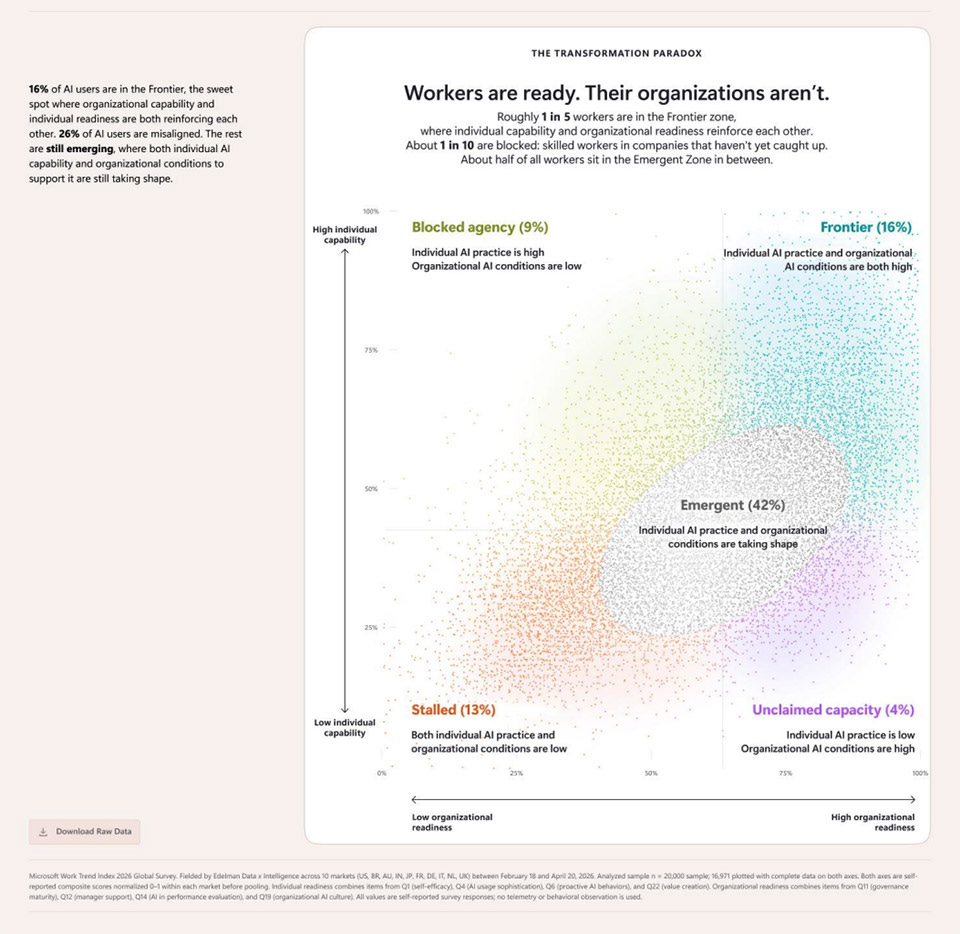 The Transformation Paradox: Workers are ready for AI, but its adoption is hindered by organizations that want to embrace it yet are slow to act. Credit: Microsoft
The largest group (42 percent) falls into what Microsoft calls the Emergent zone, where both the worker and the organization are still figuring it out. Then there’s Stalled at 13 percent, where neither the individual nor the company has meaningfully gotten off the ground. Blocked Agency accounts for nine percent and consist of workers who have developed strong AI skills but are hitting a wall because their organizations haven’t kept up. Finally, there’s Unclaimed Capacity (four percent) that flips the dynamic that the organization is ready, but the employees haven’t caught up yet.
And despite the optimistic tone Firestone hopes to strike with this year’s Work Trend Index, the research makes one thing clear: leadership still hasn’t gotten its act together. Just 26 percent of AI users say their leadership is “clearly and consistently aligned on AI.” This shows that it’s not a workforce problem, but a leadership one. The workers are ready. The people setting the strategy largely aren’t.
Microsoft classifies this as the Transformation Paradox, when employees are ready to reinvent how they work, but the system around them isn’t willing to budge. The same forces accelerating AI adoption are holding it back. It sounds similar to the Digital Transformation movement that emerged in the Web 2.0 days, an analogy that seemed to resonate with Firestone. “This is a new wave of technology, but the fundamental primitives of being a human are the same,” he says.
Firestone’s advice to leaders is more reassuring than it might seem. Yes, the pressure to transform is real, but this year’s data suggests the work is less daunting compared to a year ago. “Your people actually have a lot more agency and ability,” he says, “because your people are actually further [along] than you think they are.”
Microsoft’s research is direct about the manager’s role: when managers actively model AI use, employees report significantly higher AI value, stronger critical thinking, and greater trust in agentic AI. Frontier Professionals reflect that reality. Compared to non-Frontier peers, they’re more likely to have a manager who:
Significantly more likely to say their manager openly uses AI: 85 percent vs. 64 percent
Sets quality standards for AI: 83 percent vs. 57 percent
Creates space for experimentation: 84 percent vs. 61 percent
Encourages more ambitious work redesign: 87 percent vs. 61 percent
More likely to say they are rewarded for the reinvention of work with AI regardless of outcome: 26 percent vs. 11 percent
As Microsoft notes, the Transformation Paradox is really a systems problem, and it can’t fix itself—it has to be redesigned.
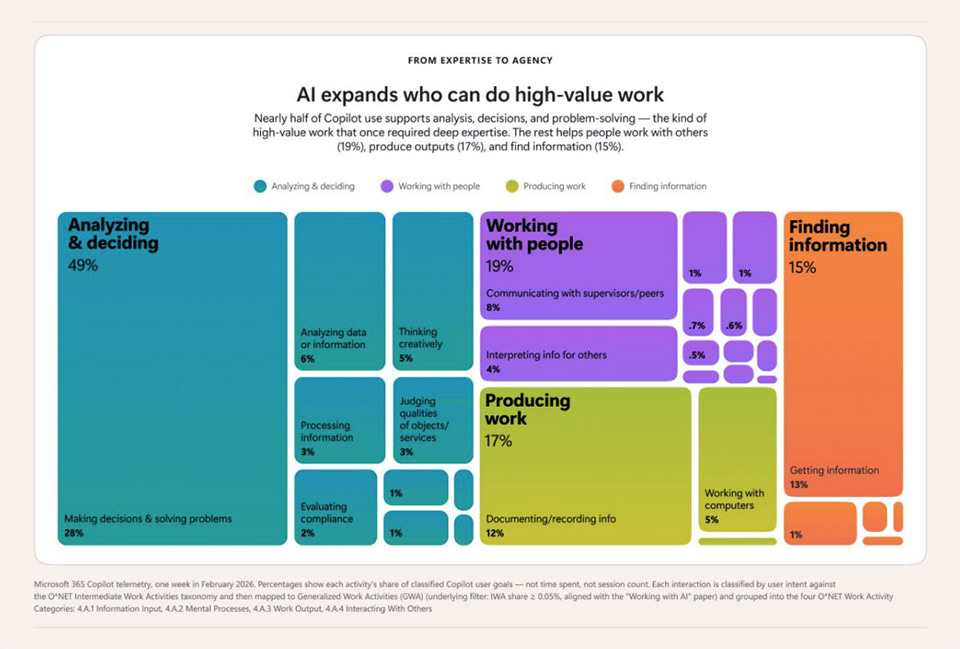 An analysis of the high-value work performed by Microsoft 365 Copilot. Credit: Microsoft
This year’s Work Trend Index goes beyond survey data. Microsoft conducted a privacy-preserving analysis of more than 100,000 Microsoft 365 Copilot conversations to get a ground-level view of how workers are actually using AI. The finding that stands out: 49 percent of those conversations involved cognitive work—analyzing information, solving problems, evaluating options, and thinking creatively. It’s evidence that workers aren’t using it simply for busywork, but to assist with high-value thinking that used to require deep expertise or seniority to do well.
Other main use cases included assisting with collaboration (19 percent), producing work (17 percent), and finding information (15 percent).
“Employees at every level now have a partner that helps them analyze, synthesize, and deepen their own expertise, while also building expertise in other areas,” Microsoft writes in its report. “AI is not just helping us do things faster. It’s expanding who can do high-value work.”
Firestone found the cognitive work statistic surprising, saying that previous waves of workplace technology were billed as delivering productivity and efficiency gains. “I would argue that the 49 percent of cognitive work is actually a counter-contrarian argument to that,” he argues. It would be natural to assume that the bulk of Microsoft 365 Copilot usage would be for time-saving tasks, such as drafting emails faster, summarizing documents, and pulling information more quickly. “It’s not. It’s the creative thinking, the judging qualities of an object, evaluating, [and] processing complex information.”
The data is clear on two things. Workers are further along than their leaders think. And leaders are the bottleneck. For executives looking at this report and wondering where to start, Firestone’s answer is less complicated than the transformation rhetoric might suggest: The advantage won’t come from access to AI. It will come from how deliberately leaders design the work around it.
Firestone’s advice to executives is straightforward: stop waiting for permission and start building in the open. “The reality is that they’re already building,” he says of workers. “They’re already using AI in complex and resourceful ways, for analysis, decision, and deliver. Build the type of team, function, or organization. Build yourself. Encourage building in the open. Experiment. I actually think that’s going to allow people to get through this, to resolve the paradox.”
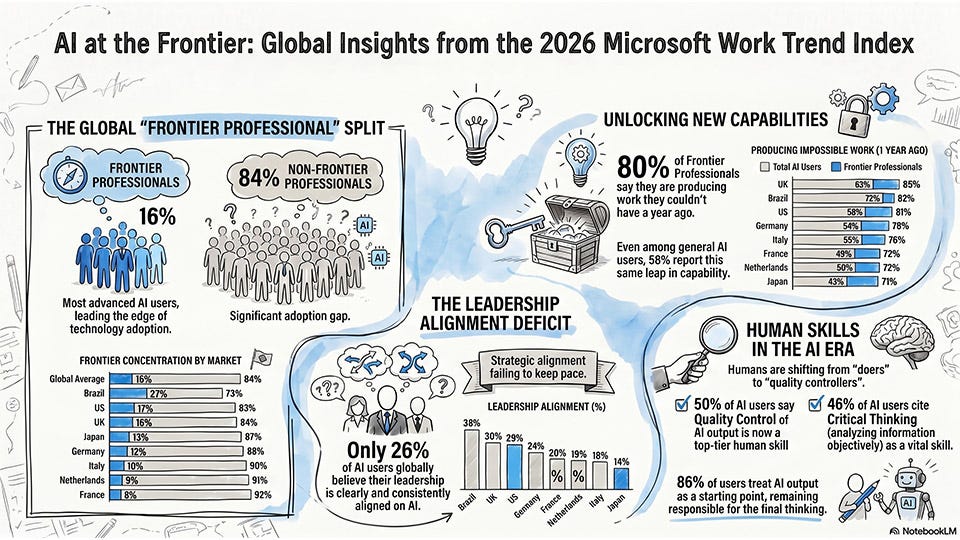 An infographic highlighting global insights from Microsoft’s 2026 Work Trend Index. Credit: Microsoft/NotebookLM
To bring human-agent collaboration beyond the desktop, Microsoft is expanding Copilot Cowork to more surfaces. Starting today, Copilot Cowork can be used on iOS and Android devices, letting people define outcomes and delegate work from anywhere—across apps, business systems, and data.
Launched in March as an experiment with Anthropic, Copilot Cowork is an assistant that can run tasks in the background, create documents, and work across Microsoft 365. However, it’s only available through Microsoft’s Frontier program. And since the company didn’t announce an upgrade, it’s likely that the mobile versions of Copilot Cowork will also be limited to that program’s subscribers.
Microsoft is also expanding the range of what Copilot Cowork can connect to. The platform now supports native plugins from Dynamics 365, Fabric, and other Microsoft services, as well as partner integrations. For organizations that need something more tailored, enterprise developers can build custom plugins to turn their own workflows and expertise into reusable, scalable processes.
Put together, Microsoft claims these features transform Copilot Cowork from “a task-based assistant into an extensible platform that helps orchestrate work across Microsoft and third-party systems.”
Thanks for reading The AI Economy! This post is public so feel free to share it.