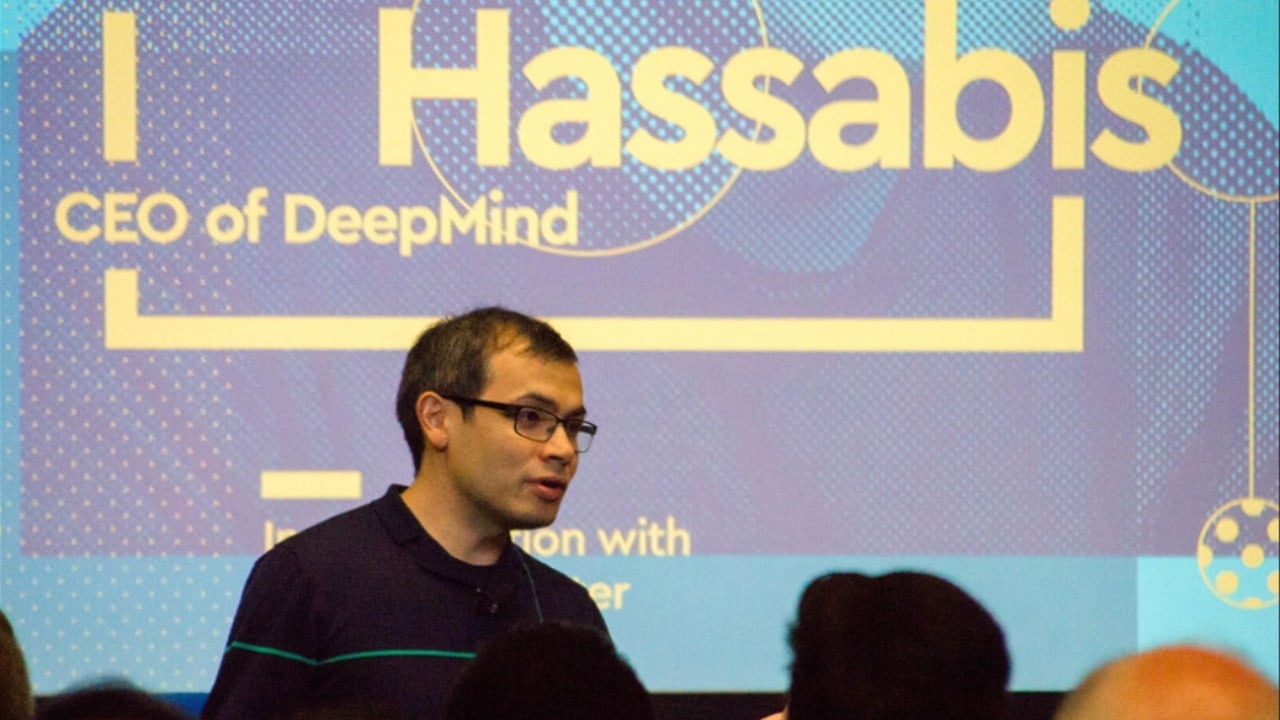

The new documentary The Thinking Game follows the British-Greek DeepMind founder Demis Hassabis and his ambitious pursuit of artificial general intelligence, as well as the questions it raises. DeepMind, a subsidiary of Google, is at the forefront of AI development and research. Credit: George Gillams / CC BY-SA 2.0
A newly released documentary, The Thinking Game, invites viewers inside one of the most ambitious scientific pursuits of the modern era: the attempt to build artificial general intelligence, or AGI. The film centers on the work of Demis Hassabis, the neuroscientist, entrepreneur, and co-founder of Google DeepMind, whose long-term goal is to create a machine capable of flexible, human-level reasoning.
Rather than following a traditional tech-industry narrative of competition or startup glamour, the documentary focuses on the intellectual and ethical questions behind the development of advanced AI systems. Cameras follow research teams as they test ideas, debate hypotheses, and confront the complexity of building systems that learn autonomously rather than through task-specific programming.
The Thinking Game : Watch the full documentary about Demis Hassabis and his team
Demis Hassabis emerges as the guiding voice of the project. Once known as a chess prodigy and later as a researcher in cognitive neuroscience, he has long believed that understanding human intelligence is inseparable from the effort to replicate it computationally. The film highlights this dual perspective: the scientific aspiration to push computational limits and the philosophical weight of producing technology that may one day match—or exceed—its creators.
A significant portion of The Thinking Game examines the ripple effects of breakthroughs in AI research. While the documentary acknowledges rapid progress in areas such as medical modeling, mathematical problem-solving, and pattern recognition, it also emphasizes that these achievements remain narrow forms of intelligence. AGI, as defined here, is not just powerful software—it would be a system capable of abstract thought, planning, creativity, and adaptability across tasks, much like a human brain.
Yet the documentary does not present AGI as inevitable. It shows the uncertainty of scientific progress: research paths that fail, predictions that don’t materialize, and constant reassessment of what intelligence truly means. Viewers witness moments of enthusiasm and moments of doubt, reminding them that high-profile innovation is rarely smooth or predictable.
Ethics and risk also play a central role in the narrative. Scientists interviewed in the film discuss issues such as alignment, transparency, and global governance—questions once seen as speculative but now treated as urgent. The tone suggests that the closer researchers move toward AGI, the more carefully society must consider how such technology should be controlled, distributed, or even limited.
Ultimately, The Thinking Game presents the pursuit of AGI as both scientific frontier and moral responsibility. It portrays the work not simply as programming but as a profound inquiry into intelligence, consciousness, and the future of human capability.
For those unfamiliar with AI research, the film acts as an accessible doorway into a field shaping global technology. For those already following the AGI debate, it offers a rare inside look at one of its most influential architects—and a reminder that the journey is still unfolding.