US-based AI company Anthropic has released eight Claude AI connectors letting users control creative and design software, including Autodesk Fusion, Blender, and SketchUp, through natural language conversation.
For additive manufacturing, this means engineers can create and iterate on 3D models, automate repetitive design tasks, and coordinate files across the production pipeline. Most of that time surfaces in the coordination work between tools, where files are manually moved, reformatted, and handed off across software environments that were never designed to communicate.
That is precisely where the connectors apply, automating the handoffs that currently consume engineering time without producing geometry or a finished part.
Connecting Claude to 3D design tools
The Autodesk Fusion integration lets engineers with a Fusion subscription create and modify 3D models through conversation. Autodesk has structured this as two separate MCPs: one for creating and modifying geometry, and one for querying and managing design information across projects, both running on an open standard accessible to any AI system.
Blender, widely used among independent designers and hobbyists for modeling and preparing geometry before it reaches a slicer, gets a similar treatment. The connector exposes its Python API through natural language, letting users build custom scripts, batch-apply changes across objects, run geometry checks, fix mesh errors, and export print-ready files without writing code from scratch.
Anthropic has made a financial contribution to the Blender project to support continued Python API development. The SketchUp connector sits further upstream, converting a conversational description into a starting 3D model for designers to refine before anything reaches build preparation.
The AI company describes Claude as capable of translating formats, restructuring data, and keeping assets synchronized across multiple applications. For an AM service bureau, that covers assessing incoming files, classifying jobs, preparing design feedback, and producing documentation.
Also part of the set, Affinity by Canva handles batch image adjustments, layer operations, and file export across production workflows.
What the connectors do not do is equally worth stating. Build preparation, support optimization, machine connectivity, and quality management remain the territory of specialized AM software. The connectors sit above that layer, at the point where engineers make decisions, move files, and manage the work that surrounds production.
Alongside the connector release, Anthropic has announced partnerships with three institutions. These include the Art and Computation program at Rhode Island School of Design, Fundamentals of AI for Creatives at Ringling College of Art and Design, and the MA/MFA Computational Arts program at Goldsmiths, University of London, with students and faculty at all three receiving access to Claude and the full connector set.
Solving the industry’s coordination gap
AI integration into AM workflows has primarily focused on isolated technical tasks, most prominently at the build preparation layer. Last year, Synera embedded Materialise’s Magics SDK into its AI-driven automation platform to handle support generation and file prep autonomously. This addressed the geometry but left the coordination gap or the time engineers lose manually moving and reformatting files between tools largely untouched.
 Magics 2025. Image via Materialise.
This friction is now the industry’s primary economic constraint. In the 3D Printing Industry 2026 executive survey, respondents ranked workflow control above process knowledge as the leading factor in competitive advantage. With software gains now outpacing hardware development, the industry is shifting away from generic AI toward compression tools that eliminate these manual handoffs to improve utilization economics.
3D Printing Industry is inviting speakers for its 2026 Additive Manufacturing Applications (AMA) series, covering Energy, Healthcare, Automotive and Mobility, Aerospace, Space and Defense, and Software. Each online event focuses on real production deployments, qualification, and supply chain integration. Practitioners interested in contributing can complete the call for speakers form here.
To stay up to date with the latest 3D printing news, don’t forget to subscribe to the 3D Printing Industry newsletter or follow us on LinkedIn.
Explore the full Future of 3D Printing and Executive Survey series from 3D Printing Industry, featuring perspectives from CEOs, engineers, and industry leaders on the industrialization of additive manufacturing, 3D printing industry trends 2026, qualification, supply chains, and additive manufacturing industry analysis.
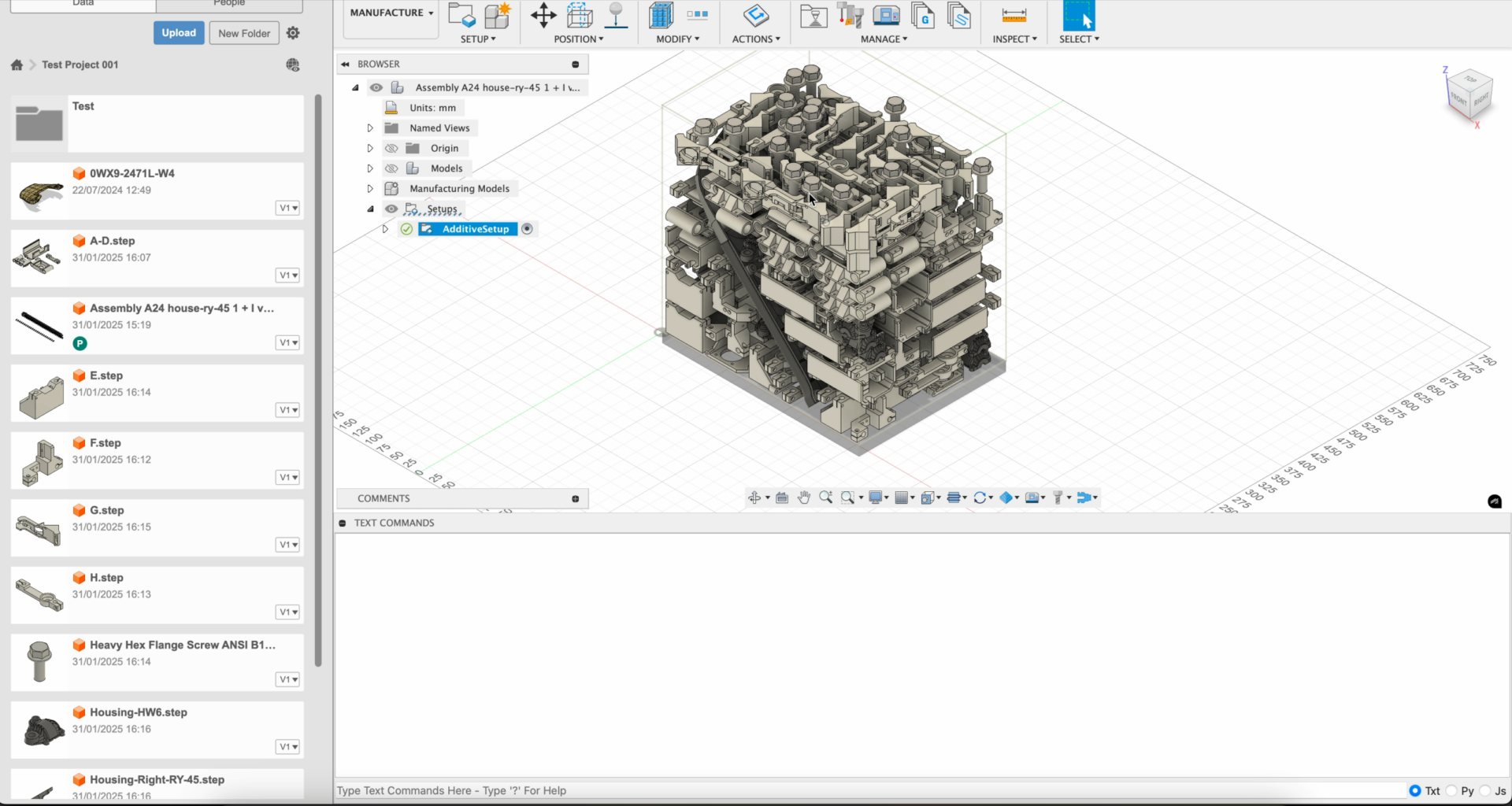
Featured image shows an assembly in Autodesk Fusion. Image via Authentise.