
TL;DR
Google Plan: Google is pushing a plan to use AI heavily in PostgreSQL engineering while engineers still own the final code that ships upstream. Replication Focus: Google’s roadmap centers on replication, upgrade resilience, and conflict cleanup during PostgreSQL migrations and multi-node deployments. Technical Risk: Active-active replication can improve scale, but consistency trade-offs still matter when multiple systems accept writes. Market Stakes: PostgreSQL ranked fourth in May 2026 and gained 8.37 points year over year, raising reliability pressure.
Google is promoting to use AI heavily in PostgreSQL engineering while still keeping engineers accountable for AI-assisted code that reaches the upstream project. PostgreSQL changes can ripple into version upgrades, replication behavior, and production recovery work rather than staying inside an internal coding sandbox.
Google Cloud VP of Databases Sailesh Krishnamurthy framed the policy as a productivity gain with a human review backstop:
“We do encourage folks to use AI heavily. We are seeing huge amounts of productivity improvements internally. In the end, we have individual engineers take accountability for our contributions.”
Sailesh Krishnamurthy, VP of Databases at Google Cloud (via The Register)
Krishnamurthy also argued that public code gives both models and reviewers more usable context than proprietary code behind enterprise firewalls. An earlier database and analytics AI capabilities push already tied Google’s database strategy more closely to PostgreSQL-centered infrastructure and migration work.
How the strategy works in practice
From July 2025 to December 2025, Google’s PostgreSQL engineering work focused on logical replication, pg_upgrade improvements, and upstream bug fixes. Logical replication copies selected database changes between servers, which makes it useful for migrations, upgrades, and multi-node deployments that cannot tolerate a blunt full-database swap.
Google’s current roadmap includes Automatic Conflict Detection first phase plus logical replication of sequences. Sequence replication reduces the manual synchronization that can create duplicate-key problems during migrations or major version upgrades. Enterprise teams care because write collisions and misaligned sequence values can turn a scale-out design into an incident-response problem.
Active-active replication trade-offs sit beside the same feature set. Multiple nodes can accept writes at once in that model, which improves scale and availability, but the setup also raises harder consistency questions when systems disagree about which write wins. Google is pitching AI inside a part of database engineering where those failures are visible fast, because replication, upgrade reliability, and conflict cleanup are the work buyers notice when migrations move from a lab test into production.
Franck Pachot, a MongoDB-affiliated database expert, used that distinction to challenge loose comparisons between Google’s replication work and stronger distributed SQL models:
“Comparing 2-way logical replication with conflict resolution and Oracle RAC or Distributed SQL like CockroachDB or YugabyteDB is a misunderstanding of database consistency. One is last write wins, the other is ACID”
Franck Pachot, MongoDB-affiliated database expert (via InfoQ)
Pachot’s warning does not erase the engineering value of better replication tooling. Google can still argue that AI-assisted development speeds feature work, but database buyers need conflict handling, upgrade resilience, and rollback planning that hold up under production pressure. Broader enterprise focus on scalability, replication, and upgrade reliability also helps explain why the company is pairing AI enthusiasm with a strong accountability line instead of promising autonomous code generation.
Why PostgreSQL pressure matters now
Migration demand from Oracle and SQL Server, alongside new applications, is helping drive PostgreSQL services at Google. For enterprise buyers, that makes the AI policy more than a productivity message because cutovers, failovers, and major upgrades are where database risk becomes expensive.
May 2026 market data helps explain why the pressure is rising. In the latest DB-Engines ranking, PostgreSQL placed fourth behind Oracle, MySQL, and Microsoft SQL Server.
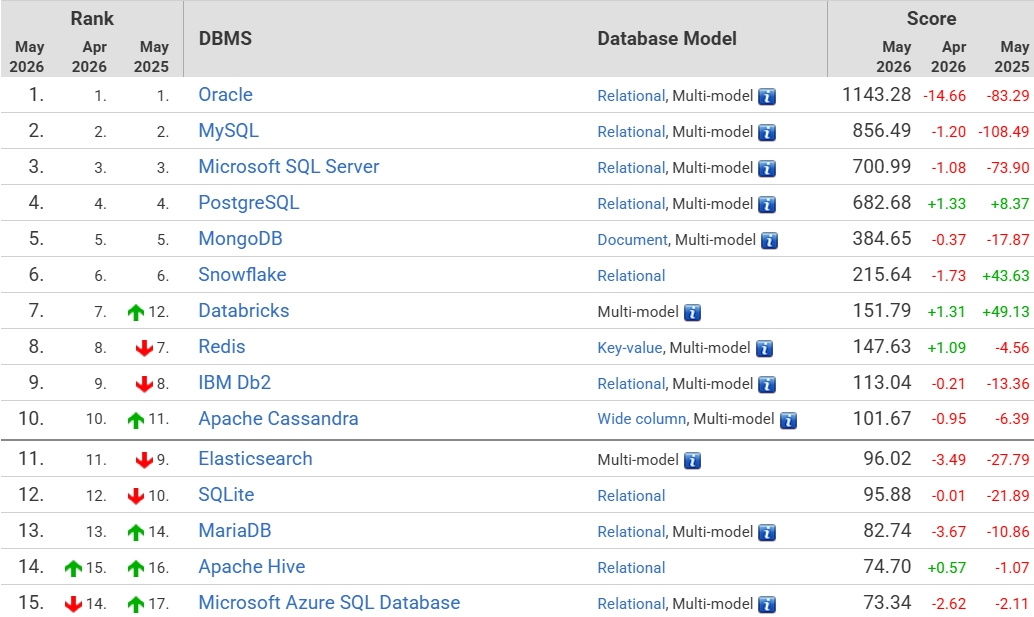 Source: db-engines.com
DB-Engines also showed PostgreSQL gaining 8.37 points year over year while all three of those older leaders declined over the same period. Growth like that does not prove Google’s engineering approach will work, but it does raise the stakes for any company trying to make PostgreSQL migrations look safer, faster, and easier to run at scale.
PostgreSQL is gaining ground as a migration destination, and Google wants AI to become part of the engineering process behind that shift without weakening human accountability for what ships. First live cutovers and multi-node rollouts will show whether that balance reduces manual repair work or simply moves more responsibility onto the engineers who still own the final code.