
COLUMBUS, Ohio — Shelly Stotzer coaches leaders for a living. For nearly 50 years, her company Crosworks has guided executives through change, taught them how to build effective teams, and helped them grow their organizations. She is accustomed to being the expert in the room.
But last year, Stotzer faced a question she could not answer: What do we do about artificial intelligence?
What You Need To Know
Shelly Stotzer coaches leaders for a living at her company Crosworks guiding executives through change
Stotzer enrolled her entire team at SkillSpout, an AI training program designed specifically for small and mid-sized businesses
Small business AI adoption has reached a critical moment
In 2025, usage of generative AI among small firms jumped from 40% to 58%, according to the U.S. Chamber of Commerce
“To me, ignoring AI is like pretending like the industrial revolution didn’t happen. We can fight it, but really it’s coming; it’s happening. So how do we embrace it in a way that allows us to do what we do better?” she said.
So Stotzer did something coaches rarely do. She became a student and enrolled her entire team at SkillSpout, an AI training program designed specifically for small and mid-sized businesses struggling to understand artificial intelligence.
The adoption tipping point
Small business AI adoption has reached a critical moment. In 2025, usage of generative AI among small firms jumped from 40% to 58%, according to the U.S. Chamber of Commerce. Now, 76% of small businesses are either actively using AI or exploring it, according to Goldman Sachs research.
The gap between small and large businesses is closing faster than in any previous technology cycle — a shift that reflects both opportunity and urgency.
But rapid adoption does not mean mastery. Businesses are moving fast, but understanding is lagging.
Melanie McGee, CEO and co-founder of SkillSpout, launched her company in 2024 after 30 years in software development. AI can handle invoices, customer service, IT management — the list goes on. But McGee says there is a critical gap: many small business owners do not know what is possible — or who to trust.
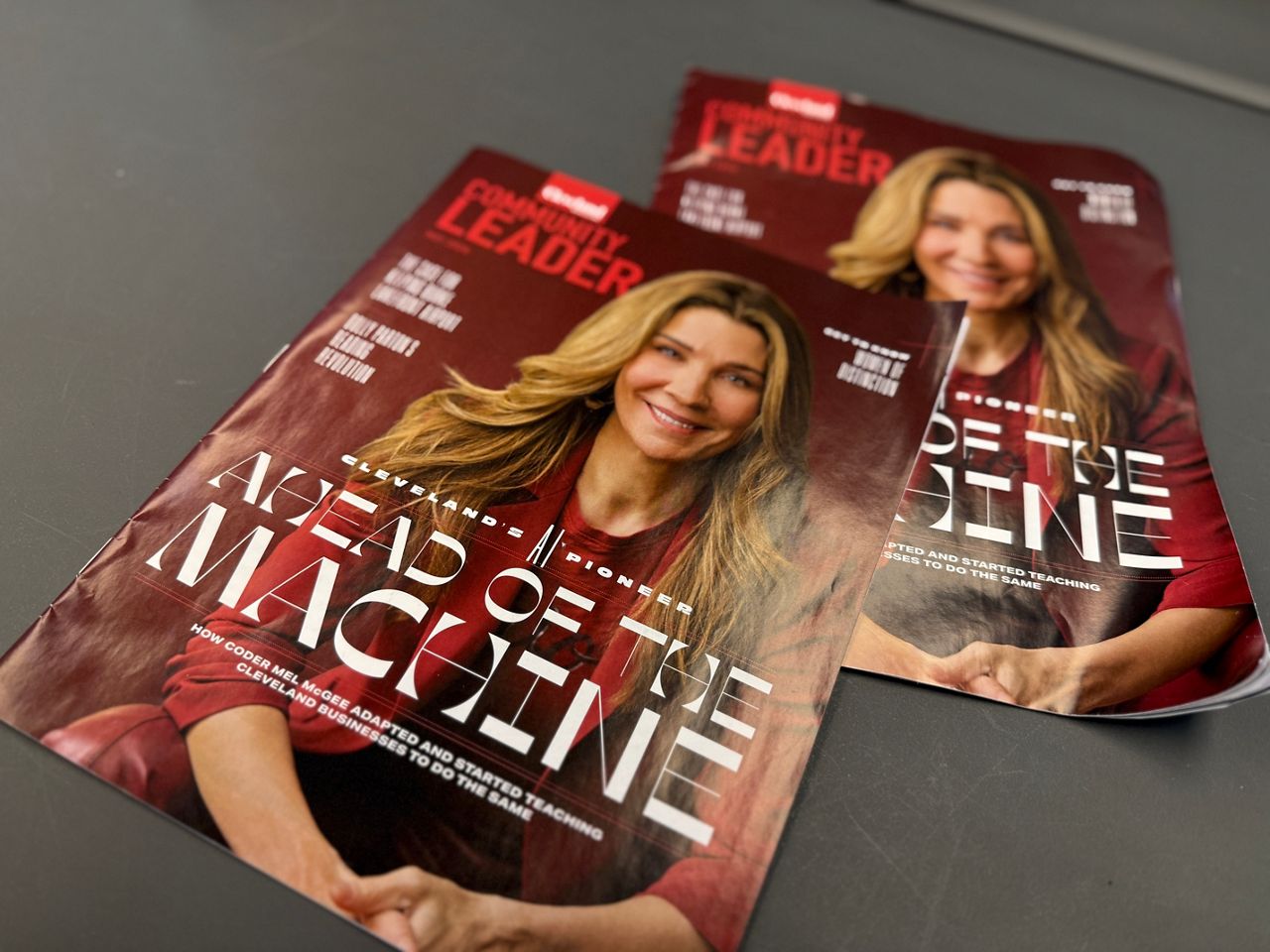
Melanie McGee, CEO and co-founder of SkillSpout. (Spectrum News 1/Taylor Bruck)
The long history of AI
Despite recent headlines, artificial intelligence is not new. McGee points out that AI has been around for decades, taking different forms as technology develops.
“I have been in software development for nearly 30 years; over 20 years of my career I’ve spent using AI. So it’s been around for a long time. It’s just taking a different shape. With large language models like ChatGPT, Anthropic’s Claude,” McGee said.
The technology has existed since the 1950s, but what has changed is the accessibility and power of modern large language models like ChatGPT and Claude — tools that suddenly put advanced AI in the hands of everyday users.
The skills gap persists
Despite rapid adoption, the learning curve remains steep. According to DataCamp’s 2026 State of Data and AI Literacy Report, nearly 60% of organizational leaders report their company has an AI skills gap, even though they are already investing in training.
Many businesses are implementing tools they do not fully understand, creating potential risks around data security, accuracy and client trust.
What surprised Stotzer is that AI doesn’t have to replace human work — it freed her employees to do more of it.
“The biggest opportunity is to take the mental load off the transactional work so that we can really focus our energy on the people,” Stotzer said. “The work that we do, leadership coaching, career coaching, requires a lot of emotional awareness and energy. So if our coaches can do some of the work that is more transactional by leveraging a tool like AI, then they just have more capacity to be present, to really do the research, to really be there for our clients.”
So far, she said, her team has learned how to set up AI agents, use prompt templates, and validate the information AI generates — critical for a coaching company where trustworthiness is paramount.
Real training, real results
SkillSpout’s approach differs from generic online courses. The program offers personalized training tailored to each organization’s specific needs and roles. Sessions are delivered in two-hour increments spread over several weeks, making the learning manageable for busy business owners.
“We provide strategy based on where they want to go with AI,” McGee said. “Always maintaining human judgment and making sure humans are leading.”
The company has trained hundreds of organizations and worked with thousands of individual employees since its founding. Many participants come from companies with no dedicated AI teams — just leaders trying to figure out how to keep up.
Doris Korda leads the Korda Institute for Teaching, an Ohio-based nonprofit that partners with educators globally to reimagine how schools teach and learn. Despite her background as a systems engineer and software developer, she knew she needed help to master AI so she could guide the schools she works with through proper implementation.
“I have a background in technology and engineering, but that doesn’t mean I am an expert in AI,” Korda said. “Our work is on education. We work with teachers. We work with schools. I desperately needed someone to help us with everything we needed to know about AI without ourselves having to become experts.”
The controversy factor
AI does not come without controversy. Concerns about data security, energy consumption and the ethics of the technology are legitimate. Plus, many Americans worry AI will replace their jobs. And they’re not wrong to be concerned. The World Economic Forum’s Future of Jobs Report 2025 projects that 92 million roles will be displaced by 2030, while 170 million new roles are expected to emerge — a net gain of 78 million jobs.
Goldman Sachs research shows many jobs will be “exposed to automation,” meaning a portion of the workload—often between 25% and 50%—could be completed by AI, leaving the rest to humans. So many experts predict that the jobs aren’t disappearing; the work inside them is changing.
“If we do learn how to use it properly, we do have more control over it and keeping up to date on the different issues that exist and governance of AI and making sure humans stay in the loop. All of that is of utmost importance as we enter this AI era,” McGee said.

Shelly Stotzer (left) with Mel McGee (middle) and Doris Korda (right). (Spectrum News 1/Taylor Bruck)
The stakes keep rising
The U.S. Chamber of Commerce calls this year a “defining era” for small business. They say those who implement AI wisely can work smarter, cut costs and compete with much larger competitors. Those who fall behind risk being left behind entirely.
“It’s unavoidable. So avoiding it is probably not going to get you where you want to be long-term,” Stotzer said. “There are lots of opportunities to keep the people who do good work for you, but streamline their work and make it easier on them. We’re all a little overworked and have competing priorities, so if we can take some of these things off our plate, it benefits everyone.”
For Stotzer, she says the training transformed her from uncertain to confident. When she returns to her office, she’s ready to act.
“I feel definitely more confident and, if anything, I feel excited about how to go back to my office and start applying it immediately,” Stotzer said. “We do human work. So I do know that certain people on my team are feeling more overwhelmed. Other people are very excited. But across the board, we all recognize that it’s important to move forward.”
For more information about SkillSpout, visit here.