
Anthropic’s latest flagship model, Claude Opus 4.8, leads most benchmarks and is designed to be more upfront about its own mistakes.
Anthropic says Opus 4.8 beats both its predecessor and OpenAI’s GPT-5.5 and Google’s Gemini 3.1 Pro across most tested categories. On agentic coding (SWE-Bench Pro), the model hits 69.2 percent, up from 64.3 percent for Opus 4.7 and 58.6 percent for GPT-5.5. For multidisciplinary reasoning (Humanity’s Last Exam), Opus 4.8 scores 49.8 percent without tools and 57.9 percent with tools, the highest marks in the field.
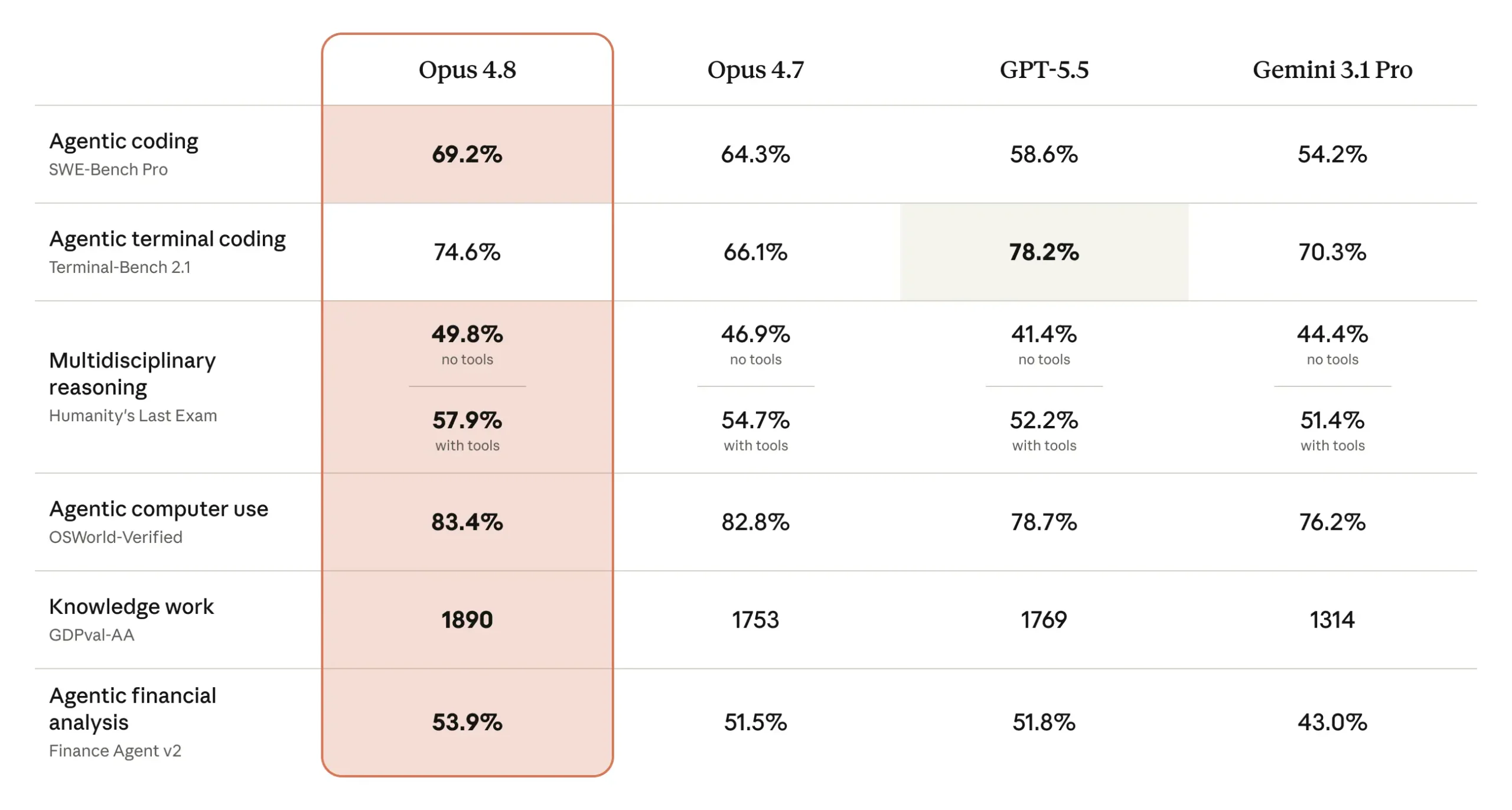 Opus 4.8 stacked against Opus 4.7, GPT-5.5, and Gemini 3.1 Pro. | Image: Anthropic
Less fake progress, more honesty
Anthropic calls the model’s improved honesty one of its most noticeable upgrades. AI models have a habit of jumping to conclusions and claiming progress that falls apart on closer look. It’s a widespread problem.
“Early testers report that Opus 4.8 is more likely to flag uncertainties about its work and less likely to make unsupported claims,” Anthropic says. The company backs that up with its own coding evaluations, where the model lets bugs slip through without comment about four times less often than Opus 4.7.
The model also sets new highs on prosocial traits like supporting user autonomy. Deception attempts and other unaligned behavior are said to be at Claude Mythos levels. Details are in the Claude Opus 4.8 System Card. The first Mythos-class models are expected to roll out to all customers in the coming weeks, once all safety measures are in place, the company says.
Dynamic workflows and effort controls steal the show
The new features Anthropic shipped alongside the model may matter more than the model update itself, which the company calls “modest but tangible.”
The biggest is “dynamic workflows.” The model can plan a task and then spin up hundreds of parallel sub-agents in a single session. Anthropic says Claude Code with Opus 4.8 can now handle codebase-wide migrations across hundreds of thousands of lines, from planning all the way to merge. The feature is available on Enterprise, Team, and Max plans.
On claude.ai and in Cowork, there’s now an effort control next to the model picker. It lets you decide how hard Claude works on a given response. Crank it up for deeper thinking and better results. Turn it down for faster answers that use less of your rate limit.
Opus 4.8 defaults to “high.” For tough tasks, Anthropic recommends “extra” (called “xhigh” in Claude Code) or “max.” These modes burn more tokens, but Anthropic says higher rate limits for Claude Code users help offset that. Anthropic’s advice is to just pick whatever level feels right for the task.
API prices stay the same, fast mode gets cheaper
Standard prices are unchanged from Opus 4.7: $5 per million input tokens and $25 per million output tokens. But 4.7 was already much more expensive in practice than its predecessor 4.6 due to higher token consumption, without delivering noticeable gains on everyday tasks.
Fast Mode, which runs Opus 4.8 at 2.5x speed, now costs a third of what it did for earlier models. Pricing sits at $10 per million input tokens and $50 per million output tokens.
Opus 4.8 might actually cost less to run
According to Artificial Analysis, Opus 4.8 could soften that price hike a bit. On the GDPval-AA benchmark, which tests real-world knowledge work tasks, the model needs 15 percent fewer passes per task and 35 percent fewer output tokens than Opus 4.7.
In practice, that could mean noticeably lower costs. But Opus 4.8 still uses roughly 30 percent more passes than OpenAI’s GPT-5.5, the second-place model.
At the “max” effort level, Opus 4.8 scored 1,890 points on GDÜVvall-AA, 137 points above Opus 4.7 and 121 points ahead of GPT-5.5, a win rate of about 67 percent head-to-head against GPT-5.5.
AI News Without the Hype – Curated by Humans
Subscribe to THE DECODER for ad-free reading, a weekly AI newsletter, our exclusive “AI Radar” frontier report six times a year, full archive access, and access to our comment section.