
On a Friday afternoon in March 2023, a Chicago construction worker ate some magic mushrooms and opened an AI image generator. After experimenting for a while, 31-year-old Pablo Xavier typed in a prompt: “The Pope in Balenciaga puffy coat”. He then posted the generated picture of Pope Francis to Facebook and Reddit.
He was not prepared for what followed. The image spread across the internet quicker than white smoke across a windy St Peter’s Square, with people convinced that the picture of the 86-year-old pontiff was real. It fooled so many that it became a symbol of a new era of deepfake misinformation, with tech commentator Ryan Broderick describing it as the “first real mass-level AI misinformation case”.
Xavier told BuzzFeed the following Monday that he “just thought it would be funny” to see the Pope in a silly jacket. “I just didn’t think it was going to be to this magnitude,” he said. “It’s definitely going to get serious if they don’t start implementing laws to regulate it.”
Three years later, Pope Francis’s successor has issued a similar plea for AI regulation, albeit in a slightly more wordy way. In his first encyclical letter, titled “Magnifica humanitas: On safeguarding the human person in the time of artificial intelligence”, Pope Leo framed the technology as one of the biggest challenges currently facing humanity.
In the 43,000-word document, which was published on Monday, Pope Leo warned of the “technocratic paradigm” that his predecessor had already denounced, and appealed for AI to be “disarmed” in order to prevent it from dominating nearly every aspect of human existence – from the economy to democracy.
In warfare, for example, AI risks triggering more conflicts by “lowering the threshold for resorting to violence, transforming defence into threat prediction and thus reducing victims to data”, he wrote.
 Pope Leo XIV’s encyclical letter ‘Magnifica Humanitas’, focused on the rise of artificial intelligence (AFP/Getty)
He also referenced AI’s ability to amplify disinformation through manipulated images and videos. Yet since the Pope in a coat image, there have actually been relatively few instances of deepfakes drastically misleading the public in a damaging way – and arguably none that have reached such a mainstream audience.
The real harms from AI currently come in the form of job disruption, environmental costs, cyber attacks, psychological impacts on vulnerable users, and the concentration of power among a small number of tech firms – all of which the Pope referenced in his encyclical.
What he did not mention was the emergence of artificial general intelligence, or smarter-than-human AI superintelligence, which some researchers claim poses an existential risk to our species. Its potential arrival could even threaten theistic culture, with techno-religions and philosophical movements already emerging that view artificial general intelligence (AGI) as a godlike entity.
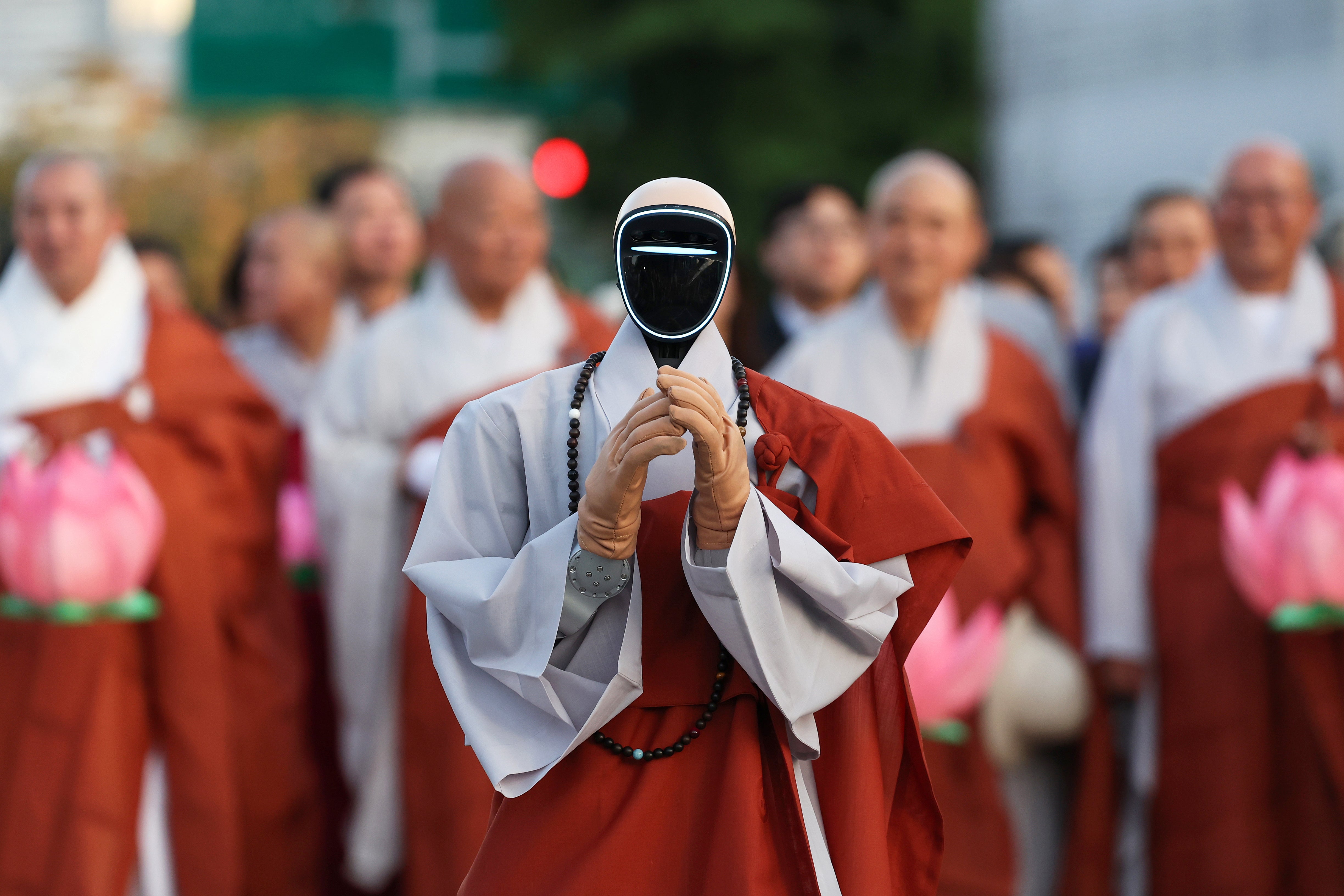 A humanoid robot dressed as a Buddhist monk attends the Lotus Lantern Festival to celebrate the forthcoming birthday of Buddha (Getty)
Some traditional religions have also adopted AI, with a Buddhist temple in South Korea initiating an AI-powered robot in an ordination ceremony last month to become a monk.
A small chapel in the Swiss town of Lucerne installed an “AI Jesus” in 2024 that allows parishioners to confess their sins to a digital version of the Son of God, with two-thirds of early users reporting a spiritual experience with the bot.
Earlier this year, a California-based startup called Just Like Me launched a platform that offers a “personal relationship with Jesus” through an AI avatar. For $1.99 per minute, users can engage in video calls with a digital deity that is actually just an AI model like ChatGPT that has been trained on the King James Bible.
Not all religious leaders are fearful of AI adoption. In an interview with The Independent earlier this year, Father Josef Wieneke, a pastor at St Matthias Catholic Church in Berlin, argued that nothing would ever replace the power of church-going, or his physical and spiritual role within his religious community. “There are lots of professions under threat, but mine isn’t,” he said. “The Catholic sacraments cannot be performed by a computer. They only work face to face.”
The co-founder of Anthropic, Chris Olah, responded to the Pope’s encyclical, speaking about AI in strikingly reverential, almost religious, terms despite calling himself an atheist.
“What has grown is far more subtle, odd, and beautiful than science fiction prepared us for,” Olah said. “[AI systems] are not the cold, calculating robots we were promised. They are made from us, from our words – and, as the Holy Father observes, they remain in important ways mysterious even to those of us who train them.”
 The ‘Deus in Machina’ project has faced criticism from some churchgoers at Peter’s Chapel in Lucerne (Deus in Machina)
Deep within the encyclical, Pope Leo called for “technological progress without allowing the heart to regress”. He cited spiritual leaders and religious figures, as well as the “martyrs of everyday life” who showcase humanity’s ability to love and worship.
“Humanity – in all its grandeur and woundedness – must never be replaced or surpassed,” he wrote. “We can embrace the technological progress that alleviates suffering and unlocks new possibilities, provided that we do not abandon the very essence of our humanity, namely the capacity for relationship and love.”
He added that human fulfilment “does not arise from a technological divinization, but through God’s grace received in Christ”.
Will Jones, the religious outreach lead at the US-based non-profit Future of Life Institute, believes the encyclical, and this passage in particular, is an exhortation to reject the idea that AI could ever be considered to have consciousness, let alone merit deifying.
“This is a direct rebuke of the leading AI companies’ stated goal of creating smarter-than-human superintelligence,” Jones told The Independent. “It is also an acknowledgement that AI tools, not autonomous general-purpose systems, are the key to a flourishing human future.”
Yet despite the warnings, all leading AI firms continue to push forward with their ambition of creating ever more powerful digital entities that could ultimately challenge perceptions of omniscient intelligence.
While the Pope in a coat was a watershed for AI-driven misinformation, the potential arrival of AI superintelligence could mean that it is not just the Pope’s image that is under threat – but his entire position as the head of the Catholic church.