 Anthropic and OpenAI logos. Reuters/Yonhap
※ Subscribe to Silicon Valley Look to receive Silicon Valley technology, investment and startup news, along with engaging reads.
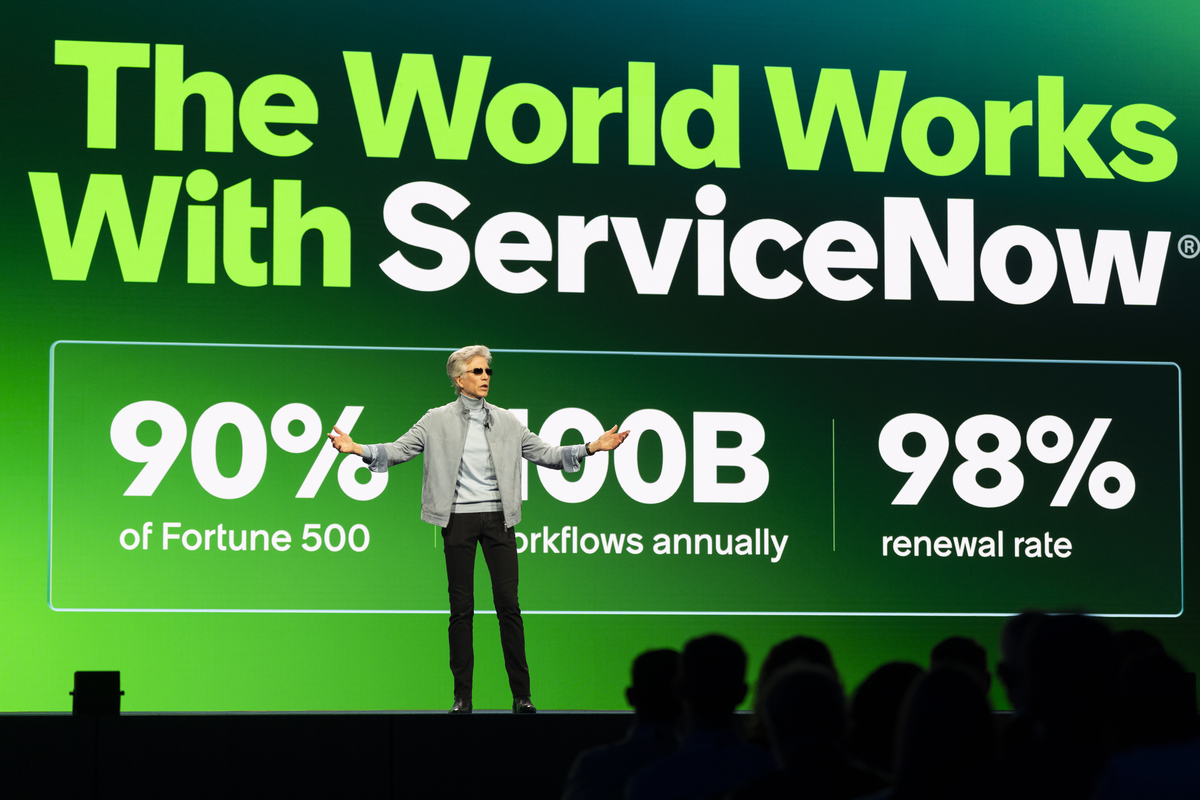
ServiceNow CEO Bill McDermott delivers a keynote address at the opening ceremony of “K26” held in Las Vegas, the United States, on the 5th (local time). ServiceNow
As “vibe coding” technology, which lets users command computers in plain language, advances, not only developers but also ordinary people are increasingly using coding agents. According to OpenAI, the number of weekly active users of its coding tool Codex has surpassed 5 million, more than a sixfold increase since the app launched in February. While developers are the main users, knowledge workers account for about 20% of all users, and their growth rate is more than three times faster than that of developers.
As Codex and Anthropic’s Claude Code have grown popular, the number of “multi-agent” users who combine various coding agents is also rising. The thinking is that using multiple agents can combine the strengths of each to produce more than twice the output.
However, a study at Stanford University found that when two coding agents collaborate, their work ability declines compared with when they write code separately. In human society, just as the saying goes that “many hands make light work,” collaboration is the best way to boost work efficiency, but in the AI world it instead creates a bottleneck. The assessment is that while AI’s ability to learn and reason on its own may have approached human intelligence, its collaboration ability still has a long way to go.
Stanford University’s Institute for Human-Centered Artificial Intelligence (HAI) released a study titled “AI Coding Agents Fail at Teamwork” on Monday. HAI explained that “the two models were found to perform worse when working together than when working alone,” and that this “revealed a significant gap in AI capabilities.” The research was also presented as a paper at an ICLR workshop in April, with the lead researcher participating as first author.
The materials introduced results of research based on CooperBench, conducted by Stanford assistant professor of computer science Diyi Yang and postdoctoral researcher Hao Zhu. CooperBench is the first benchmark to evaluate teams of agents and measure how well an agent functions as a team member, jointly developed by Stanford University and SAP Labs. CooperBench was introduced based on the judgment that measuring an agent’s ability requires not only the ability to perform specific tasks but also social intelligence to find common ground and reach consensus. This is because the ability to coordinate work is important for an agent to demonstrate its capabilities in complex collaborative tasks.
The research team designed more than 650 software engineering tasks for two agents to collaborate using one of four programming languages—Python, TypeScript, Go, and Rust. The tasks were designed assuming situations where the agents conflict with each other. Each agent can write code, execute commands, and exchange messages with the other agent in real time. The research team said that when they assigned tasks to the two coding agents, the results fell short of expectations, and a “coordination gap” occurred.
The lead researcher said that the study found a single model performed better than two agents sharing a task, calling it “the curse of collaboration.” He analyzed that “the models have excellent language skills but cannot use language in social behavior, so they lack the coordination ability needed to behave reliably during collaboration,” adding that “the problem is that the models were trained not to use language in a social way.” Professor Yang also explained, “When collaborating, AI’s performance actually drops sharply. Even the best coding agents lose nearly half their capability when paired to share a task,” adding that “this shows that social intelligence, not coding skill, is the key bottleneck in AI collaboration.”
The research team had expected that designing the agents to communicate with each other would increase the chances of successful collaboration, but it had little effect on the results. The team explained that AI struggled with spatial and semantic coordination, citing a case where one agent warned of a conflict but the other agent ignored it. That is, the agents failed to distinguish in the communication process what was wrong in the code and which part needed to be fixed. The team pointed out that in human society such behavior damages trust and is an insulting act.
The research team analyzed that while AI-to-AI collaboration is a solvable problem, the key task is not simply to give better instructions but that a new type of social intelligence, which AI does not yet possess, is needed. Beyond simply writing good code, AI must be taught what a successful partnership is. They also proposed introducing a system for developers to verify agents’ fulfillment of commitments and having agents draw up agreements with each other. The lead researcher said, “Through the CooperBench research, we learned that AI agents speak like humans but still have much to learn before they grasp how language works in a social context.”
In the actual AI industry as well, orchestration among agents is becoming important. According to market research firm IDC, the number of agents worldwide is expected to grow from 28.6 million in 2025 to 2.2 billion in 2030. The more agent use increases, the more collaboration is needed, but to achieve that, the bottleneck problem must be solved. ServiceNow, a software company focused on improving corporate work efficiency, last year unveiled an AI control tower that integrates and orchestrates tens or hundreds of AI agents.
