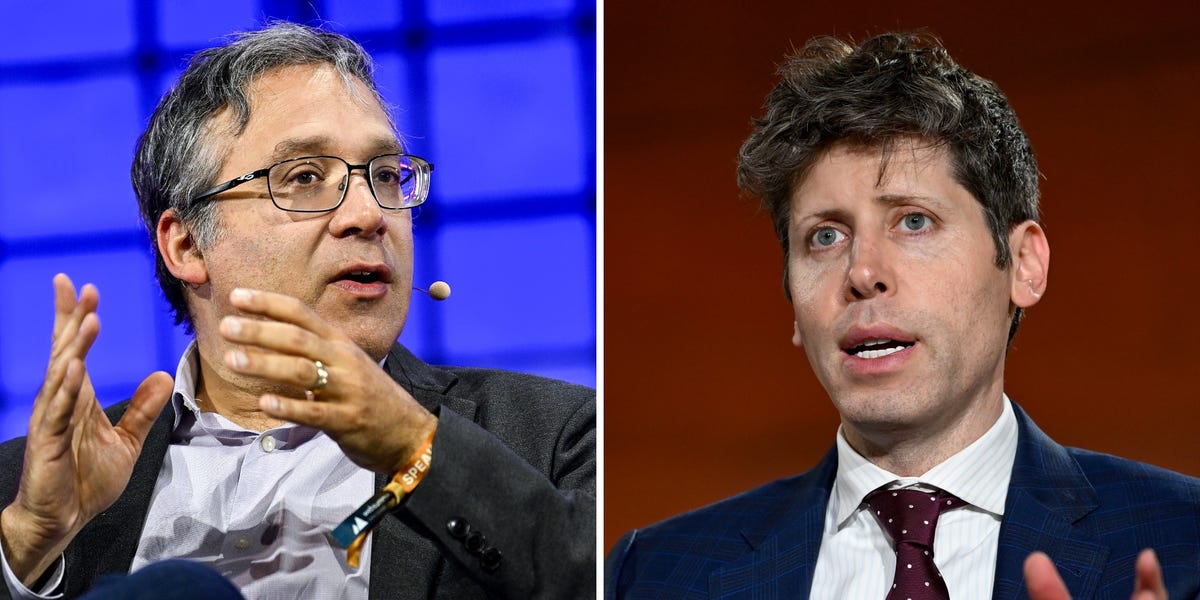
Gary Marcus isn’t one to hold back when he has concerns about AI. Right now, he sees a possible problem brewing for some of the stock market’s most popular names ahead of OpenAI’s IPO.
The ChatGPT maker recently confidentially filed an S-1, only to follow up with news that it was considering price cuts. Marcus, an AI researcher who has written multiple books on the subject, posted to X that he sees this as bad news not just for OpenAI but for tech stocks like Nvidia, Oracle and CoreWeave with high exposure to it.
“Their values rely to a significant degree on the expectation that OpenAI will have an immense demand for chips and data centers, but OpenAI is burning cash very, very, very, fast,” Marcus told Business Insider. “They probably have problems if they don’t get public money. If they have problems, that puts the future of other companies that count them as a major customer in doubt.”
Marcus’ thesis centers around the fact that OpenAI requires significant compute power to continue building out and scaling its AI infrastructure. Nvidia, Oracle and CoreWeave have all benefitted significantly from this demand.
If the OpenAI IPO falls has issues or underperforms, a scenario that he sees as increasingly likely, it could force the company to scale back spending, thereby depriving all three companies of a major revenue source.
Throughout recent months, Marcus has been critical of OpenAI, comparing to WeWork, a former darling of Silicon Valley now synonymous with failure after a 99% crash in the fall of 2023.
“WeWork was valued at a hard-to-comprehend (relative to its fundamental numbers), seemingly more on show than substance,” Marcus noted. “I often see OpenAI in the same way, and it has been apparent to me that they had no significant technical moat, and that others would catch up to them, leading to price wars, making profits elusive.”
Marcus made it clear that he sees almost the exact same scenario playing out now with OpenAI, particularly after its move to potentially scale back prices. But he also sees major risk for the startup stemming from the fact that rival Anthropic is making notable progress, continuously threatening its market share.
This comes at a time when companies are cutting back on high AI usage only months after encouraging due to high AI costs, presenting another obstacle for OpenAI.
“The death of tokenmaxxing is forcing OpenAI to consider drastically cutting costs,” he stated. “That might help with retaining users, but pushes them even further away from profitability.”
All this points to a scenario that Marcus sees in which the tech stocks with the most exposure to OpenAI are jeopardized when the company’s IPO doesn’t go as planned.
From there, he sees the potential for an AI credit event that could force lenders to question the stability and creditworthiness of AI-linked assets.
“Nobody really knows what the blast radius might be, because we don’t how how much of a problem there would be for lenders, both directly if loans around OpenAI failed, and indirectly if loans for data centers went bus,” Marcus added.