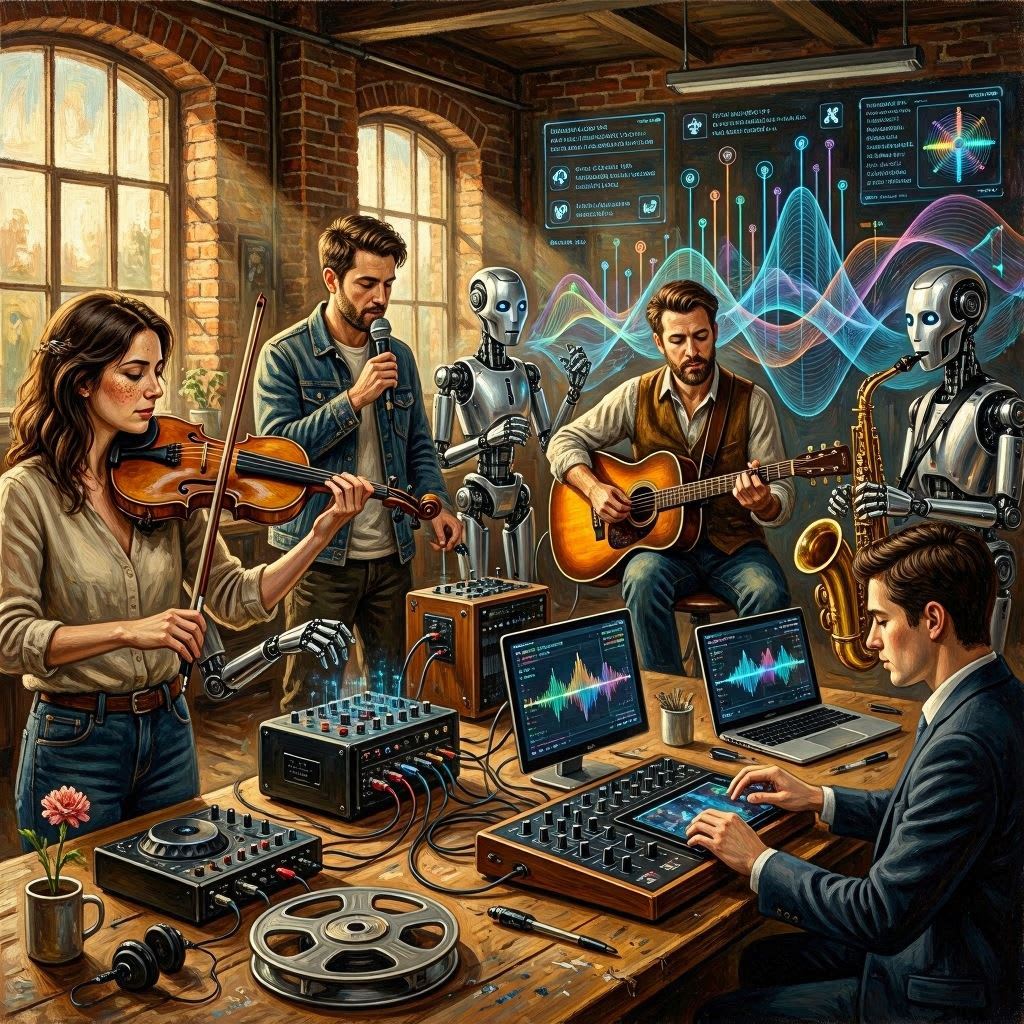
In recent years, artificial intelligence has quietly shifted from being a behind the scenes experiment to a practical tool inside modern music production. While many listeners still imagine songs as either fully human performed or entirely synthetic, the reality is far more blended. AI is now used for everything from generating chord progressions and assisting with mixing decisions to enhancing vocal clarity or even building full guide vocals for independent artists. Because these tools often sit inside the production process rather than replacing it outright, many tracks circulate on streaming platforms without clear labeling of how much AI contributed. The result is a new kind of “invisible collaboration” between artists and algorithms, where the final sound may carry a digital fingerprint that most listeners never notice.
Several recent independent releases often discussed in this context include tracks by Breaking Rust. Songs like Livin’ on Borrowed Time and Walk My Walk by Breaking Rust are frequently mentioned in conversations about AI assisted country and rock fusion. While production details are not always publicly documented in full, listeners and creators alike point to their highly polished vocal consistency and tightly controlled instrumentation as signs of modern production tools that may include AI assisted mastering, vocal processing, or generative backing arrangements. In today’s independent music environment, these kinds of tools are increasingly common, allowing small teams or solo creators to achieve a level of sonic polish that once required large studios.
Another example often discussed is How Was I Supposed To Know by Xania Monet. This track has drawn attention in online music communities for its emotionally expressive delivery and modern vocal texture. In a landscape where AI vocal modeling and enhancement tools are widely available, songs like this are frequently analyzed for subtle digital shaping; whether through pitch correction systems that go beyond traditional autotune, or AI assisted vocal layering that smooths transitions between phrases. Even when human performance remains central, AI tools can influence how polished and emotionally “perfected” the final result feels to the listener.
Spiritual and inspirational music has also begun integrating similar technologies. The track Find Your Rest by Solomon Ray is often mentioned in discussions about modern independent gospel influenced production. In this space, AI is frequently used to assist with arrangement structuring, background harmonies, and mixing consistency, especially for creators working outside traditional studio systems. These tools help maintain a cohesive sound across layered vocal tracks and ambient instrumentation, giving independent releases a more expansive and professionally balanced feel.
A notable cluster of inspirational releases comes from IngaRose, including Piece by Piece, Her Truth, and Celebrate Me. These tracks are often discussed in relation to AI assisted production workflows because of their clean vocal separation, consistent tonal balance, and modernized emotional delivery style. In many independent music pipelines today, AI tools are used not only for technical correction but also for creative experimentation; helping shape harmonies, suggest melodic variations, or refine lyrical pacing during production. While the emotional core of the music remains human driven, the production polish often reflects a hybrid workflow between artist intuition and machine assisted refinement.
Similarly, Cain Walker has gained attention with tracks like Still Standing and Don’t Tread On Me. These songs are often associated with high impact vocal mixing and cinematic instrumental layering, areas where AI driven mastering tools are increasingly common. Such tools can analyze frequency balance, optimize loudness levels, and enhance clarity across streaming platforms automatically, allowing independent artists to release music that competes sonically with major label productions.
Finally, the catalog of Thorne Empire, including tracks such as Getting Square and Gone With The Summer, is sometimes referenced in broader discussions about the evolving landscape of AI assisted independent music. Rather than being treated as a distinct category of its own, these releases are more often cited as examples of how contemporary independent production frequently exists within hybrid digital workflows. In today’s music ecosystem, AI driven tools are commonly integrated into standard production stages such as mixing, mastering, and audio cleanup, alongside traditional songwriting and performance. Because these technologies are now embedded so deeply into digital audio workstations, many independent tracks are discussed in relation to AI assistance not as a claim about their origin, but as an illustration of how modern production environments function as a blend of human creative direction and machine supported refinement.
What ties all of these songs together is not that they are “AI songs” in a purely synthetic sense, but that they exist in an evolving production ecosystem where AI is increasingly embedded in the creative process. For listeners, this means the definition of what counts as human made music is becoming more fluid. A song may still originate from a human emotion, a lived experience, or a personal story, while still being shaped, refined, or even partially constructed with the help of machine intelligence. As these tools continue to develop, the line between artist and assistant will likely become even harder to distinguish and the music we hear every day may carry more AI influence than we ever realize.