Self-driving cars that talk to each other, robot vacuums that divide and conquer a messy house, and underwater machines mapping undiscovered ocean floors are all dreams Florida Atlantic University researchers say could be a reality within the next few years.
FAU’s Center for Connected Autonomy and Artificial Intelligence is leading two separate but related research projects — one in the sky and the other in the ocean — that could reshape how autonomous machines work together.
A smartphone on its own is a decent camera and calculator, but the moment it connects to the internet, it becomes something else entirely: a means to attain infinite information or knowledge and also a way to reach anyone on Earth.
Dimitris Pados, director of FAU’s autonomy and AI center, said he sees the same logic in robots.
“Back in the 80s, we had the very first personal computers created,” he said. “Personal computers could run code, could do things, you could type stuff, you could create documents, you could print documents, but that’s it. The real revolution was the connectivity: the internet.”
Robots, he argued, are next.
“The real breakthrough is we have a bunch of drones that self-organize and work together, just like humans,” said Pados, who spearheads both research projects. “A human can do great things, but a bunch of humans is so much more than just the individual skills of everyone.”
Right now, two separate research grants are funding the attempt.
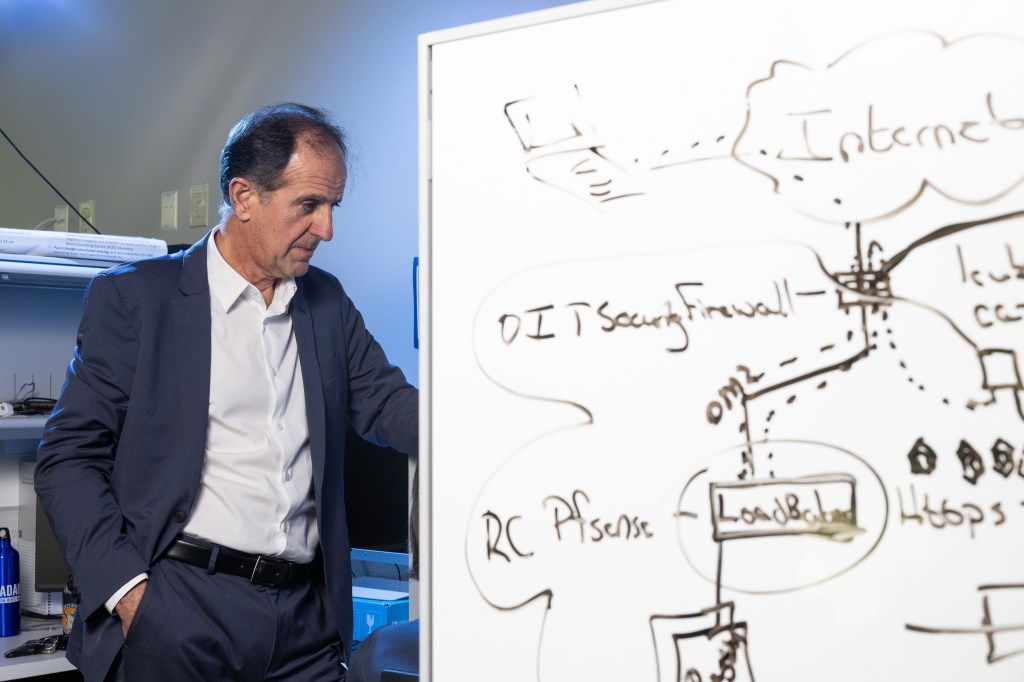
 Jose Angel Sanchez, a Ph.D. student in FAU’s Center for Connected Autonomy and Artificial Intelligence, works in the lab in the College of Engineering and Computer Science. (Alex Dolce/Florida Atlantic University)
Teaching drones to be a team
The first project, backed by a $2.2 million grant from the U.S. Air Force Research Laboratory, focuses on aerial drones and the wireless networks that let them collaborate in real time.
Researchers explained that currently, the way most wireless devices communicate introduces delays. This lag, even a fraction of a second, may not be important in a phone call, but for a team of autonomous drones trying to coordinate a mission in real time, it could be problematic.
“What’s very important for … groups of drones is to have very good synchronization,” he said. “So what you see right now is exactly what I see right now.”
The network and technology the team is building bypasses the middleman entirely. The drones connect directly to each other, and unlike humans, Pados noted, machines can transmit and receive at the same time, which means no talking over each other or waiting turns.
But any discussion of AI-powered autonomous machines will inevitably raise the question of what happens when something goes wrong?
“There’s always a kill switch in everything we design,” Pados said. “If things go really bad and you’re not trusting anymore what’s happening, you shut everything down.”
Improving connectivity underwater
FAU’s second project, part of a $1 million grant from the AUKUS Maritime Innovation Challenge, a defense initiative involving the U.S., UK and Australia, takes the same idea underwater.
Radio waves — the backbone of wireless communication — don’t travel well through seawater.
Acoustic signals (sound) travel far but slowly, whereas optical signals (light) travel quickly but can only cover a short range. Until now, underwater systems have had to choose one or the other.
The goal is a team of autonomous underwater vehicles that can make decisions collectively with minimal guidance or intervention from the humans at the surface.
Improving connectivity underwater drives the project’s military objective, but it also could help ocean exploration, researchers say.
“We really have no idea what exists underwater,” Pados said. “If we want to see what’s out there, if we want to understand what’s going on, we need to be there. And we cannot be there as humans, we have to be there as machines.”
Even though the ocean covers about 70% of Earth’s surface, scientists estimate between 80% and 95% of the ocean is unexplored.
Transportation, Pados said, is likely the first domain where consumers will see the impact of this new technology.
Driverless cars are already on Florida’s roads — Waymo, an autonomous vehicle company, offers ride-hailing services in parts of the U.S., including Miami and Orlando. But Pados said the next step is cars that talk to each other, coordinating routes and negotiating intersections.
“So you are in a car, the car takes you wherever you want to go, but at the same time, as the car goes, it talks to whatever other car it happens to cross paths with,” Pados said.
The same principle could revolutionize medicine. Medical imaging machines, such as MRIs and scanners, typically work alone. But Pados said that when you link multiple machines together, they stop acting like separate machines and start acting like a single more powerful unit.
He pointed to human vision as a comparison: Two eyes connected to one brain produces a perception that neither eye could achieve alone. Connected robots, he suggests, could do something similar.
Within three to four years, he said, connected robots will start showing up in everyday life, most likely in the vehicles carrying people to work or the trucks dropping off packages at doors.
“This is the future of connected robots,” he said. “This is what will happen sooner or later.”