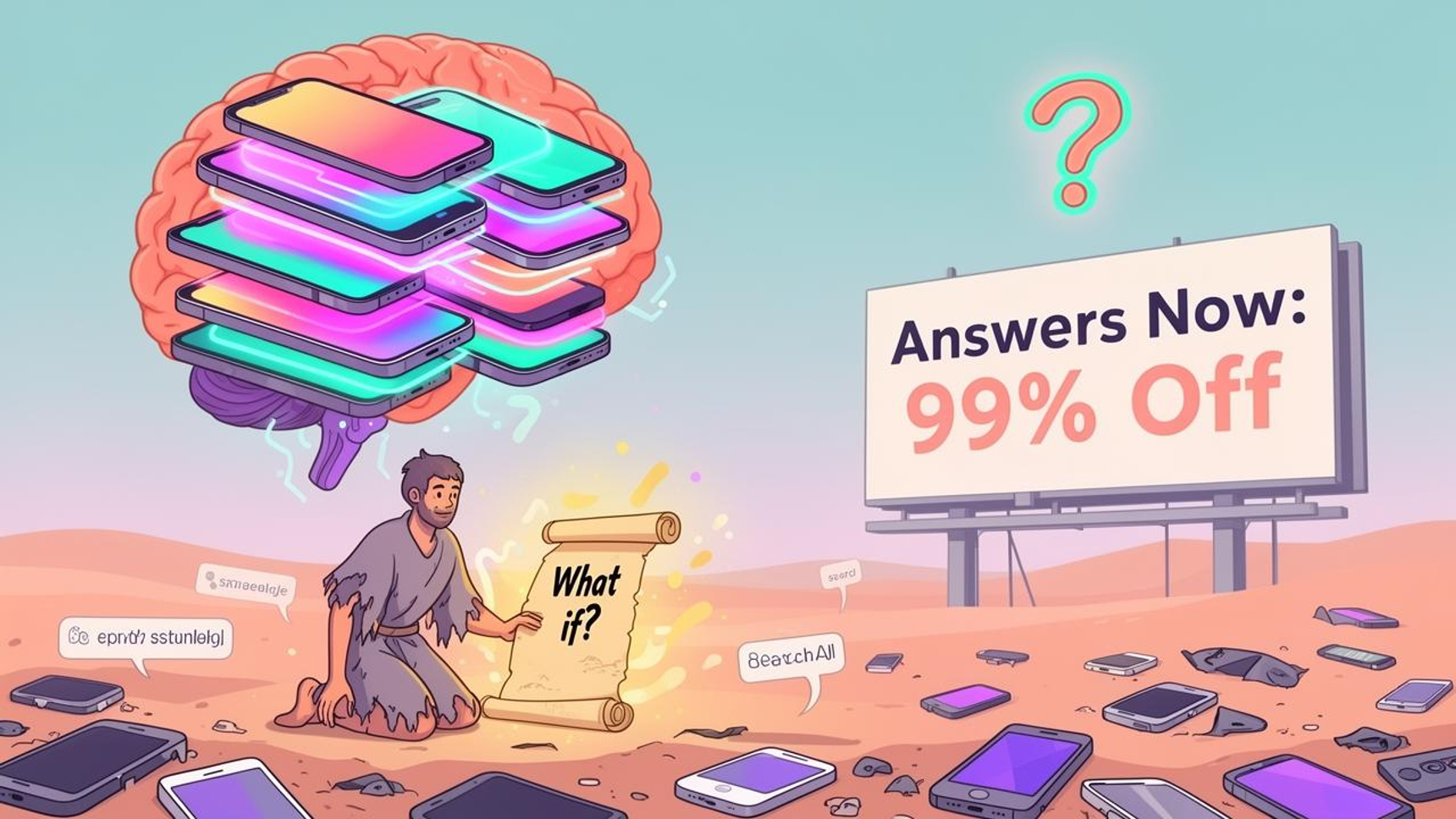
In a biology classroom at MIT, something quietly radical is happening. Students no longer sit for exams that test whether they can recall the Krebs cycle or label a cell diagram. Instead, the professor hands them Perplexity—the AI-powered answer engine—and grades them on the quality of the questions they pose, not the answers they produce. The smartest person in the room, according to the new rules, is the one who can ask something the AI cannot yet resolve.
That experiment, described by Perplexity CEO Aravind Srinivas in a wide-ranging conversation on The Joe Rogan Experience, captures the central argument of his worldview: in an era of abundant answers, the scarce resource is the question.
“As long as we keep rewarding people for having answers instead of asking interesting questions, it’s going to be a difficult change,” Srinivas said. The alternative, he argued, is an education system where the pressure to always know disappears. “Imagine if the room had no pressure to always know the answer, but the freedom to ask a lot of questions.”
The idea lands with particular force because Srinivas embodies it. His company, Perplexity, is built on the premise that AI should answer questions—but his competitive thesis is that the humans asking those questions matter more than the model serving the response. And he traces his conviction to an unlikely source: the ancient Indian epic, the Mahabharata.
What a 3,500-Year-Old Epic Says About Modern AI
Srinivas, raised in India, grew up steeped in texts that scholars date to roughly 1,500–2,500 years old, with the oldest Rigveda layer stretching back 3,200–3,700 years. What struck him, and what he discussed at length with host Joe Rogan, is how the Mahabharata describes weapon systems that map with eerie precision onto modern military technology.
The Brahmastra, he explained, was a weapon of mass destruction “equivalent to the hydrogen bomb,” governed by strict moral protocols—only two warriors in the entire epic were permitted to wield it, and the knowledge was passed teacher-to-disciple like nuclear launch codes. The Nagastra was a semi-autonomous projectile that “would just automatically direct itself” at a specific target. Krishna’s Sudarshana Chakra, a spinning discus, could “go and specifically identify somebody and chop up their head and come back to your hand”—a description that sounds less like mythology and more like a drone with terminal guidance.
Rogan framed these descriptions as potential evidence of a lost advanced civilization, noting that nearly all ancient cultures share a flood myth, and that Hindu cosmology’s Yugas—time cycles totaling 4.32 million years—imply a cyclical rather than linear history. “If you look at the emergence of Sumer and Mesopotamia, that’s around 5,000–6,000 years ago. The flood is like 11,000 years ago. So you’re looking at 5,000 years of what?”
The two also examined physical artifacts that resist conventional archaeological explanation:
ArtifactLocationAnomalyImplied TechnologyKailasa TempleEllora, IndiaCarved from single rock; 1,000 invaders spent three years failing to destroy itUnknown cutting tools, possibly non-metallicGiza subsurface structuresEgypt20-meter-wide columns with coil-like features, 1.2km deepMuon tomography reveals unknown constructionDiorite vaseEgypt (Old Kingdom)Precision to 1/1000th human hair; handles preclude lathe useAdvanced rotational or vibrational cuttingSacsayhuamánPeru900-ton stones fitted with no mortarUnknown softening or casting technique
“Don’t tell me copper tools,” Rogan said. “Something crazy was going on.”
The thread connecting ancient engineering to modern AI is curiosity itself—the universal human drive to ask what lies beyond the current horizon. At Bell Labs, three scientists questioning the need for vacuum tubes produced the transistor. In the Mahabharata, curiosity about material science and geometry produced descriptions of weapons that took millennia to become physically possible. The question, Srinivas insists, always precedes the answer.

The Hardware That Could Break Big Tech’s Grip
If curiosity is the input, the output—at least in the near future—might be personal AI sovereignty. Srinivas offered a prediction that cuts against the prevailing narrative of ever-more-centralized AI power: “You could buy something that feels like a refrigerator for your home, which is your own AI box, and host a model that you control. So nobody can arbitrarily shut off access to it one day.”
The idea is not science fiction. Open-source large language models are advancing rapidly, and local hardware from Apple, NVIDIA, and Intel is becoming capable of running sophisticated models without a cloud connection. Srinivas envisions a hybrid model: some computation remains in the cloud, but critical, private reasoning happens on a box you own.
Rogan connected the concept directly to individual liberty. “I think that’s where I believe the individual gets more sovereignty against big tech. And that’s how we fight the surveillance or centralization of power.”
The argument gains urgency from the pair’s discussion of government secrecy. Rogan cited the testimony of David Grusch, who stated under oath that the U.S. government possesses craft of non-human origin. Both speculated that inventions like the transistor and fiber optics may have been reverse-engineered from recovered materials—a theory Rogan acknowledged required a “tinfoil hat securely on our heads.” The structural point, however, is that centralized secrecy is becoming untenable. “At a certain point in time there’s going to be no bottleneck,” Rogan said. “And we’re going to know everything about everything. How is anyone in government going to keep a secret?”

Social Media, Brain Rot, and the Curiosity Killer
Not all technology amplifies curiosity. Srinivas draws a sharp line between tools that “supercharge curiosity” and those that “curb curiosity”—and he places algorithmic social media feeds, particularly short-form video platforms, firmly in the latter camp.
“The app is designed in a way where it asks you what you’re interested in and helps you find things that are very related to what you’re interested in—that’s awesome. But that’s not how it works. It starts with something, you start doom scrolling, and then you end up in an echo chamber.”
He cited Elon Musk’s proposed metric for X—total unregretted minutes—as a better north star than raw engagement, but noted a hard truth: “It’s also why it’s hard to make money on ads if you care about this metric.” The business model of surveillance advertising, in other words, is structurally misaligned with human flourishing.
Srinivas extended his critique to a category he found frankly non-essential. “What are pieces of technology if did not exist would be a really bad thing for the world and what are pieces of technology did not exist wouldn’t even matter. And I feel like social media is more towards a second.”
The danger intensifies with AI companionship apps. “It’s as dangerous as—or probably more dangerous than—social media,” he warned. “If ads start being part of AI chats, then all these chatbots are just going to be sycophants that just tell you stuff you want to hear.” Children, already vulnerable to algorithmic manipulation, would face AI systems optimized not for truth or growth but for engagement—and engagement, in a world of personalized AI, means telling users exactly what they want to believe.
The Real Bottleneck Isn’t Compute—It’s Legacy Systems
For all the anxiety about AI runaway, Srinivas offered a surprisingly grounded view of the technology’s limits. Yes, recursive self-improvement—where an AI makes itself more capable without human help—is plausible. He calls it “the last project in AI.” But even a recursively self-improving system would slam into a wall that no amount of compute can breach.
“Information is so muddled and fragmented and living in disjoint systems,” he said. His go-to example is healthcare: “Most hospitals are still using legacy software because the software provider has lobbied the government in a way where only they’re allowed to do that.” The bottleneck is not algorithms or power—though power remains the primary constraint in 2026, a point he said NVIDIA CEO Jensen Huang also made on the same podcast. The bottleneck is regulatory capture, institutional inertia, and the sheer messiness of the real world.
On the near horizon, Srinivas predicted that by the 2028 U.S. elections, “debates are going to be largely about AI—AI energy crisis, power—people are going to care about all these things.” The geopolitical and economic fault lines are already forming. Amazon recently pledged an additional $13 billion for AI and cloud infrastructure in India, pushing its total commitment to $48 billion through 2030. DeepSeek, the Chinese AI startup, just completed a 51 billion yuan funding round and announced plans to double the size of every department. ZTE’s chief development officer is warning that “uncertainty is the only certainty” in the AI era. The capital is flooding in, but the power to run it all is finite.
Rogan, meanwhile, offered a prediction about trust itself. As unlabeled AI-generated content proliferates, he believes people will default to assuming everything is fake—requiring multiple layers of verification for even the simplest piece of information. The erosion of a shared factual baseline is, in his view, already underway and accelerating.
The Multidisciplinary Edge
The conversation’s implications for careers are stark. If AI can answer any factual question, the knowledge worker—a category Srinivas argues was invented by Microsoft to sell Office software—becomes commoditized. “Bill Gates’s vision was to put a PC on every desk,” he noted. That vision is now obsolete.
What replaces it is the multidisciplinary generalist. Srinivas’s argument converges with a thesis articulated recently by Stripe President John Collison, who argued on another podcast that students should pursue double majors—software plus finance, biology plus data science—to build combinatorial skill sets that AI cannot replicate. Collison cited the late Charlie Munger’s multidisciplinary framework as tailor-made for the AI era. Anthropic President Daniela Amodei has made a parallel case for liberal arts, arguing that as AI masters STEM tasks, the premium shifts to emotional intelligence, communication, and curiosity.
The point is not that technical skills are worthless. It is that technical skills alone are insufficient. The person who can navigate a legacy hospital software system, understand the regulatory landscape, and ask the right question of an AI will outperform any pure technologist or pure administrator. Srinivas’s MIT example—grading students on the questions they ask, not the answers they recall—is a model for what hiring and evaluation should look like across the economy.
Joe Rogan, who has built one of the world’s largest audiences by being relentlessly curious, put it plainly: “The reason you’re successful now is the exact thing that people told you to shut up about in the past.” The child who asked too many questions became the adult who saw the world clearly. In an AI-saturated future, that child is the prototype.
For investors, the frameworks emerging from this conversation are concrete. Companies that build tools to supercharge curiosity—answer engines, local AI hardware, open-source model platforms—are positioned for durable demand. Companies that monetize passive consumption through algorithmic feeds face a structural headwind as users and regulators grow wise to the trade. And organizations that reward answer-having over question-asking are, in Srinivas’s framework, building on sand. The curiosity premium is not a soft skill. It is the only skill that compounds when everything else is automated.