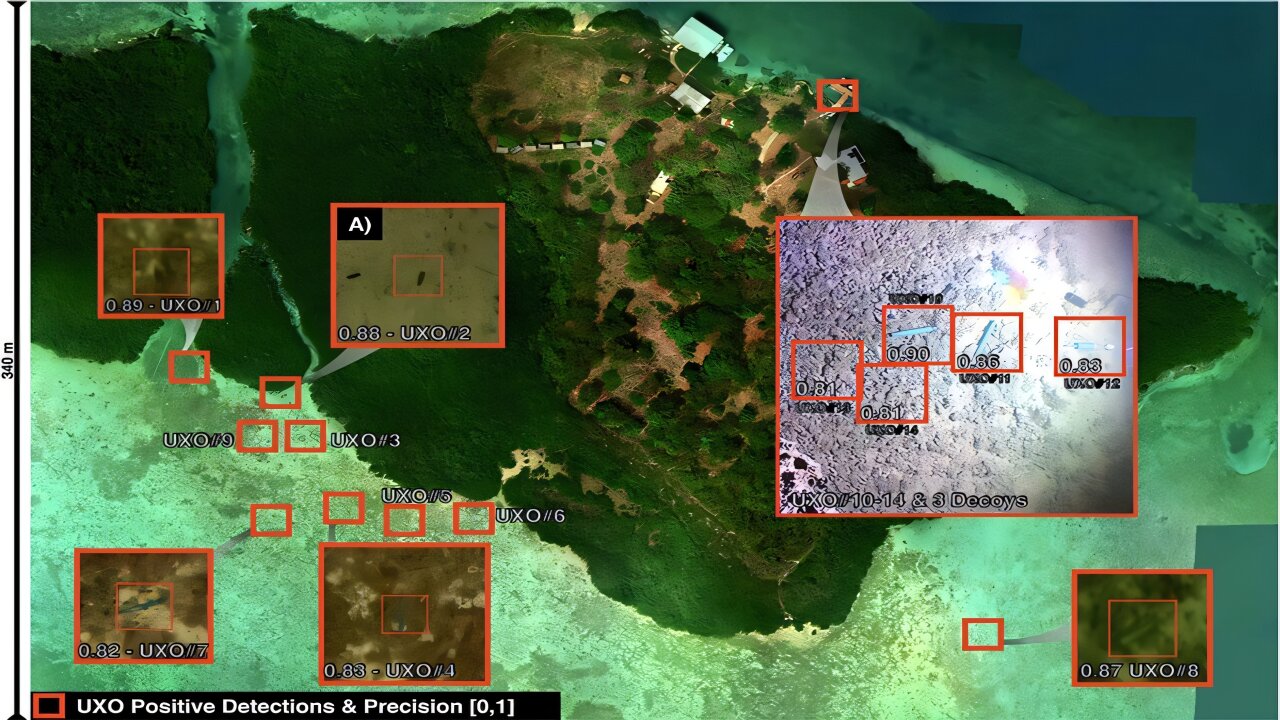

UXO positive detections at Broad Key Research Station and detection precision. All UXO targets were successfully detected in the Fluid Lensing RGB image. All locations and detections are highlighted in red boxes with associated F1 (Dice) precision score in white. Note that in panel A, the black nipple dummy target was not detected as UXO, and several highlighted examples show detection against complex backgrounds. (UXO, unexploded ordnance). Credit: Aircraft Center for Earth Studies
A new airborne imaging approach can reliably detect unexploded weapons that lie in shallow coastal waters and remain an ongoing hazard to public safety, marine ecosystems and infrastructure worldwide. By combining advanced multispectral sensing with artificial intelligence, the researchers were able to identify underwater munitions with high confidence, even when they are partially hidden by sediment, biological growth or debris.
Scientists at the University of Miami Rosenstiel School of Marine, Atmospheric, and Earth Science developed and tested the approach and published their findings in the April issue of Frontiers in Marine Science. The study demonstrates that integrating NASA underwater imaging technologies with machine learning enhances detection accuracy while reducing false positives in complex marine environments.
“Unexploded ordnance in shallow waters remains a serious global challenge,” said Ved Chirayath, Vetlesen Endowed Chair of Earth Sciences in the Department of Ocean Sciences, the study’s lead author. “Our results demonstrate a scalable, airborne solution that can help improve detection accuracy and support safer coastal environments.”
Unexploded ordnance, or UXO, in shallow waters less than 10 meters (33 feet) deep remains particularly difficult to detect. Traditional acoustic search methods are limited in their ability to cover large areas, while optical imaging is often distorted by surface waves and water conditions. Improved detection methods are critical for reducing risks to coastal communities, preventing environmental contamination and supporting safer marine operations.
To address these challenges, a team led by Chirayath, director of the Rosenstiel School’s Aircraft Center for Earth Studies (ACES), conducted airborne imaging missions over a test site at Broad Key, a research island in the northern Florida Keys. Inert munitions and decoy objects were deployed across two locations, then imaged using drones equipped with NASA Fluid Lensing and MiDAR (Multispectral Imaging, Detection, and Active Reflectance) technologies.
Fluid Lensing corrects distortions caused by ocean surface waves, enabling high-resolution imaging of the seafloor, while MiDAR provides active multispectral illumination across multiple wavelengths. The resulting imagery was used to train a machine-learning model to detect and distinguish munitions from surrounding objects.
The system successfully identified all deployed targets, even after weeks of biofouling and sediment accumulation that made detection more difficult. Active MiDAR sensing produced the highest precision, while both sensing approaches achieved strong detection performance with minimal false positives.
While the results are promising, researchers note that additional testing is needed to expand the system’s capabilities across different environments and types of munitions.
Publication details
Ved Chirayath et al, Automated airborne detection of underwater munitions using NASA multispectral passive and active MiDAR Fluid Lensing, Frontiers in Marine Science (2026). DOI: 10.3389/fmars.2026.1776178
Provided by
University of Miami
Who’s behind this story?


Citation:
Airborne AI spots underwater munitions in shallow seas with high precision (2026, July 2)
retrieved 2 July 2026
from https://phys.org/news/2026-07-airborne-ai-underwater-munitions-shallow.html
This document is subject to copyright. Apart from any fair dealing for the purpose of private study or research, no
part may be reproduced without the written permission. The content is provided for information purposes only.