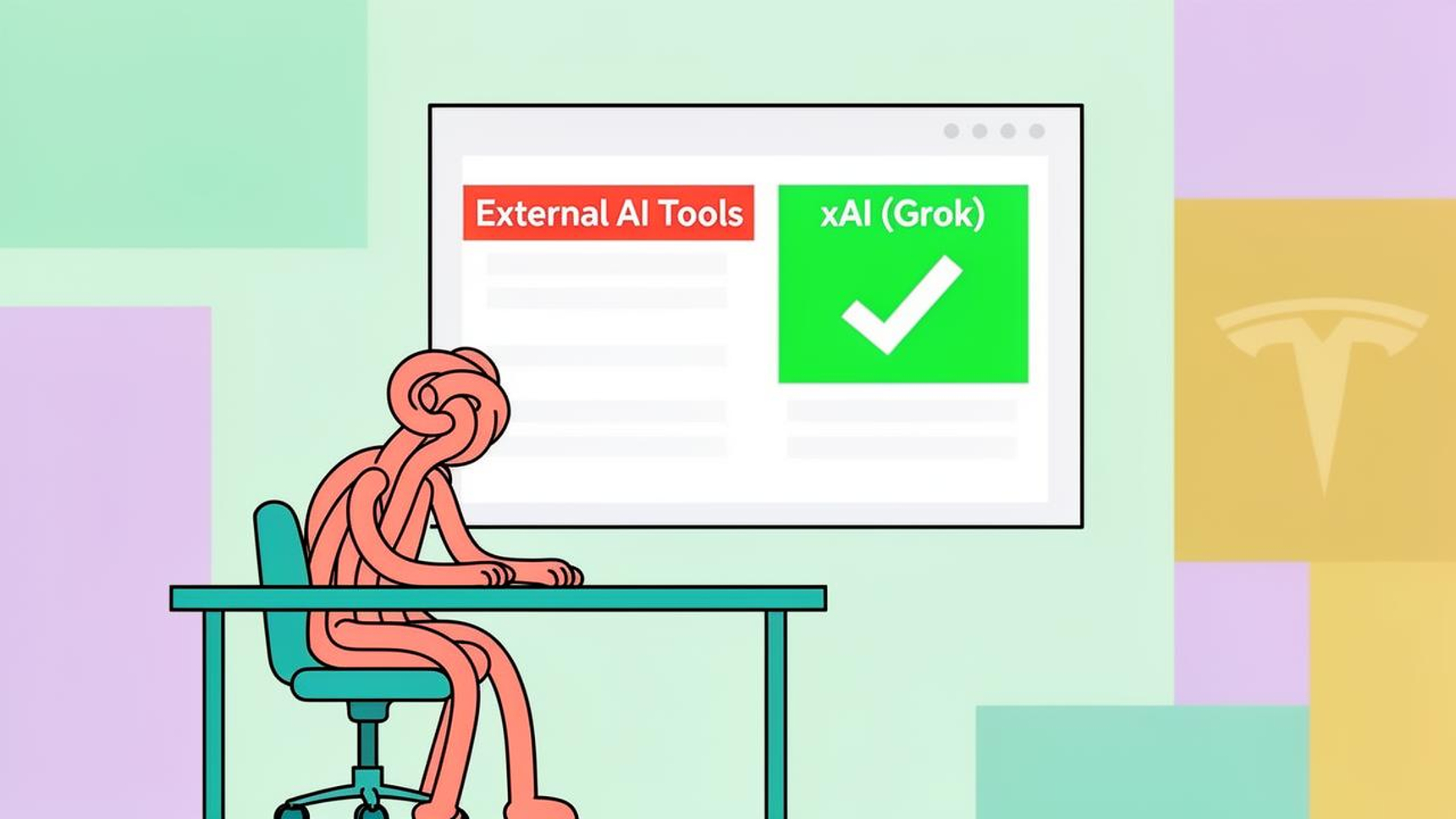
Tesla is slamming the brakes on runaway artificial intelligence costs, telling employees they will be limited to $200 per week in spending on external AI tools starting July 6, a dramatic about-face from the company’s earlier push to embed the technology in every corner of its operations.
The new policy, communicated to staff in an internal memo, marks a stark reversal for the electric vehicle maker, which had spent the past six months consolidating AI access through an internal platform called Bottle Rocket and even deploying dashboards that tracked token consumption. Some software engineers were reportedly burning through thousands of dollars each week on AI tokens—the usage-based units that determine the cost of interacting with large language models. Going forward, any employee seeking to exceed the $200 weekly cap will need managerial approval.
Notably, the spending limit does not apply to beta versions of products from xAI, the artificial intelligence startup founded by Tesla CEO Elon Musk. The exemption effectively steers employees toward Grok and Cursor’s Composer model, giving Musk’s own AI venture a protected lane inside one of the world’s most valuable companies. SpaceX, Musk’s aerospace firm, is reportedly preparing to acquire Cursor’s parent company Anysphere in a deal valued at roughly $60 billion. Despite the internal push, many Tesla engineers continue to favor Anthropic’s Claude over Grok, people familiar with the matter said, highlighting the challenge xAI faces in winning over technical talent even within Musk’s corporate ecosystem.
The spending clampdown arrives at a sensitive moment for Tesla. Musk has repeatedly staked the company’s long-term future on artificial intelligence—autonomous Robotaxis and the Optimus humanoid robot—rather than its traditional electric vehicle business, which has seen broadly flat automotive revenue over the past two years. Earlier this year, Musk predicted that AI would drive employee output to a “nutty high.” Now, the company is applying the brakes, signaling that even the most ambitious AI adopters are confronting the technology’s runaway costs.
Tesla’s move is part of a broader industry reckoning. Uber, which had previously encouraged employees to use AI as much as possible, recently imposed a monthly spending cap of $1,500 after burning through its entire 2026 AI budget by April. Meta, Walmart, and Coinbase have all introduced similar limits or directed employees toward lower-cost models. Amazon has also tightened controls. The era of “tokenmaxxing”—a derisive term for the indiscriminate burning of AI tokens to create an illusion of progress—appears to be giving way to a new phase of cost discipline.
The pushback against token-based pricing has found its most prominent voice in Alex Karp, CEO of Palantir Technologies. In a July 1 appearance on CNBC’s “Squawk Box,” Karp launched a blistering critique of the business models of OpenAI and Anthropic, arguing that the token economics underpinning the AI industry have broken down as costs have spiraled. “I’m not trying to badmouth them, but things have clearly gone off the rails,” Karp said. He questioned why AI companies charging by the token don’t simply take a share of the value they claim to create, suggesting that even the AI developers themselves cannot quantify the return on investment for enterprise customers.
Palantir had laid the groundwork the day before, publishing a nine-point manifesto on “AI sovereignty” that slammed tokenmaxxing and urged companies to retain control over their own data. The document warned against ceding critical data and AI capabilities to external vendors, arguing that whoever controls the AI controls the future of the enterprise.
Karp’s critique resonated because it articulated a growing anxiety in corporate boardrooms: companies are paying enormous AI bills without a clear understanding of what they are buying. Unlike traditional enterprise software—CRM for managing customers, ERP for supply chains—AI’s value is far harder to measure. An AI customer service agent might process thousands of queries, but how many were resolved? An AI coding assistant might generate reams of code, but how much required human rework? The token meter keeps running, but the link between consumption and value remains opaque.
The costs can be staggering. One developer, Peter Stensberg of OpenClaw, recently shared a monthly OpenAI API bill of roughly $1.3 million, covering 603 billion tokens and 7.6 million requests from approximately 100 Codex instances. While an extreme case, it illustrates how quickly token consumption can escalate when AI moves from a chat interface to a fleet of autonomous agents.
OpenAI CEO Sam Altman has acknowledged the problem, recently describing cost as a “serious issue” and suggesting the company has ways to help customers get more value for less spending. The Wall Street Journal reported in June that OpenAI is considering significant price cuts as it battles Anthropic for enterprise clients. Both companies state that business and API customer data is not used for model training by default, though enterprises remain wary about where data is cached, who can access it, and whether model outputs could inadvertently leak proprietary logic.
The industry’s collective belt-tightening has stirred unease in financial markets, where AI infrastructure spending has been a primary engine of the stock market’s record-breaking run. The investment thesis has rested on the assumption that the technology would achieve rapid, widespread adoption and monetization. Signs that enterprises are pulling back on spending have raised questions about whether that assumption still holds.
Musk himself moved to calm those fears. In a July 1 post on X, he acknowledged that “even a rapidly growing economy will always have brief pullbacks” but argued that “the productivity gains from AI and robotics are so enormous that the overall macro trend will remain overwhelmingly upward.”
The next phase of enterprise AI adoption is unlikely to involve simply abandoning large language models. Instead, three shifts are taking shape. First, companies will increasingly distinguish between high-value and low-value tokens—the same million tokens spent on critical code generation versus routine document summarization carry vastly different returns. Second, enterprises will route different tasks to different models, reserving expensive frontier systems for complex reasoning while using smaller or open-source models for simpler jobs. Third, AI vendors will face pressure to offer pricing tied more closely to outcomes—per resolved support ticket, per merged code commit, per converted sales lead—rather than raw token volume.
Goldman Sachs research projects that token consumption could grow 24-fold by 2030, reaching 120 quadrillion tokens per month as agentic AI adoption accelerates. For AI companies, that represents a revenue opportunity. For enterprise customers, it is a cost alarm. The era of measuring AI progress by token volume is ending. The era of measuring it by return on investment is just beginning.