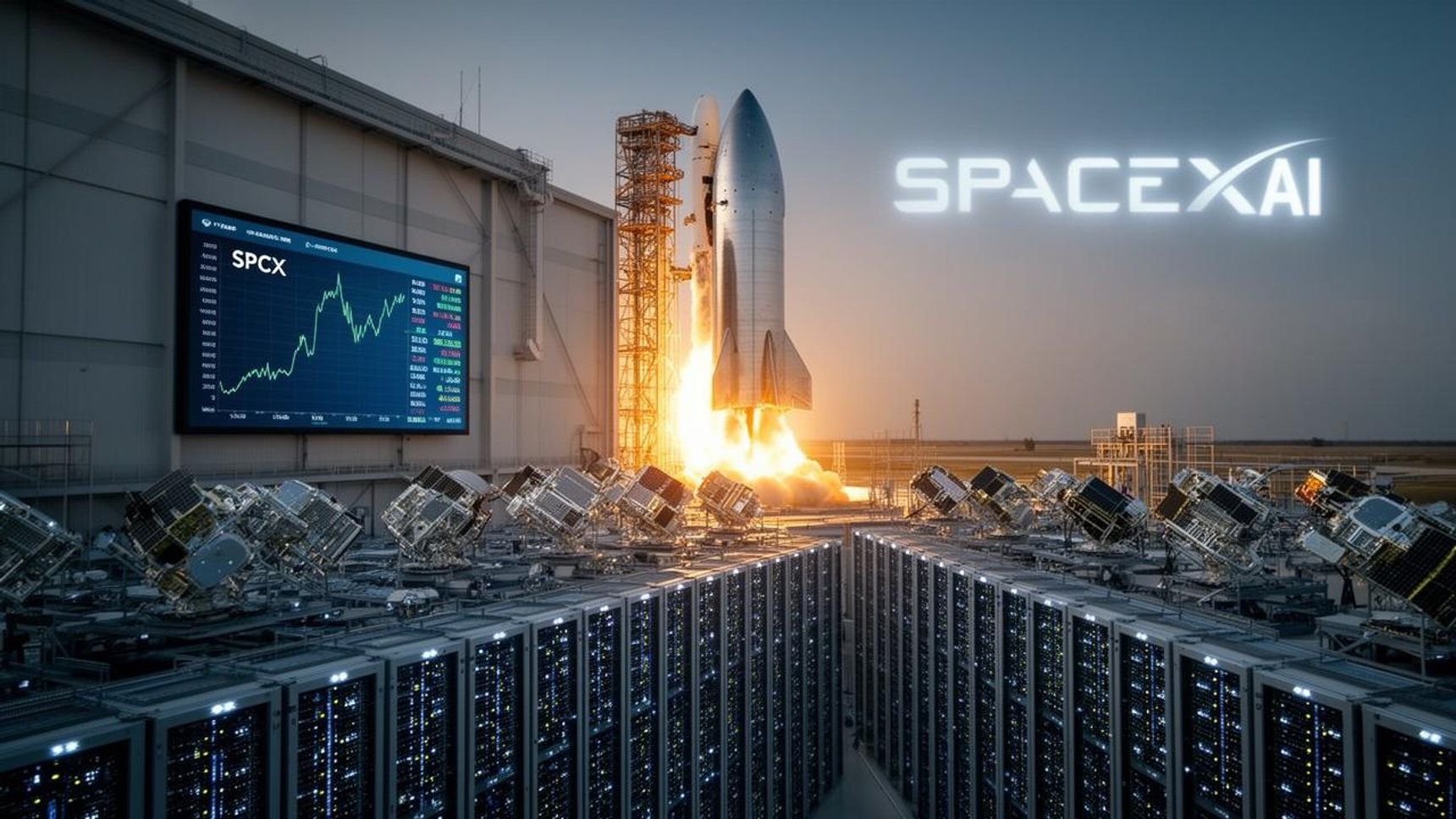
Elon Musk’s artificial intelligence venture has a new name and a new identity. The company formerly known as xAI announced on July 6 that it has officially rebranded to SpaceXAI, completing its absorption into the rocket and satellite giant SpaceX. The change was unveiled through a post on X, the social media platform also owned by Musk, alongside a short animation showing the old xAI logo folding into a redesigned emblem that embeds ‘AI’ within the iconic SpaceX swoosh.
The rebranding marks the final step in a consolidation process that began in February, when SpaceX acquired xAI in an all-stock deal. The transaction brought the Grok chatbot, the X platform, and a sprawling AI infrastructure roadmap under the same corporate umbrella as the world’s most valuable private space company. By dropping the standalone xAI name and adopting the SpaceXAI moniker, Musk is signaling that artificial intelligence is no longer a side project—it is now a core pillar of SpaceX’s long-term strategy.
SpaceX went public in June in the largest initial public offering in history, raising $75 billion at a valuation of approximately $1.77 trillion. The IPO prospectus laid out a total addressable market of $28.5 trillion, with $26.5 trillion of that figure attributed to AI. That dwarfs the company’s traditional space business, pegged at $370 billion, and its connectivity segment, estimated at $1.6 trillion. The filing also revealed that SpaceX’s capital expenditures on AI reached $12.7 billion in 2025—more than three times what it spent on its space and Starlink satellite internet operations combined.
Those numbers underscore why Musk has moved aggressively to fold AI into SpaceX’s identity. During an all-hands meeting in February, he described a future where orbital data centers, powered by the sun and serviced by the company’s Starship rocket, would allow AI computing to scale beyond the physical and regulatory constraints of Earth. “Space is the only way to scale at scale,” Musk wrote on X on July 5, responding to a post about the bottlenecks facing terrestrial data centers, including lawsuits, land disputes, and power-grid limitations.
SpaceX has already begun laying the groundwork for that vision. The company has filed plans with the Federal Communications Commission for up to one million “orbital data center” satellites, operating at altitudes between 500 and 2,000 kilometers. It also unveiled the first-generation AI1 satellite design, a stripped-down platform that relies on solar cells, radiators, and laser links rather than the complex communications antennas found on Starlink hardware. Manufacturing plans include an 11-million-square-foot “Gigasat” facility in Bastrop, Texas, with AI satellite production targeted for late 2027 and an eventual goal of 100 gigawatts of annual space-based AI compute capacity around 2030.
On the ground, SpaceXAI is already monetizing its computing infrastructure. The company has secured major deals with Anthropic and Google, which have agreed to pay $1.25 billion and $920 million per month, respectively, for access to compute power at SpaceX’s Colossus data centers. These agreements provide a revenue stream for a division that remains deeply unprofitable—the AI segment posted a $6.4 billion operating loss in 2025—but which the company describes as having the largest growth potential in human history.
The Grok chatbot, SpaceXAI’s flagship consumer-facing product, is also undergoing a significant overhaul. Musk acknowledged in March that the model was so flawed it needed to be “rebuilt from the foundations up.” Since then, SpaceX has moved to acquire Cursor, an AI coding tool, and has incorporated its data into Grok’s training pipeline. In May, Musk reported that the Grok foundation model V9-Medium, with 1.5 trillion parameters, had completed training and that fine-tuning and reinforcement learning were underway, with a public release expected within weeks.
SegmentAddressable MarketKey DriverAI$26.5 trillionEnterprise applications, AI infrastructure, consumer subscriptionsConnectivity$1.6 trillionStarlink satellite internet, direct-to-cell servicesSpace$370 billionLaunch services, orbital infrastructure
Note: Figures drawn from SpaceX’s IPO prospectus as reported by multiple outlets. The AI addressable market includes enterprise, infrastructure, consumer subscriptions, and advertising revenue streams.
Despite the grand ambitions, SpaceXAI faces significant hurdles. Scientists and astronomers have warned that large satellite constellations could harm astronomy, ecosystems, and air quality. The European Southern Observatory has previously raised concerns about the impact of mega-constellations on ground-based observations. Engineering challenges also remain formidable. Cooling server clusters in the vacuum of space, assembling them at scale, and maintaining reliable operations in orbit are problems that have never been solved at the magnitude SpaceX is proposing.
The financial picture adds another layer of complexity. SpaceX’s stock, which trades under the ticker SPCX on the Nasdaq, closed at $160.42 on July 6, down 1% ahead of its inclusion in the Nasdaq-100 index on July 7. That price still represents a premium to its $150 debut, but the shares have retreated from a high of $225. With a market capitalization of roughly $2.1 trillion and trailing 12-month revenue of $18.7 billion, the stock trades at a price-to-sales ratio of approximately 112. That valuation leaves little room for missteps, and the company’s AI-driven growth story is likely to unfold over years, not quarters.
Wedbush analyst Dan Ives has added another dimension to the speculation surrounding Musk’s corporate empire, putting the odds of a merger between Tesla (TSLA) and SpaceX at more than 80% over the next year. Tesla invested $2 billion in SpaceX earlier in 2026, acquiring nearly 19 million shares. A full combination would create a sprawling platform spanning electric vehicles, robotaxis, humanoid robots, energy storage, satellite internet, and AI infrastructure. Tesla already supplies Megapack batteries and Cybertrucks to SpaceX and xAI, with purchases totaling roughly $650 million in 2025. The two companies are also collaborating on chip fabrication at the Terafab facility in Austin, Texas, and on an early-stage AI platform called Macrohard.
However, a merger would also transfer SpaceX’s substantial losses and capital demands directly onto Tesla’s balance sheet. SpaceX posted a net loss of $4.9 billion in 2025, and its AI division alone consumed $12.7 billion in capital expenditures. Musk controls an estimated 82.4% of SpaceX’s voting power post-IPO and holds a 19.9% stake in Tesla, giving him outsized influence over any potential deal. For Tesla shareholders, the key question is whether the combined entity would generate more value than the two companies could create independently.
For now, the rebranding to SpaceXAI crystallizes the message Musk has been delivering for months: artificial intelligence and space exploration are inseparable pieces of a single, sprawling vision. The new logo is a small change, but it represents a fundamental shift in how the company sees itself—not just as a rocket builder, but as the owner of what it hopes will become the largest AI infrastructure platform ever constructed.