The latest edition of C&EN’s Global Top 50 chemical firms has arrived. Owing to changes to C&EN’s production schedule, it is being published a few weeks earlier than it has in past years.
The effort takes about 2 months to pull together, with the last 2 weeks a blitz of double- and triple-checking, and editing. There are too many people who contributed to the project to acknowledge them all here individually.
As I do every year, I wrote all 50 the summaries of the goings-on at companies over the past year—internally, we call them capsules. Putting them together gives me insight into the themes that are important to the chemical industry. In previous years, the vital issues were investment and sustainability initiatives, but what currently preoccupies chemical firms is managing through a long and severe industry downturn. Firms are reducing production and divesting businesses in an effort to streamline.
Of course, another concern is globalization. Chinese companies hold as many places on the list—nine—as US firms. And this year sees the addition of a second African firm, the Morocco-based phosphate fertilizer maker OCP.
We hope you find this industry snapshot as illuminating to read as we did to write and edit.
Send any questions, comments, or tips to me, senior correspondent Alex Tullo, at a_tullo@acs.org.
Top stories from C&EN

A closeup of a tank holding liquefied hydrogen.
The Louisiana project is just Air Products’ latest cancelation in low-carbon hydrogen production.
Credit:
Air Products and Chemicals
Business in brief
Methanex idles Trinidad plant because of gas supply
The Canadian methanol producer Methanex plans to idle its Titan methanol plant in Trinidad and Tobago after failing to come to terms with the country’s national gas company on a new contract for natural gas feedstock. Methanex will preserve the plant, which has 860,000 metric tons per year of capacity, in the event that it will be able to secure feedstocks in the future. Trinidad, which has attracted export-oriented methanol, nitrogen fertilizer, and liquefied natural gas companies that depend on natural gas, has been struggling to maintain natural gas production. According to S&P, its output has declined by more than a third from its peak in 2010. The National Gas Company of Trinidad and Tobago (NGC) says it offered Methanex the same volumes of gas but maintains that Methanex demanded lower prices than its previous contract. NGC says the prices Methanex wanted would have been below its acquisition costs for the gas. The fertilizer maker Nutrien shut down an ammonia and urea complex in Trinidad late last year and is considering selling the unit.
—Alex Tullo
Bayer to carve out US glyphosate business

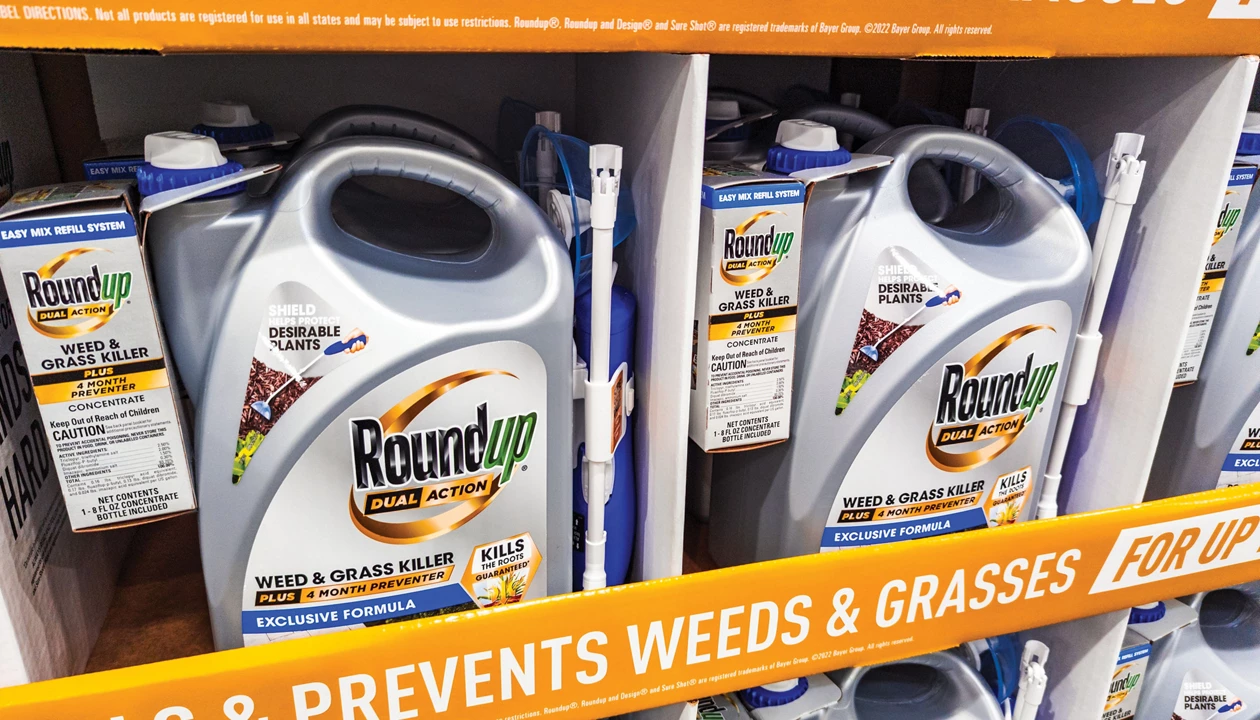
A display of containers of Roundup weed killer on a store shelf.
Bayer is carving out its US glyphosate business, long the basis of its Roundup herbicides, though not currently used in consumer formulations, into a new company.
Credit:
Shutterstock
Bayer plans to carve out its US glyphosate business into an entity called Ruveon, based in Saint Louis. It says the move is part of a 5-year framework aimed at making the German group’s crop protection businesses more resilient and profitable. The firm announced the carveout days after it scored a legal victory in the long-running dispute over the lack of a cancer warning on its glyphosate-based Roundup herbicide. “Ruveon’s launch is a sign of our ongoing commitment to excellence in the glyphosate market,” Brian Naber, Bayer’s head of crop science for North America, Australia, and New Zealand, says in a statement.
—Vanessa Zainzinger
Tessenderlo to buy 20% of FMC
The Belgian industrial conglomerate Tessenderlo Group is investing $400 million in the US agrochemical maker FMC. The deal will forestall FMC from putting itself up for sale, an option that it has been weighing since February. The investment will give Tessenderlo a 20% stake in FMC. Agrochemicals comprise about a third of Tessenderlo’s sales. While FMC has been weighing its strategic options, it has also been trying to raise $1 billion to reduce its high debt burden. To this end, the company has agreed to sell its business in India for about $250 million. It also entered a licensing agreement with Corteva that earned it an up-front payment of $200 million and sold property in Delaware for $100 million.
—Alex Tullo
Yara to buy Gulf Coast ammonia plant
The Norwegian fertilizer maker Yara has agreed to purchase Gulf Coast Ammonia, a new ammonia plant that is starting up in Texas City, from GCA Holdings for $1.3 billion. Yara aims to ramp up the plant’s output to beyond its nameplate annual capacity of 1.3 million metric tons by year-end; the plant will allow Yara to take advantage of low natural gas costs in the US. Yara will source hydrogen and nitrogen feedstocks for the operation from Air Products and Chemicals, which built a $500 million steam methane reformer for the facility. Air Products recently canceled a low-carbon hydrogen plant in Louisiana. Yara had been considering signing on to purchase hydrogen from that project to produce ammonia.
—Alex Tullo
Greenland rejects rare earth mining license
The government of Greenland will not extend the exploration license for Energy Transition Minerals’ Kvanefjeld rare earth mining project in southern Greenland. In a press release, Greenland’s mineral regulator says it rejected the extension because further exploration in the area is not likely to lead to the discovery of deposits that can be exploited in accordance with the country’s Uranium Act, which bans uranium mining. Rare earth elements are often found in association with uranium, a by-product that is challenging for mining firms to manage. Energy Transition Minerals says that its most recent exploration results show zones that have low levels of uranium but that the government didn’t consider those results. The company calls the decision unfair and says it is working with legal advisers to investigate all options. The mining rights will not be reassigned until the matter is resolved.
—Matt Blois
Mitsubishi Gas Chemical teams up with Gold Hydrogen for H2 to methanol
Mitsubishi Gas Chemical (MGC) has signed a deal with the geological hydrogen start-up Gold Hydrogen in which the firms will try to build a facility in Australia that converts naturally occurring hydrogen into low-carbon methanol. Gold Hydrogen has been developing its Ramsay Project in the Yorke Peninsula, a series of wells that the company has shown to contain high levels of naturally occurring molecular hydrogen and economically useful quantities of helium. Meanwhile, MGC is expanding its Carbopath platform that makes methanol from various combinations of CO2, H2, and syngas made from waste gasification. The methanol could be used to decarbonize chemical production and ship fuel. As part of the deal, MCG also invested an undisclosed sum in Gold Hydrogen.
—Craig Bettenhausen
Covestro completes purchase of Vencorex isocyanate sites

A Covestro sign in front of a plant in Thailand. A white building with a blue awning is on the left, and two of the nation’s flags fly on poles in the background.
Covestro’s hexamethylene diisocyanate derivatives production site in Rayong, Thailand
Credit:
Covestro
Almost a year after announcing the deal, Covestro has completed its purchase of two plants from the bankrupt specialty chemical maker Vencorex. The plants, in Thailand and Texas, produce derivatives of hexamethylene diisocyanate (HDI). Unlike aromatic isocyanates used to create polyurethane foam, these aliphatic isocyanates find use in polyurethane coatings, adhesives, and sealants. Covestro says it already makes such products in China, Germany, India, and the US. In a press release, the company says the purchase complements its 2021 buy of DSM’s coating resins business for about $1.8 billion.
—Michael McCoy
Quote of the week
“Compared to prior cycles, where M&A was often driven by growth expectations, today’s deals are more focused on resilience and strategic positioning through the cycle rather than near-term expansion.”
Federico Mennella, managing director for industrial, DC Advisory, in an email to C&EN
Anthropic launches Claude Science for researchers
The artificial intelligence company Anthropic has launched Claude Science, an agentic AI application geared toward researchers. The application integrates popular research tools such as PubMed, Jupyter, and R into its latest model, Sonnet 5, allowing human researchers to access quick literature analysis and execute multistep research, among other tasks. “Every output carries an auditable history of how it was made, so you can validate and reproduce the results,” Anthropic says in a press release. The firm says that during the app’s beta testing, researchers used the platform to conduct tasks such as single-cell RNA sequencing analysis, CRISPR screen design, protein structure prediction, and cheminformatics. During the platform’s launch, Anthropic said that it would start its own drug discovery program focused on neglected diseases, STAT reports.
—Aayushi Pratap
Lonza strikes deals with US companies
The Swiss drug services firm Lonza has acquired rights to a technology that enables the delivery of therapeutics across the blood-brain barrier (BBB) from Nona Biosciences, a US-based biotech company. The BBB naturally restricts the delivery of biologics across the central nervous system, but Nona says its platform enables efficient delivery into the brain. Under the agreement, Lonza will deploy the technology for its clients developing central nervous system therapies. “The relationship is rooted in a prior research collaboration between the two companies that has validated Nona’s BBB-crossing technology,” Lonza says in a press release. The company will also continue to work with Nona to advance future BBB delivery solutions. Separately, Lonza has expanded its collaboration with what it calls a leading US-based biopharmaceutical company. As part of the deal, Lonza will produce two commercial-stage biologics for the unnamed firm.
—Aayushi Pratap
AstraZeneca, CSPC further research partnership for kidney siRNA
AstraZeneca has signed a deal for $30 million up front with the Chinese company CSPC Pharmaceutical, according to an announcement (PDF) from CSPC. The two companies will use CSPC’s tools for designing small interfering RNA (siRNA) and delivering RNA medicines to tissues beyond the liver to pursue two targets they say are of interest in multiple kidney diseases. The deal furthers the firms’ existing partnership. AstraZeneca licensed a small-molecule drug candidate for heart disease from CSPC in 2024; last June, they teamed up on oral treatments for chronic disease; and this January, AstraZeneca committed up to $18.5 billion for eight CSPC assets in weight loss and diabetes. Kidney disease is an important therapeutic area for AstraZeneca. Farxiga, which is the company’s top selling drug, is approved for chronic kidney disease among other indications. The firm also sells a treatment for a potassium imbalance that can result from advanced kidney disease and is awaiting a decision from the US Food and Drug Administration on a drug candidate to treat the autoimmune kidney disease IgA nephropathy. In the current deal, CSPC could be paid up to $1.7 billion for development and sales milestones.
—Laurel Oldach
Ipsen snatches up 2 biotech companies
Ipsen, a French pharmaceutical firm, has inked back-to-back acquisition deals. On June 29, it agreed to acquire Kartos Therapeutics, a biotechnology firm developing an oral blood cancer drug candidate called navtemadlin, for $450.0 million up front and potentially another $1.3 billion in milestone payments. Days later, on July 1, Ipsen announced it will acquire the Swiss biotech Memo Therapeutics, which is developing an antibody to treat BK polyomavirus, a pathogen that can cause serious infections in people who receive kidney transplants. Ipsen will pay about $229 million and could pay another $570 million in milestone fees.
—Rowan Walrath
Novartis to acquire ADC firm Myricx Bio
The pharma giant Novartis will acquire Myricx Bio and its antibody-drug conjugates (ADCs), which inhibit N-myristoyltransferase, a critical enzyme for cancer cell growth and survival. The firm’s main assets target B7-H3 and HER2. Novartis will pay $1.1 billion up front and potentially up to $400 million for milestones. Last week, Novartis inked a $1.9 billion partnership with Antares Therapeutics to develop small-molecule oncology therapies; in March, it agreed to pay $2.0 billion to license Synnovation’s PI3Kα inhibitors.
—Sarah Braner
PureTech Health spinout Celea raises $180 million
Celea Therapeutics has completed a $180 million funding round. The money will go toward starting a Phase 3 trial for its drug candidate deupirfenidone, a deuterated form of the drug pirfenidone, as a treatment for idiopathic pulmonary fibrosis (IPF). The firm aims to start the trial this quarter. Leaps by Bayer contributed to the funding round, as did an undisclosed “leading sovereign wealth fund,” according to a press release. Celea spun out of PureTech Health in 2025, betting that a more tolerable version of pirfenidone, an approved drug for IPF, could capture more of the market. Deuterating pirfenidone is supposed to slow the process of metabolizing it, thus making it safer.
—Sarah Braner
Vertex to buy Crinetics for $10 billion
Vertex Pharmaceuticals has agreed to buy the endocrinology biotechnology firm Crinetics Pharmaceuticals for $85.00 per share, or $10 billion in total. Since starting with a focus on treating cystic fibrosis, Vertex has expanded into other therapeutic areas, in part through strategic acquisitions. The latest deal, Vertex’s largest to date, gives the company a fifth area of focus: Crinetics brings with it Palsonify (paltusotine), a small-molecule drug for treating the growth hormone–related disorder acromegaly, and a development pipeline of other endocrinology treatments.
—Laura Howes
What we’re reading