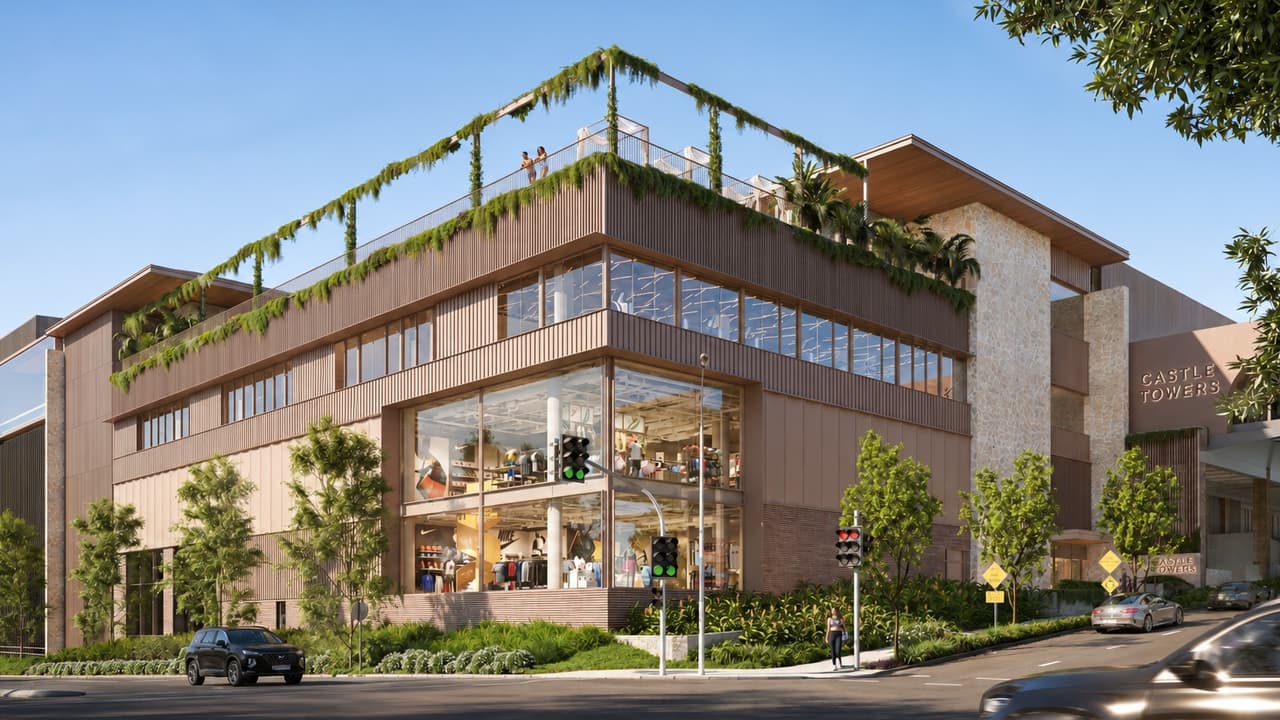
Fund manager QIC is backing the resilience of retail property despite tougher times for key tenants, pledging a $600m revamp of Castle Towers Shopping Centre in Sydney’s Hills District.
While the retail sector has been hit by poor trading since the outbreak of the Iran war in February, the Albanese government’s federal budget in May and a deteriorating environment since July, QIC is betting on an expansion, partly due to the shortage of new centres.
Big retailers that are under pressure include Myer, after the department store posted the second-worst loss in its 126-year history. Other national retail chains Country Road, Mimco, Witchery, Kathmandu, Tarocash and rival department store owner David Jones have reported tough trading conditions.
QIC managing director of real estate Deborah Coakley said the strength of retailer demand for space showed the broader nature of shopping centre tenants.
“We’re seeing some very strong resilience in consumer spending, particularly when you consider that retail centres are no longer just places for fashion,” she said. QIC is banking on a blend of discretionary and non-discretionary spending across lifestyle, wellness and health uses in the centre.
QIC hopes to capitalise on the centre’s connection to Sydney’s metro network and expand its lifestyle and service products. It is moving at a time when trades may become more available as residential projects slow down.
Works will begin in October on the first major phase of the broader Castle Towers mixed-use scheme, when about 30,000sq m of space will be transformed across four levels. A 6000sq m rooftop health and wellness precinct, billed as the largest of its kind in Sydney, is also to be opened. The work is due to be completed in late 2029.
QIC said it has a strong conviction in Sydney’s Hills District and the long-term potential of Castle Towers. It plans to widen the centre’s retailing across fresh food, fashion, sport, premium and Australian designer labels, dining and lifestyle, alongside a new Gold Class experience by Event Cinemas.
The proposed rooftop health and wellness section will introduce a health club concept focusing on wellness, fitness and recovery.
Other players are upgrading their centres; Scentre Group is spending $240m expanding an upper level of its flagship Westfield Bondi in Sydney.
In the case of Castle Towers, QIC wants to broaden the centre’s category mix and extend its relevance more into the night-time economy. The move is aimed at locking in Castle Towers’ role as a higher-frequency destination for daily life, and support its shift to become a more active day-to-night destination.
The overhaul will boost the mall’s presence in fresh food, fashion, sport, footwear and lifestyle, adding to its design precinct, forthcoming lifestyle precinct and established premium retail section.
QIC is already repurposing existing space such as where David Jones departed, into a two-level fashion and lifestyle hub, drawing new brands JD Sports, Lululemon, LSKD and City Beach, alongside refreshed Nike, Universal Store and Kookai.
Ms Coakley is bullish about the complex and says construction costs can be contained. “Retail space of this quality, scale and connectivity is increasingly difficult to create in established metropolitan markets, and retailer demand for Castle Towers has been exceptionally strong,” she said.
QIC’s footprint in the area extends beyond the centre and it had previously flagged plans to create as many as 22 buildings ranging from two to 36 storeys atop and around Castle Towers over coming decades. The first stages are being planned.
“We are running a process at the moment talking to residential developers about approximately 1400 new homes (with) a mixed use high density precinct-style approach, which would really start to coincide with the development of the centre itself,” Ms Coakley said.
 Ben WilmotCommercial Property Editor