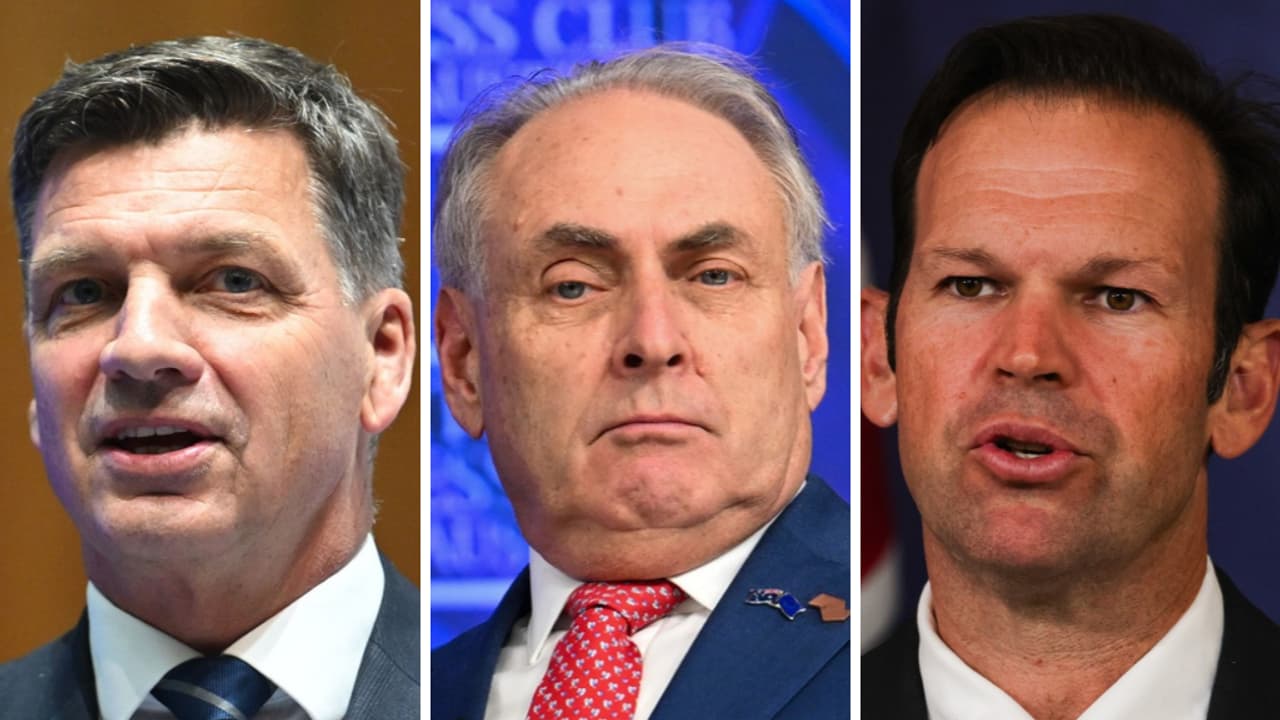
Trade Minister Don Farrell has issued a formal request for the Coalition to hold constructive talks on the EU free-trade agreement and drop political point scoring on the issue, arguing that rejecting the deal for political purposes would “significantly damage Australia’s reputation and place in the world”.
In a letter sent to opposition foreign affairs spokesman Ted O’Brien last week, Senator Farrell took aim at the approach taken by the Coalition on the issue by declaring Australians expect their political representatives to act in the national interest rather than “simply seek headlines”.
The Australian has been told Mr O’Brien is yet to respond to the letter, with the Coalition’s opposition to the FTA causing unease in Angus Taylor’s ranks as several Liberal senators consider crossing the floor to back it.
“Given the current opposition have yet to engage on the content of the agreement itself … I again invite you and shadow minister (Matt) Canavan to reconsider and engage constructively,” Senator Farrell wrote, according to a copy of the letter seen by The Australian.
Senator Farrell told The Australian the deal could lead to more European investment in West Australian rare earths developer Arafura, after the company this year received an $84m equity injection from a German-government fund.
“Our trade deal with the EU deal will make Australia a more attractive investment destination for EU companies, bringing more capital to our resources projects,” he said.
“It removes tariffs on Australian critical minerals, opening up major export opportunities for Australian miners.
“This deal will facilitate more investment and export opportunities for projects like Arafura, which will make a huge contribution to global supply chains, and support thousands of Australian jobs.”
Mr O’Brien told The Australian Senator Farrell’s letter was sent in response to his own to Foreign Minister Penny Wong, proposing a side letter to the FTA for both parties to agree that there would be no penalties on Australian companies for failing to meet the Albanese government’s climate targets.
Mr O’Brien’s proposed side letter also sought agreement that a future Australian government would not be in breach of the FTA if it implemented new domestic policies that altered the nation’s emissions profile.
“Unfortunately, Senator Farrell’s letter failed to address my proposal at all,” Mr O’Brien said.
“I continue to engage constructively (as) evidenced by me putting forward a pathway to address climate issues.”
Senator Canavan said he had offered to meet Senator Farrell last week but the two could not agree on a time.
“I am happy to meet Don any time. I offered to meet last week, but times didn’t work out. My door remains open as always,” Senator Canavan said.
The Australian revealed over the weekend that Liberal senator Andrew McLachlan had committed to crossing the floor to vote in favour of the legislation to ratify the deal, while this is also being considered by Tasmanian senator Richard Colbeck and Queensland senator Paul Scarr.
The deal is expected to pass parliament with the Greens’ backing, but this is not guaranteed and Senator Farrell is working on securing enough votes in the Senate in case the left-wing party baulks.
Labor needs nine extra votes to pass legislation in the Senate, with Liberal senators crossing the floor being a potentially decisive factor if it is opposed by both the Coalition and the Greens.
One Nation is considering delivering its four votes in favour of the deal, while an extra vote would be given by United Australia Party senator Ralph Babet.
Labor wants the Coalition to show bipartisan support for the agreement to guarantee it will survive beyond a change in government.
The biggest issue for the Coalition is the climate provisions in chapter 18 of the agreement, with the parties agreeing to effectively implement the Paris agreement, pursue net zero and reach interim emission-reduction targets.
Senator Canavan has also accused the government of securing no extra market access for the agriculture sector, compared to the agreement rejected by Senator Farrell in 2023.
The exact terms of the deal are subject to commercial-in-confidence agreements, but Senator Farrell said Australia had secured a better deal for the agriculture sector under the agreement compared to what was rejected in 2023.
“We got more and we gave less,” he said.