
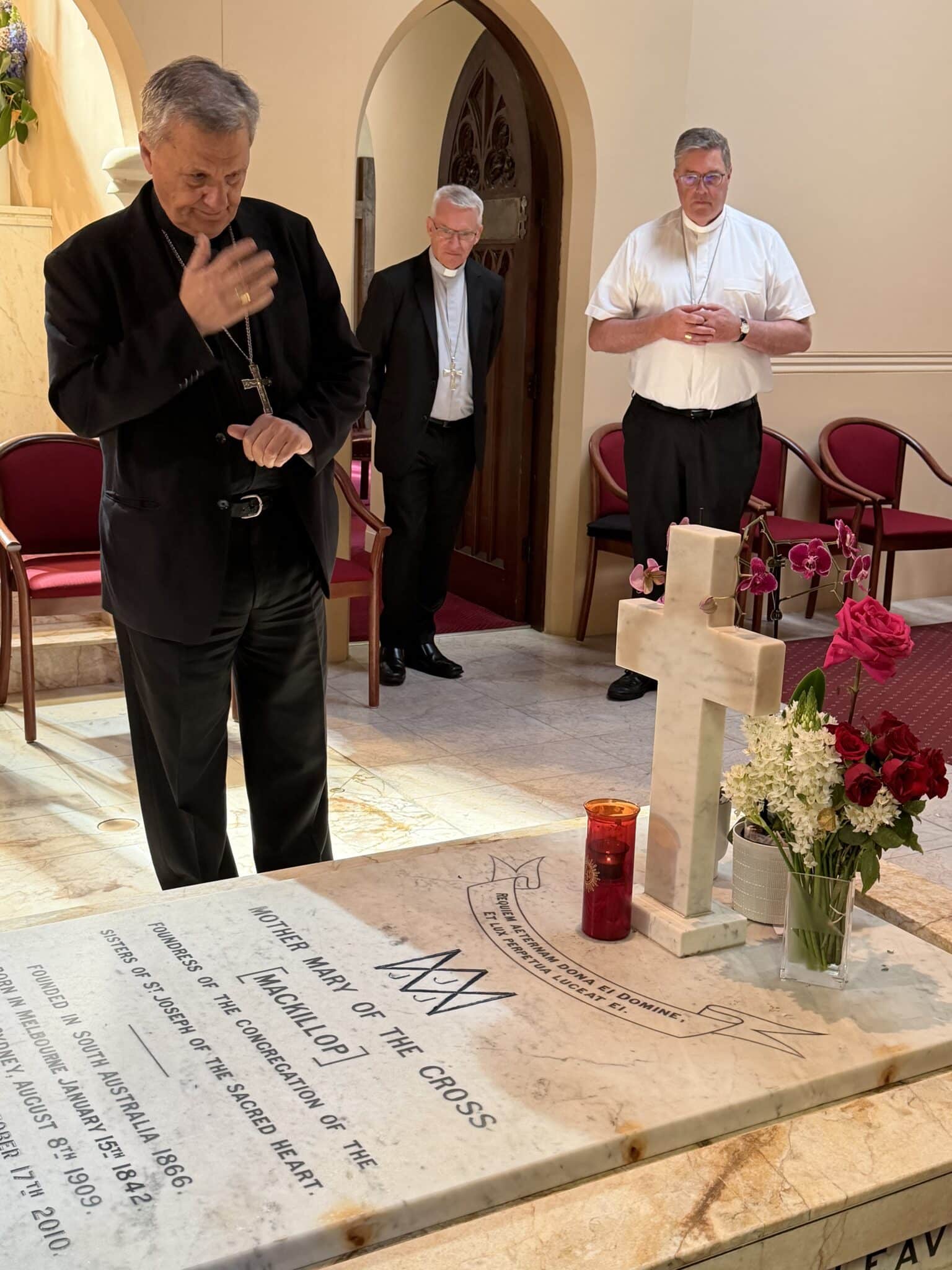
 Cardinal Mario Grech at the tomb of St Mary of the Cross MacKillop. Photo: Paul Osborne/Australian Catholic Bishops Conference.
Cardinal Mario Grech has praised Australia’s Plenary Council as a landmark for the global church and urged Sydney Catholics to embrace the joy of the Gospel and a renewed sense of mission.
The Secretary General of the Synod of Bishops addressed Australian bishops in Sydney on 6 November during a national visit bringing together church leaders, academics, students and parish communities.
His Sydney engagements included receiving an honorary Doctorate of Divinity from the University of Notre Dame Australia in St Mary’s Cathedral crypt on 6 November, and celebrating Solemn Mass at the cathedral on 8 November.
About 1100 people attended the Mass, including a strong contingent from the Maltese-Australian community.
In his homily, he urged Catholics to ensure their liturgies conveyed the joy of the Gospel and to embrace synodality as a path towards renewed mission.
Recalling a young woman’s observation that nobody seemed to smile at a carefully prepared first Mass he once attended, he asked whether worship communicated the hope of resurrection and the beauty of encountering Christ.
He stressed this was not about turning liturgy into an emotional experience or measuring faith by smiles.
“Are we simply maintaining what we have inherited, or are we living with a renewed sense of mission?” he asked.
Cardinal Grech linked Sydney’s synodal priorities of enriching liturgy, building Christ-centred communities and strengthening mission to the need for renewed Christian hope.
He warned against becoming preoccupied with protecting institutions and preserving structures while losing the courage to proclaim the Gospel.
“Fidelity to the gospel does not mean remaining motionless,” he said.
“It means remaining attentive to the living God, who continues to speak to his church, to us, and to guide us along the path of conversion.”
Emphasising that “synodality is for mission”, he said walking together involved listening to the Holy Spirit and becoming more faithful witnesses to the risen Christ.
“There can therefore be no mere spectators in the life and mission of the church,” he said.
He thanked Archbishop Anthony Fisher OP and those contributing to Sydney’s synodal journey, praying that the Holy Spirit would renew the church as it prepared to host the International Eucharistic Congress in 2028.
Before addressing the final day of the bishops’ Spring plenary, Cardinal Grech prayed at the North Sydney tomb of St Mary of the Cross MacKillop.
He told the bishops the next phase of the international synodal process must strengthen the church’s mission rather than simply generate more paperwork.
“The primary aim is not to produce new documents – we have had enough,” he said.
“Rather, it is to encourage a circulation of gifts that strengthen communion and supports mission.”
Asked about Australia’s Plenary Council decrees, Cardinal Grech said he shared concerns about the time being taken for their recognition.
However, Australia’s experience was already attracting interest from local churches overseas, he added.
“There are many who are asking how the Australians managed to celebrate the Plenary Council,” he said.
“There are already fruits, although you have not received the reply from Rome.
“It is already a landmark for the whole church.”
Cardinal Grech stressed the importance of listening across cultural differences, describing every local church as a “laboratory of the Spirit” where the Gospel becomes incarnate.
“The Gospel doesn’t diminish their cultures – every culture is, in principle, compatible with the Christian message,” he said.
Reflecting on the past five years, he said the movements of the Holy Spirit were evident and offered hope.
He also welcomed the interest shown by ecumenical partners.
Each diocese is expected to hold an evaluation assembly in 2027, followed by national and continental gatherings in late 2027 and early 2028 ahead of an ecclesial assembly in Rome.
Hosted by Notre Dame’s Global Centre for Catholic Leaders, the cardinal’s Australian program runs from 3–13 November, with engagements in Melbourne, Sydney, Fremantle and Broome.
A Fremantle forum on 9 November examines dialogue and social cohesion, including how respectful engagement can strengthen communities amid growing division.
The Broome leg will include participation in celebrations marking the diocese’s 60th anniversary, extending the visit’s focus on listening and shared mission to the Kimberley’s Catholic communities.