
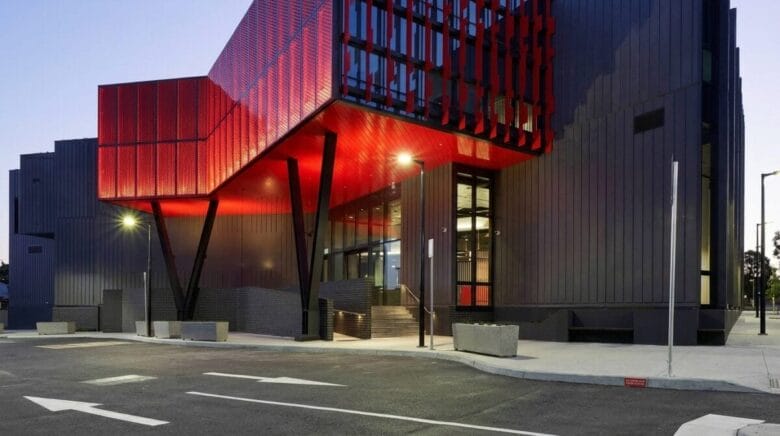
The expansion of a Melbourne campus has been delayed by issues securing additional power (Image: NextDC)
Australian data centre operator NextDC has frozen development of new projects near residential areas and may sell sites it no longer plans to build on, after community opposition to power line works stalled the expansion of one of its Melbourne campuses.
The Brisbane-based company said in an ASX release on Friday that uncontracted development projects, including at sites in Melbourne, Sydney, the Gold Coast and Auckland, and new land acquisitions remain on hold. Apart from development sites near homes that it no longer intends to develop, NextDC said it does not expect to sell sites in the near term, and that no decision has been made on any sale.
The retreat by Australia’s biggest listed data centre operator shows how resistance from neighbours has become a constraint on the AI infrastructure boom. In the US, at least 120 data centre projects worth around $198 billion were blocked or delayed by local opposition in the first half of 2026, according to research group Data Center Watch, while in Sydney, Goodman Group and Blackstone-controlled AirTrunk have both dropped projects after residents objected.
“We acknowledge there’s growing community opposition to data centres in Australia and worldwide,” chairman Douglas Flynn told shareholders at the company’s annual meeting. “NextDC only builds data centres on land zoned as industrial. Given community sensitivities we do not intend to pursue new development opportunities that are near residential properties.”
Pipeline on Hold
NextDC did not identify which of its sites are near housing. The company said it will commit new capital on an individual project basis in the future, and only when it has customer contracts for a new development, expected returns above its cost of capital, sufficiently advanced power and planning approvals, and funding in place.

NextDC chief executive and managing director Craig Scroggie (Image: NextDC)
The paused projects include M4 in Melbourne’s Fishermans Bend precinct, which won state approval in January as a 150-megawatt campus with a planned investment of A$2 billion ($1.4 billion). They also include S7 at Eastern Creek in western Sydney and M5, which NextDC’s August results presentation lists as a Melbourne site targeting 1.2 gigawatts, without disclosing its location.
Among the paused sites, S5 at Macquarie Park in Sydney has drawn objections over its proximity to housing. In a 2024 submission to state planners, the City of Ryde council objected to the project, saying the site is close to existing and proposed housing on Lane Cove Road. NextDC has not said whether S5 is among the sites it no longer intends to develop.
The company is also evaluating a joint venture structure for its S4 Sydney campus, where 250 megawatts of the planned 365 megawatts of IT load is contracted and a first 115-megawatt phase is under construction. Chief executive Craig Scroggie told shareholders the company is constrained by its ability to deliver projects, rather than by demand.
“In the past we relied on formal council and state planning processes to set the standard and own the conversation with the community,” he said. “That is no longer enough. We will now engage earlier and directly, alongside our power and construction partners.”
Power Line Standoff
Community opposition to power upgrades at the company’s M3 project, which is located just 10 kilometres from central Melbourne in West Footscray, caused a delay that forced NextDC to cut its guidance in October, sparking a sell-off that wiped about A$3 billion from the company’s market value. The company’s shares have staged a partial rebound from their October low, but remain down about 27 percent this year.
Residents raised concerns about the size of new power poles being installed by utility Jemena, which suspended the works citing safety concerns and a lack of site access. The M3 campus sits 15 metres from homes, according to the ABC.
NextDC said it is working with Jemena on alternative power routes through industrial streets and underground, alternative substations, upgrades to existing feeders and broader grid options. The Victorian government’s planning decision on M3’s final two stages is expected to resume after the state election on 28 November.
Investor Pressure
Scroggie agreed last month to give up his fiscal 2027 bonuses, and non-executive directors cut their fees by 10 percent. Shareholders still voted 72 percent against NextDC’s remuneration report at Friday’s annual meeting, but rejected a resolution that would have forced directors to stand for re-election, with 96 percent voting against, according to the meeting results.
The turmoil at NextDC has drawn the interest of two rivals. A vehicle owned equally by Goodman Group and Digital Realty bought 75.2 million NextDC shares between 3 and 6 November through an aftermarket book build open only to institutional investors, or about a 9.9 percent stake. At the average price of A$9.22 a share, that’s about A$693.5 million, according to a Mingtiandi calculation.
In a joint statement, Goodman and Digital Realty said neither has any present intention of making a takeover offer, but both reserved the right to do so. NextDC’s board called the purchase opportunistic, and said it had received no formal communication from either company.
Rules Tighten
Australia’s state governments are moving to restrict where data centres can be built. Victoria’s Labor government has announced regulations including a ban on facilities near homes and schools, and both major parties have pledged ahead of Saturday’s election that new facilities will not be built near homes. Critics note the rules would not apply to projects already being assessed.
In New South Wales, an upper house committee on 5 November published 26 recommendations for data centre development, including a public register of facilities. National Cabinet agreed in August to develop mandatory national standards for large data centres, with the Commonwealth committing to legislate in early 2027.
Opposition has already cost developers projects. Goodman’s Project Mars in Lane Cove West drew 374 public submissions, only nine of them supportive, before the developer withdrew its application in September. AirTrunk also scrapped a Sydney data centre in the same suburb.
Investors have cooled as well. In October, data centre operator Firmus pulled its blockbuster ASX float after weak investor demand amid concerns about its debt, saying it would pursue private funding instead.
Guidance Edges Up
NextDC now expects fiscal 2027 net revenue of A$485 million to A$500 million, up from its October forecast of A$475 million to A$500 million, and underlying EBITDA of A$260 million to A$275 million, up from A$245 million to A$265 million.
The upgrade recovers only a sliver of the ground lost in October. At its midpoint, the new EBITDA range is about 33 percent below the A$385 million to A$410 million that NextDC forecast in August, according to a Mingtiandi calculation.
The company reaffirmed capital expenditure guidance of A$4.5 billion to A$5 billion, most of which will go to existing contracts at S4 in Sydney, at M2 and M3 in Melbourne, and at KL1 in Kuala Lumpur.