
Beneath the surface of Sydney Harbour, one of the most important ecosystems on the planet is disappearing, and most of us have been swimming over it for years without a second thought.
Posidonia australis, a slow-growing seagrass found in the shallows of the harbour and Pittwater, is now officially endangered – pushed to the brink by decades of dredging, poor water quality and thousands of boat moorings gouging the seabed.
 Seagrass in Sydney Harbour. Photo: Supplied by SIMS
A team of scientists at the Sydney Institute of Marine Science (SIMS) is not waiting for it to disappear.
Through a program called Project Restore, they are replanting it by hand, one storm-washed shoot at a time.
Tia Bool, Project Restore Research Assistant and Engagement Officer said: “We have planted just over 7000 shoots, which is huge.”
 Dr Francisco Martinez-Baena and Tia Bool at SIMS. Photo: Harriet Thornton
Posidonia australis is protected under both NSW and federal law, meaning scientists cannot harvest it from existing meadows, including the one close to home at Quarantine Beach in Manly.
Instead, the team relies entirely on fragments that have naturally broken off and washed ashore, and that is where the community comes in.
“After big storm events, we rely on community members to go out and walk up and down the beaches collecting these shoots,” said Bool.
 Tom Burd and Tia Bool collecting seagrass fragments up at Pittwater. Photo: Supplied by SIMS
Palm Beach is home to one collection site, allowing volunteers to walk the shorelines and leave collected fragments in bags suspended in the water, ready for the SIMS team to retrieve.
“Right near the Joey restaurant, on Station Beach, we have a system set up where people can do their walk, collect the shoots, and then they put them in these bags attached to a line,” said Bool.
“They sit in the water, nice and fresh for us, until we go up and collect them.”
Once collected, the fragments spend three days in quarantine to ensure nothing foreign enters Sydney Harbour. Then the real work begins.
Each fragment must be carefully and regularly cleaned of any algae or debris that would block sunlight and inhibit growth.
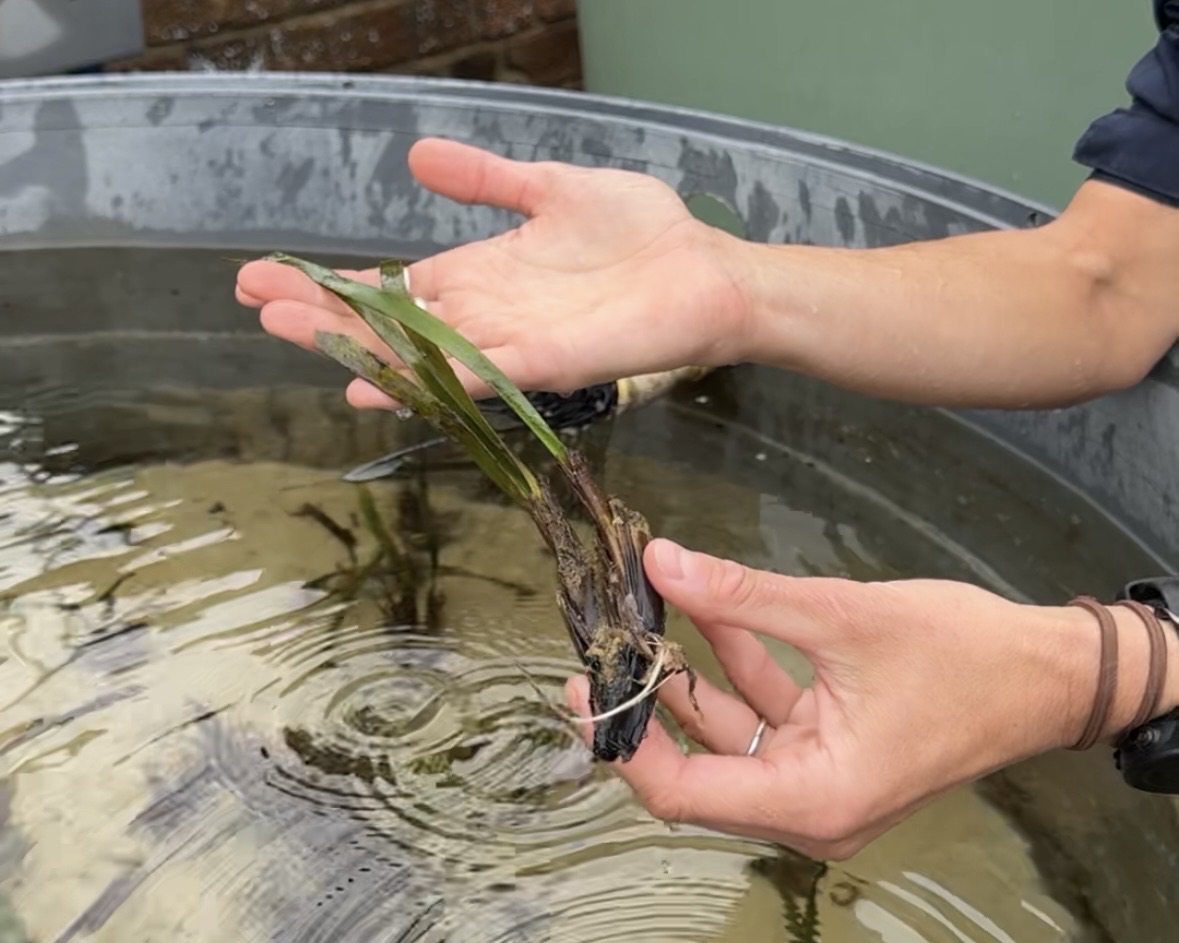 One seagrass fragment. Photo: Harriet Thornton
“The process requires a lot of hands-on care.
“We have a number of people whose role is literally to clean the shoots.”
One of the most destructive human impacts is the traffic on the water, specifically the mooring and anchoring of boats.
There are more than 6000 boat moorings in Sydney Harbour, and almost all use the same outdated design: a heavy chain leading from a concrete block on the seabed to a surface buoy.
“One of the biggest impacts on seagrass is actually traditional swing moorings,” said Bool.
 Traditional moorings cause scars on the seafloor. Photo: Supplied by SIMS
“The swinging from the moorings in the currents and wind create what we call mooring scars.
“In these areas where seagrass once flourished, we start to see these big rings where it is just bare sand and bare sediment.
“Over the years, the seagrass has just been ripped out.”
To help the boating community and Posidonia australis thrive side by side, the SIMS team have been installing Environmentally Friendly Moorings (EFMs) with funding from the NSW Environmental Trust.
Ten have already been replaced at Balmoral Beach, costing around $4000 each.
EFMs are neutrally buoyant and secured with a low-impact screw piling system, leaving a fraction of the footprint of a traditional mooring, small enough that seagrass fragments can be planted directly beneath them.
Steven Hedge, Owner of Balmoral Boatshed, said: “When we were approached by the scientists at SIMS we were sceptical about what role we could play in Posidonia protection and re-growth, yet excited about the idea of being able to make a significant contribution to improving the ecology of our seabed and the harbour in general.”
“This project enables meaningful collaboration between the boating public, scientists and commercial interests on our precious waterways.”
 The new design allows seagrass to grow beneath it. Photo: Operation Posidonia
EFMs are often described as new technology, but there is nothing new about them.
Queensland and countries across Europe and the Mediterranean have been using them successfully for years.
For a city whose waterways rank almost the busiest in the world, NSW is surprisingly late to adopt them.
Alongside EFMs, courtesy moorings are another piece of the puzzle.
Acting like designated parking spaces on the water, they allow vessels to secure safely without dropping anchor – but during the busy summer months, there simply are not enough of them.
Dr Francisco Martinez-Baena, Project Restore Project Manager at SIMS said: “By anchoring in an area where there are some seagrasses, we can just destroy it in a matter of seconds, growth that has happened for decades.”
“These seagrasses are incredibly important for us, not only as a nursery for fish, but they also store huge amounts of carbon.
“As plants, they are taking CO2 from the water and the atmosphere and storing it underneath in the sediments, to levels even higher than rainforests.
“They also create these really huge root systems in the water.
“They protect our beaches from erosion, something we are seeing so much of on the Northern Beaches.”
 Planting of fragments under the new EFMs. Photo: Supplied by SIMS
The work at SIMS does not just require shoots being planted by hand.
For the past three years, the team has also battled significant red tape, as restoration projects currently face a similar approval process as building a jetty.
Streamlining that pathway is something SIMS is actively working with government to change.
“The main issue with recovery is that they cannot recover by themselves,” said Dr Martinez-Baena.
“Their rate of growth is no more than six centimetres per year laterally.
“That is why we need to give them a helping hand, by actively restoring seagrass in areas where we have seen they still have a chance to grow back.”
Project Restore’s ambitions extend beyond the seafloor.
The program also encompasses the installation of living seawalls, several of which can be found at Fair Bower in Manly.
 A living seawall that acts as a rockpool. Photo: Harriet Thornton
Built on two decades of scientific research, these structures mimic the natural features of rockpools that are absent from the smooth concrete walls lining much of the water.
According to Environment and Heritage NSW, after just two years, living seawalls in Sydney Harbour have supported at least 36% more species than unmodified walls.
Get Northern Beaches news in your inbox every week — it’s free. Sign up here.