A former Australian Federal Police detective superintendent has questioned provisions in the government’s response to the Islamophobia Envoy’s landmark report.
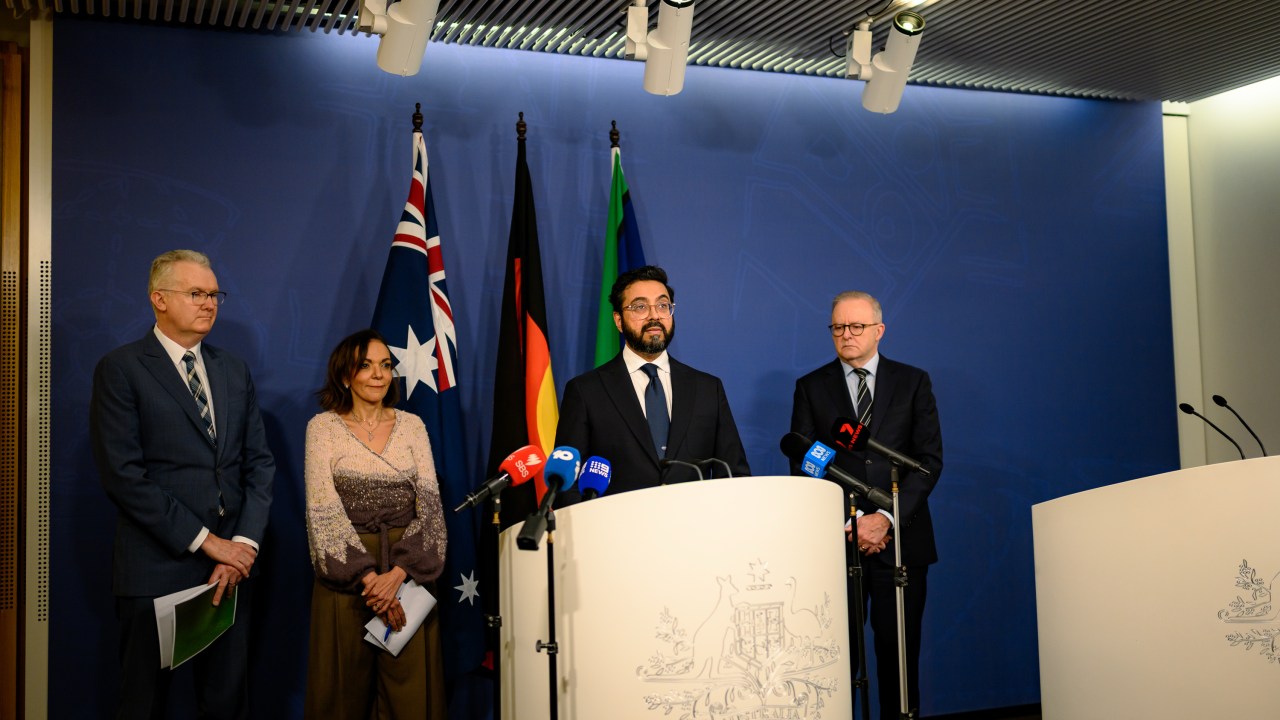
Anthony Albanese on the weekend said his government would accept 35 of Envoy Aftab Malik’s 54 recommendations while others remained under further review.
Under broader categories the government will direct $41.9 million to improve Islamic faith locations, and further funding for organisations helping communities affected by hate.
Further multicultural grants will look to support sports and cross-cultural events, alongside improved Islamophobia reporting systems with responses and community supports to be “improved”.
But former AFP detective superintendent David Craig said the announcement left much to be desired.
He took aim at further “training” for AFP officers and parliamentarians, disputing the need.
“Having been in the AFP for a substantial period of time, there is already a lot of cross-cultural training done,” he told Sky News host Peta Credlin on Monday.
“The last thing the AFP needs now, the last thing the Australian community needs now, is pulling more frontline officers off to tick some box for some additional training which they’ve had in depth anyway.
“Where are the AFP showing that they’re Islamophobic?”
He said he was disappointed with the report and ensuing response at large.
“I thought that [Mr] Malik was going to put together a fairly astute report and not just a pro-Muslim report. I mean, I’m very disappointed. He could have done a lot better,” he said.
“I mean $15 million for a Muslim community centre. Now what’s a Muslim sports centre, I mean? How is that going to help Islamophobia? Every other religion or atheist that goes past the $15 million Muslim-only sports centre, how is that helping social cohesion?”
He questioned lifting faith-based security funding from $25 million by $42 million, saying the majority of religious attacks were happening elsewhere.
“They’re happening in synagogues. They’re in churches more often than they’re happening in mosques,” he said.
“They’re also asking to rewrite the school curriculum and to educate people about Islamophobia, et cetera. But that’s only for the state-based schools … that doesn’t apply to Islamic schools. They’re not meant to be taught about social cohesion. It’s only all the other schools.
“I think it’s very one-eyed, it’s myopic, and it won’t help.”
Mr Albanese’s response came ten months after the report was first handed to government.
The government specified the accepted recommendations fell under four themes: Education and awareness, protection and support, building social cohesion, and accountability and responsibility.
Notably absent, however, was support for a more controversial suggestion which targeted terrorism legislation.
Mr Malik submitted to the Royal Commission into Antisemitism and Social Cohesion last month a condensed list of 17 recommendations.
One such recommendation was to water down “ideological labels” and definitions of “terrorist act” in Australia’s criminal code.
Mr Malik wished to “reduce a reliance on ideological, political or religious motivation as a central criterion to the offence”.
Mr Albanese explained his government decided to rebuff the suggestion as terror laws operated “on the basis of appropriate advice from national security agencies”.
“But primarily, we sit in the National Security Committee of the government, and we take advice from our security agencies. I have confidence in them,” he said on the weekend.
Home Affairs Minister Tony Burke last week rejected the idea on the grounds Australia’s terror definitions “tended” to be internationally agreed upon by security partners.
Mr Craig labelled the suggestion “naive and blatantly stupid”.
“I mean it is a naive and blatantly stupid idea. I’ve never seen something that would be so defeating of the good efforts that have been put in to fight crime in every respect, not just terrorism, but terrorism and extremism in all its forms, ideology is a basis for it,” he told Sky News last week.
“To discount that means you lose the ability to measure it. React to it, put social services around it, intervene when you need to.”
Last week, Mr Malik’s office clarified the submission was not advising police “ignore ideology”.
The office contended: “Modern radicalisation is shaped by multiple, overlapping factors, not one simple cause. Modern terrorism does not fit neatly into three boxes. Politics. Religion. Ideology”.
The 17 suggested outcomes called for debate about the role of religious motivations in the nation’s terrorism definitions, and the need for a federal anti-racism framework.
Mr Malik’s second recommendation of 17 was the government “amend the definition of ‘terrorist act’ in section 100.1 of the Criminal Code 1995 to reduce a reliance on the ideological, political or religious motivation as a central criterion to the offence”.
Another recommendation argued cabinet should embrace an “ideology-agnostic framework in relation to extremism in both legislation and policy”.
It would classify extremism by “reference to its capacity to mobilise harm, incite violence and erode social cohesion”, not by its “ideological label”.
“The recommendation made by the Independent National Security Legislation Monitor in its current Defining Terrorism review, to the extent the Monitor recommends modernisation along these lines, should be prescribed in legislation,” it continued.
The submission additionally pushed for “a cabinet protocol that seeks to reduce the politicisation of operational decisions and create consistency in responses to incidents”.