
A tropical archipelago just 1,500 kilometres from Australia, rich in gold and copper, is preparing itself for nationhood next year.
But as Bougainville moves towards independence, unresolved conflicts and memories of a bloody past are coming back to the surface.
 Dennis Kuiai joined the Bougainville Revolutionary Army in his early 20s.
Dennis Kuiai says he never wanted to kill anyone.
“But that really is the sort of legacy we are living with now,” he says.
“We continue to live with that trauma because we have killed.”
 Decades after laying down weapons, Dennis Kuiai and other veterans of the Bougainville civil war are still waiting for independence.
In his early 20s, Mr Kuiai was recruited to fight for Bougainville’s separatist militia, the Bougainville Revolutionary Army, in a brutal civil war over land, resources and identity.
The conflict claimed up to 15,000 lives.
But while weapons were laid down decades ago, the fight for Bougainville’s independence is far from over.
On a humid afternoon, Mr Kuiai shows us around a luscious rainforest landscape that looks like somewhere you might build a luxury resort.
Loading…
Instead, it’s slated to become the main prison facility for the prospective nation.
A group of veterans has been employed to prepare the site for construction.
Mr Kuiai says it’s a priority project because Bougainville’s current prison facilities are extremely limited.
But coming back here stirs up bitter memories.
Loading… Dennis Kuiai says the prison project is a priority for Bougainville.
In 1990, during Bougainville’s civil war, Mr Kuiai was involved in a dramatic plot to free separatist rebels held in an old prison at this very location. The operation ended with the facility being burnt down and seven people killed.
Now, he’s determined to rebuild.
A war that never fully ended
The tensions behind Bougainville’s bloody 1988–98 civil war began before independence in 1975, when Papua New Guinea was still under Australian administration.
 Bougainville in 1996 in the midst of the civil war.(Supplied: Ben Bohane/wakaphotos.com)
 Panguna mine closed down in 1989 amid the conflict.(ABC News: Tim Swanston)
In the late 1960s, the giant Panguna copper and gold mine was developed by Australian company Rio Tinto, fuelling anger in Bougainville that outsiders, including the PNG government in Port Moresby, were reaping the benefits of Bougainville’s wealth while locals bore the cost.
Bougainville mine that sparked civil war on rapid path to reopening
These resentments grew and spiralled into conflict and war in 1988. The mine was shut down the following year, crippling PNG’s biggest export earner at the time, and has remained closed since.
Like many veterans, Mr Kuiai wants to see his homeland gain independence within his lifetime and won’t settle for anything less.
“We have fought for it. We have died. We have shed blood,” he says. “The highest price that has been paid.”
But although more than 97 per cent of Bougainvilleans voted for independence in a 2019 referendum, the result must be ratified by Papua New Guinea’s national parliament in Port Moresby to take effect.
 Bougainville is roughly 1,500 kilometres from Australia.
 The Autonomous Bougainville Government is preparing to lead its people to independence.Loading…
 If Bougainville gains independence it will become the fifth largest country in the Pacific after Papua New Guinea, Solomon Islands, Fiji and Vanuatu.
Many PNG politicians fear Bougainville’s independence could incentivise other separatist movements around the country.
Negotiations between the two sides, which have turned hostile at times, are coming to a head, with a vote in parliament expected to take place next month.
The Autonomous Bougainville Government (ABG) says both parties are actively working towards agreed timelines.
But, far from banking on PNG’s approval, Bougainville is preparing to unilaterally declare independence if the vote fails.
ABG president Ishmael Toroama, a former rebel commander, has set September 2027 as the deadline for achieving sovereignty.
 Bougainville has a population of about 350,000 people and the capital is Buka. The town of Arawa used to be the capital until the war broke.
 Locals go for a relaxing afternoon swim in capital Buka in north Bougainville.
If Bougainville gains independence, it will be among the five largest countries in the Pacific after Papua New Guinea, Solomon Islands, Fiji and Vanuatu.
Located in the Pacific Ocean about 1,000 kilometres east of Port Moresby, it has a population of over 350,000.
It’s closer, both geographically and culturally, to Solomon Islands and is sometimes referred to as “North Solomon Islands Province”.
When the ABC travelled around Bougainville in April, support for independence was almost ubiquitous.
“I want people to stay together as one people.” — Lyneaesha Baranangko
“A lot of us were desperate because of how long we have suffered after the crisis until now.” — Essau Sihon
“We want to be independent so we can manage ourselves. We believe that we have our resources. Our country of Bougainville can survive on its own.” — Mathew Hatsu
Peaceful ambitions clashing with a bloody past
Solomon Semoso, captain of Bougainville’s rugby union team, describes how Bougainvilleans see themselves as ethnically and culturally unique.
 Skin colour is a big part of Bougainvillean identity, according to rugby captain Solomon Semoso.
 These rugby union players say they want to represent their country if Bougainville gains independence.
A large part of his identity is the colour of his skin.
“In other provinces you will not see other people who have the same skin colour as us. We are the only black people here in Papua New Guinea,” he says.
“I am proud. Black life matters. I am proud to be born black.”
 Bougainville’s rugby 7’s team, the Black Orchids, train with a stunning ocean backdrop.
Despite its troubled past, Mr Semoso describes Bougainville as a peaceful and welcoming place.
“We are different from other [PNG] provinces where there are petty crimes,” he says.
“In Bougainville you can move freely as tourists, no-one will steal from you. We don’t want that attitude of stealing to come in, that is why we support independence.”
 Staff at the Buka Hospital: access to essential services in Bougainvillle is a constant worry due to a struggling economy.
 Facilities at Bougainville’s main hospital are run down.
 Bougainville’s economy is heavily reliant on Papua New Guinea and some are concerned about its ability to sustain itself.
 Access to schools, hospitals and banks is limited and rates of unemployment are high.
Unlike the majority of Papua New Guinea, Bougainville is a matrilineal society, meaning land is passed down through the mother’s bloodline.
But as the 2027 deadline for independence draws closer, tensions within the community are starting to emerge.
Who’s going to foot the independence bill?
With an economy that is heavily reliant on Papua New Guinea, only generating between 5 and 6 per cent of its revenue internally, some are concerned about Bougainville’s ability to sustain itself.
The Bougainville government says it has been actively progressing economic initiatives aimed at strengthening revenue generation and building long-term self-reliance.
Others worry about the state of essential services such as schools, hospitals and banks, the lack of universities and high rates of unemployment.
Even more frightening, regardless of its likelihood, is the possibility of another conflict if things don’t go to plan.
 Beverley Ittamari stands beside abandoned machinery from the old copper and gold mine in Bougainville.
It’s something that’s been playing on the mind of Panguna landowner Beverley Ittamari.
“There’s still a fear because, you see, this had been a violence-filled place before,” she says.
Her village, Guava, is situated around the large copper and gold mine that fuelled the 1988 civil war.
Loading…
In recent months, Ms Ittamari has watched the Bougainville government charge forward with plans to reopen the Panguna mine to bankroll Bougainville’s independence.
Despite being abandoned by Rio Tinto during the war in 1989, today the Panguna mine is a hive of activity.
Small-scale alluvial miners, employed informally, work against a backdrop streaked with vivid blue: the strangely beautiful marks of exposed copper deposits.
Tip trucks weave around serpentine roads, rusty machines sputter and children run around, playing in the gravel.
A young man uses his bare hands to wash fine ore shimmering with gold. It’s hard work but the pay-off is worth it.
 Working with bare hands: the alluvial mining sector is unregulated and sometimes risky.
 Rocks like these contain precious gold that provides an income for locals in Bougainville.
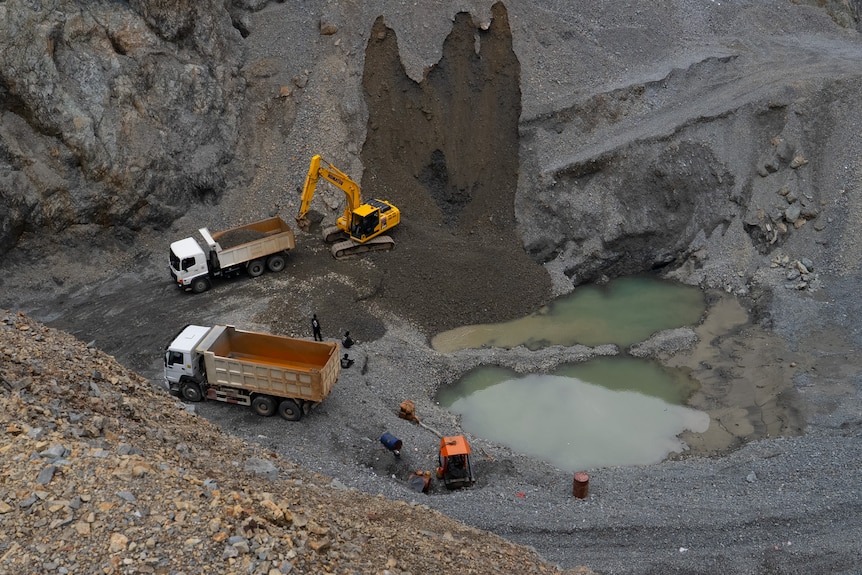 Despite being abandoned by Rio Tinto in 1989, Panguna mine is a hive of activity today.
 Work doesn’t stop for alluvial miners at Panguna, where locals extract gold on a Saturday afternoon.
 Locals are making use of old machinery at Panguna mine in Bougainville.
“Even a little child can walk around with lots of money in his pocket,” Lincy Itona says.
But he’s concerned the reopening of Panguna will take jobs away from locals like himself.
“We are worried. When this happens, we will not mine like how we are mining now,” he says.
 Lincy Itona says he’s worried he will be kicked off this land if the Panguna mine officially reopens.
 Black sand glitters with gold as Lincy Itona works at the Panguna mine.
 Alluvial miners have taken over the abandoned Panguna mine site in Bougainville.
In January, the Bougainville government controversially ordered the mine licence holder, Bougainville Copper Limited (BCL), to pursue a development partnership with Indian company Lloyds Metals and Energy Limited (LMEL).
The directive circumvented a separate expression of interest process run by BCL, which identified a Chinese company as the preferred mining partner.
Three BCL board members subsequently resigned from their positions out of frustration with the government.
Many Panguna landowners say they were not consulted over the government’s decision.
 Beverley Ittamari is worried Bougainville could find itself in another crisis if people don’t agree on the government’s direction.
 Lloyds Metals and Energy Limited has started construction to build a state of the art hospital in Arawa, Bougainville.
“What the president [Toroama] is doing … he’s doing everything without the consultation of the landowners,” Ms Ittamari says.
She’s now among landowners ordering Lloyds Metals to stop work at Panguna, with claims the company is trespassing on indigenous land.
Without widespread support from the people, Ms Ittamari is worried hostilities could reignite.
“When the people are not in the same mindset with the president, tension might rise up.”
The Bougainville government has not responded to the ABC’s questions about the mine and Lloyds Metals, but the president has subsequently held personal talks with Panguna landowners.
In a statement, the ABG said it was firmly committed to ensuring the process towards independence continued to be peaceful, orderly and inclusive.
“The focus is on ensuring that economic readiness, institutional capacity, and nation-building progress together in a coordinated and responsible manner,” the government said.
Others believe reopening the mine is crucial for Bougainville’s future and are putting their faith in the government’s leadership.
Theresa Jaintong is one of seven Panguna landowners who travelled to India late last year at the invitation of Lloyds Metals to see their other sites.
 Theresa Jaintong travelled to India to see Lloyds Metals operations overseas.
 Indian mining company Lloyds Metals and Energy Limited has started setting up operations in Arawa, Bougainville.
 Decades after a devastating civil conflict, Bougainville prides itself on being a peaceful region.
Although the company doesn’t have any prior experience in mining gold and copper, Ms Jaintong was impressed with how it assisted other communities with historic tensions around mining.
“I saw their setups in there and then I saw how they rehabilitate the people,” she said.
“I see Lloyds Metals as one of the credible investors who is speaking for the people.”
In November, the Bougainville government signed a non-binding memorandum of understanding with Lloyds Metals.
Along with reopening Panguna, it referenced plans to build a gold refinery, copper plant, new hospital and government offices and establish commercial banking in Bougainville.
 Bougainvillean locals must be treated fairly, says this former Lloyds Metals employee who did not want to be identified.
 A former Lloyds Metals employee says he walked away from the company over a wage dispute.
The company already has a presence on the ground, with construction sites seen around the town of Arawa, Bougainville’s former capital.
But signs of discontent among employees have started to emerge, with one former worker, speaking on condition of anonymity, complaining about wages and unfair treatment: the same sorts of resentments that fuelled previous conflicts.
“We tried our best to highlight these things. We did try our best [with Lloyds Metals] but we see that the same thing is happening,” he said.
Lloyds Metals has not responded to the ABC’s request for comment and workers on the ground declined to speak with us.
Pacific dreams beyond the mine
While lucrative, mining isn’t the only potential source of revenue for Bougainville.
Agriculture, fisheries and tourism all present alternative income opportunities for the prospective nation.
 Discarded cocoa pods at a plantation in Bougainville’s south near Buin.
 Albert Nukuitu says he funded his own education through planting cocoa.
 Cocoa beans fermenting before they are roasted.
In the island’s south, near the town of Buin, Albert Nukuitu has been planting cocoa since he was a kid.
He says that money from cocoa has provided funding his entire life, starting with his primary school education, through university and until this very day.
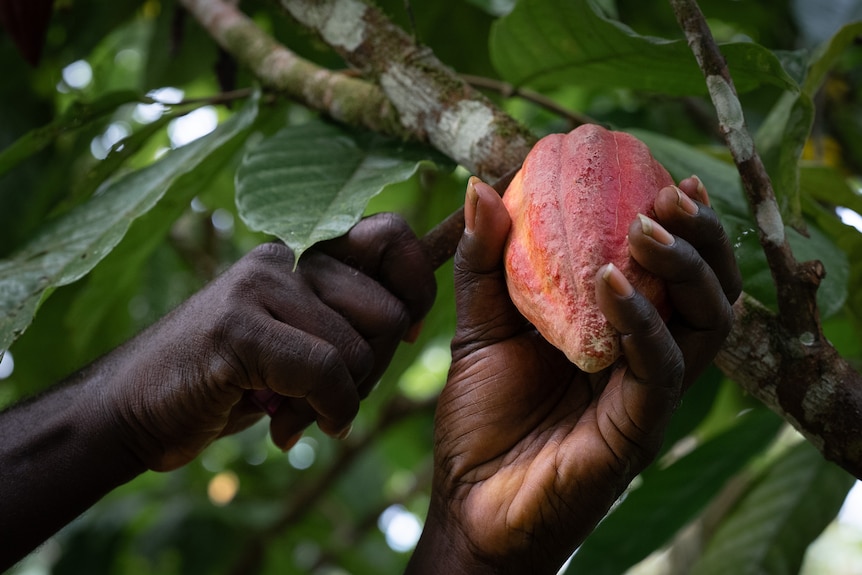 Cocoa is a tree of life for Bougainville, according to Albert Nukuitu.
“Cocoa is a tree of life for us Bougainvilleans,” he says.
 Cutting open a ripe cocoa pod to reveal its valuable contents.
“I paid my school fees myself, from grade three up to university.
 Cocoa has provided a source of income for many Bougainville households.
“It has helped a lot of families send kids to school, build good homes — good houses, permanent houses — and even buy cars.”
While plantations were damaged in the recent Tropical Cyclone Maila, Mr Nukuitu says the government could benefit from cocoa revenue.
“So much money has been spent on mining,” he says.
“What I want to see is the government equally spend … not just on cocoa, but other cash crops as well: coconut, tourism, fishing.”
While Bougainville’s future remains uncertain, one thing is clear to Mr Nukuitu: the resilience of its people.
 Children in the capital town of Buka are all smiles on a sunny afternoon.
 Everywhere you look, the Bougainville flag flies proud.
 Children take in the view of sunset in Buka, north Bougainville.
Having lived through a civil war, survived a blockade and, more recently, a destructive cyclone, the citizens of Bougainville have clung to their identity, their culture, each other and their land.
How that spirit translates into statehood, as Bougainvilleans work through the processes, politics and fine print of becoming a new country, will be put to the test in the months ahead.
Watch The Pacific’s special on Bougainville’s independence tonight here on iView or on YouTube.
CreditsReporting: Marian Faa, Gabriella Marchant & Theckla Gunga in BougainvillePhotography & Drone Footage: Marian FaaAdditional Photography & Filming: Gabriella Marchant, Theckla Gunga, ABC Archives, AFP, ReutersGraphic Design & Video Editing: Cordelia BrownDigital Production & Editing: Steven VineyTok Pisin Translations: Theckla Gunga