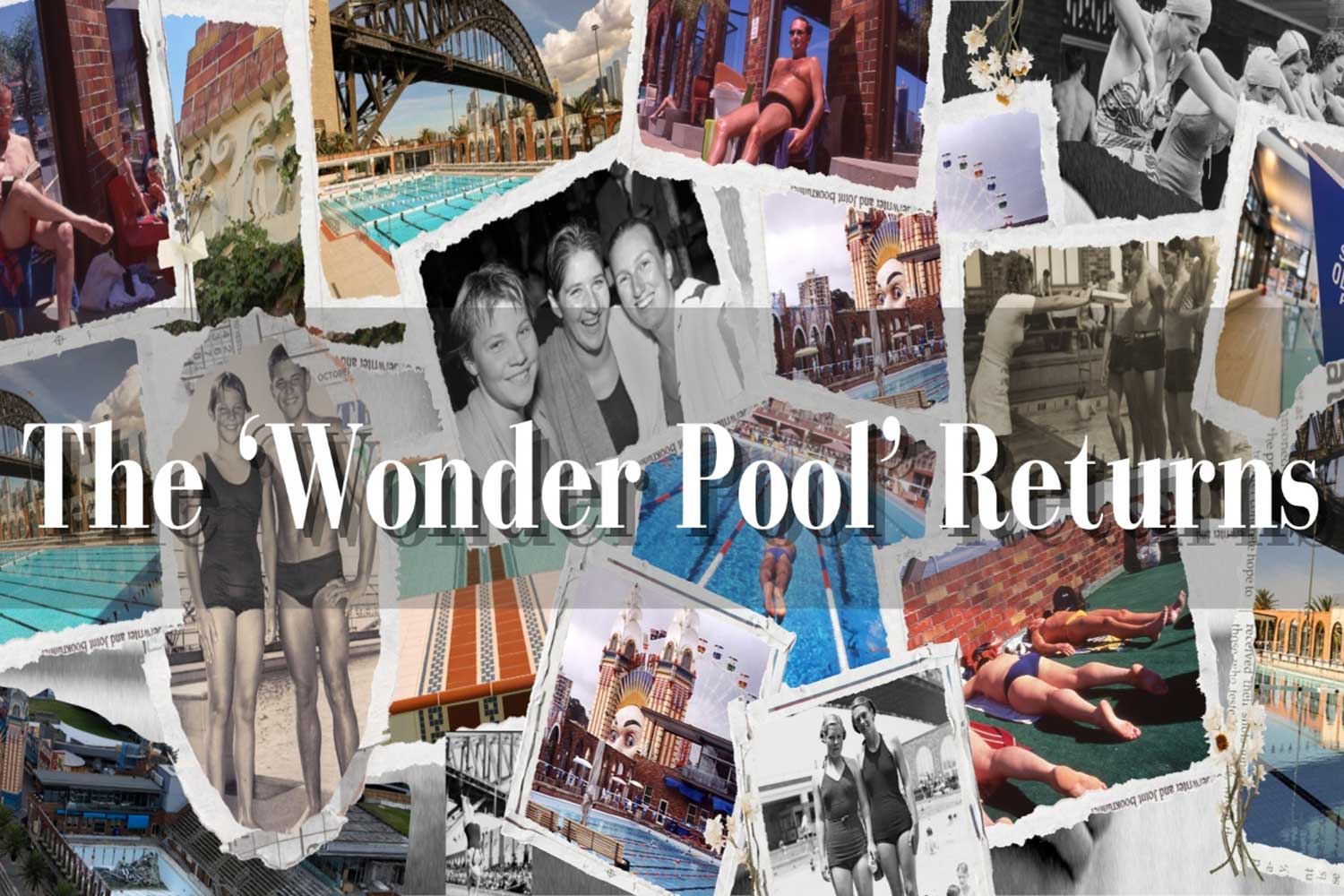
For sixpence, the best show in town
This was before television, so people didn’t just come to swim. They came to watch, and for a few coins it was the best ticket in town. Sixpence at the gate for adults, threepence for the kids, and a penny if your teacher brought you. The pool held 3,000, but 5,000 would squeeze in for a big carnival, queuing from early morning to get inside. Others who couldn’t afford to pay climbed the Bridge walkway to a spot they nicknamed Scotsman’s Hill and watched for free.
And what they witnessed below were the best swimmers in the world. Australia invented the crawl, and Dick Cavill perfected it nearby, at his family’s Lavender Bay baths, borrowing the overarm stroke from Solomon Islander Alick Wickham and making it his own around 1901. We’ve ruled world swimming ever since. When the racing finished, everyone dried off the same way, flat out on the hot concrete in the sun until bodies were baked dry enough to jump back in.

In 1938, the pool hosted the British Empire Games, launching North Sydney onto the world stage. Image: Stanton Library.
In 1938 the pool threw its biggest party, the British Empire Games. Crews drained the salt water and fire engines pumped it full of fresh, the only time that ever happened. Over at Luna Park a maintenance fitter named Jack Sullivan shimmied up the towers and watched the whole thing for nothing. “I had the best view and I was getting paid,” he said. “Oh, that was a big show.”
The swimming costumes tell their own story. In the 1930s you swam in a heavy woollen suit, because council had strict rules about modesty. Yvonne Elliott, who ran the pool with husband Charles for 32 years, said the fashion went “full circle from full-length speedos to high waist lines, then bikinis, and back again.” There was even the odd topless sunbaker, until the office towers next door rang up to complain their staff had stopped working.

Next door, Luna Park had its wild rides, but North Sydney Pool had the tower of terror. Image: NSW State Library.
The tower and the dare
At the western end stood a foreboding structure every local kid of a certain age remembers: a 10 metre tower, a 5 metre tower – and four springboards. Locals rated the top board the scariest drop in Sydney. Climbing it was a rite of passage, hand over hand, a mate egging you on from below, that awful pause at the top before you descended into the cold water, in the shadow of the Bridge. Former Mayor Genia McCaffery, who swam here in the 1950s, never forgot it: “the tower I once feared, then grew to love.”
The fun – and fear – did not last and the council pulled the tower down in 1970 when its frame rusted out. Roger Pegram, a swimming official for years, said it plain:
“The angle irons in the corner frame had rusted right through.” Ten years later, the springboards went too, and workers concreted the deep end, put down to the cost and the risk of someone getting hurt.
The fast pool
Swimmers called the pool “fast”. Murray Rose, who won four Olympic golds and rated it “the most exciting pool in the world,” reckoned it was the atmosphere that made you quick. The numbers back him up. Swimmers set 86 world records here between 1953 and 1974, more than any pool on earth. Frank O’Neill set the first in 1953. Then came the Konrads kids, John and Ilsa, who rewrote the record books, John alone taking 23.

In 1964 Dawn Fraser swam the 100m freestyle in 58.9 seconds, a world record that stood for eight years. Image: NSW State Library.
The most famous night belongs to Dawn Fraser. In 1964 she swam the 100m freestyle in 58.9 seconds, a world record that stood for eight years, and Kevin Berry broke another world record at the same meet. Weeks later, a car crash killed her mother, leaving Fraser in a neck brace for nine weeks, and she still went to Tokyo and won her third straight Olympic gold. Michelle Ford set the last of the pool’s 86 records in 1978.
But it was never just for champions. North Sydney’s free Learn to Swim classes put more than a million people in the water, ordinary local kids getting their first strokes in that salt water.
The most beautiful backyard
The Elliotts did more than run the pool, they lived at it, in a flat above the change rooms. The water ran cold for the pool’s first 36 years, and nobody heated it until 1972. It was the Elliotts who then made it the first pool in the country to throw a giant airtight bubble over the water so you could swim through winter, in 1981. They were also the first in Sydney to install lap lanes, which every other pool then copied. When they retired, they called it “the world’s most beautiful backyard,” and asked what he would miss most, Charles could not quite say. “I don’t know, you just can’t put your finger on that touch of magic.”

“We are all democrats in our bathing costumes”. Image: Stanton Library.
He was not the only one who felt it. Back in 1986, Mayor Ted Mack put the pool alongside Circular Quay and the Opera House as one of the “essential symbols and heart of Sydney.” It was a former councillor, however, who perhaps summed things up best when he said upon entering the pool that: “we are all democrats in our bathing costumes.”
For decades she never stopped drawing a crowd. Every upgrade the council and the Elliotts threw at her bought a few more years, and kept the lanes full long after the cold used to send swimmers home. But salt, sun and time wear a pool down. The concrete cracked, the pipes aged, and after 85 years the grand old girl was in bad need of a facelift.
In 2021, the gates shut. For five long years the frogs looked down on an empty pool while a $122 million rebuild dragged on well past its deadline. This Friday the crowds pour back through the gates, with the Wonder Pool open free all weekend, ready for the next lot of lower north shore kids to flop on the hot concrete under the Bridge.