
Misogyny and its amplification through the “manosphere” may be a key driver of ideologically motivated extremism in young men and boys in Australia, the antisemitism royal commission has heard.
The Royal Commission on Antisemitism and Social Cohesion has this week examined the drivers of antisemitism and radicalisation in the community, hearing from lived experience and expert witnesses.
The University of Melbourne’s Sara Meger was called to discuss the findings of her recent research into misogynistic attitudes and support for violent extremism.
Dr Meger said her survey of 1,100 boys aged between 13 and 17 and 2,300 adults found misogyny was the most common predictor of men being driven to extremist ideologies.
“More so than how someone places themselves on a political spectrum, more so than their religiosity, their ethnicity, what online things they engage with, the one thing we measured that was most likely to be able to predict if someone any of the forms of violent extremism we measured was their attitudes about the permissibility of violence against women,” she said.
“It finds that if you combine the hostile gender attitudes with only the gendered online behaviours [such as] manfluencer engagement, online dating and online pornography, these factors together accounted for between 90 and 97 per cent of all the explained variants in how someone responds to the violent extremism measures.”
‘We’ve got to pump those numbers up’
Dr Meger also recounted a discussion with a representative of the Department of Homes Affairs in December and said “more than two thirds of their countering violent extremism case load is taken up by young boys and men between the age of 10 and 24 years old”.
“They’re massively over-represented in our countering violent extremism efforts,” she said.
Dr Meger said after her research was published, she was shocked by the social media reaction to the findings.
“The most common comment made [on social media] was that the frequency of young men expressing misogynistic attitudes was too low,” she said.
“The most common sentiment was ‘those are rookie numbers, we’ve got to pump those numbers up’.”

Dr Meger says Andrew Tate has been a big influence on students. (Reuters: Kevin Lamarque)
Dr Meger said her research also included qualitative and quantitative data provided by more than 500 Australian teachers about the manifestation of misogynistic and extremist views in the classroom.
“It was roughly 25 per cent [of teachers surveyed] said they had experienced sentiments from students that violence to resist government authority was legitimate,” she said.
“Teachers frequently noted very hostile misogynistic attitudes expressed by students.
“The teachers independently spoke about [controversial social media influencer] Andrew Tate and the manosphere as having a significant influence on these attitudes.
“They also noted racism and a degree of celebration of overseas political violence being expressed by students, as well as some examples of students drawing swastikas on notebooks or around campus.
“This indicates to us this political polarisation is having very real world impacts on social cohesion at ages perhaps even younger than we had anticipated.”
Reformed neo-Nazi speaks at inquiry
Dr Meger said early intervention programs for children as young as six years old should be mandated to prevent the spread of misogynistic attitudes.
“If we could more fully integrate an awareness and perhaps risk assessment of how these gender attitudes could be motivating a range of political ideologies, we might be better placed for effective early intervention strategies,” she said.
Deradicalisation programs
NSW Police Assistant Commissioner Leanne McCusker fronted the commission for a third time to discuss deradicalisation programs in the community.
The commission heard NSW Police does not administer such programs, but is a contributor to initiatives like the engagement and support program run by the Department of Communities and Justice across the state.
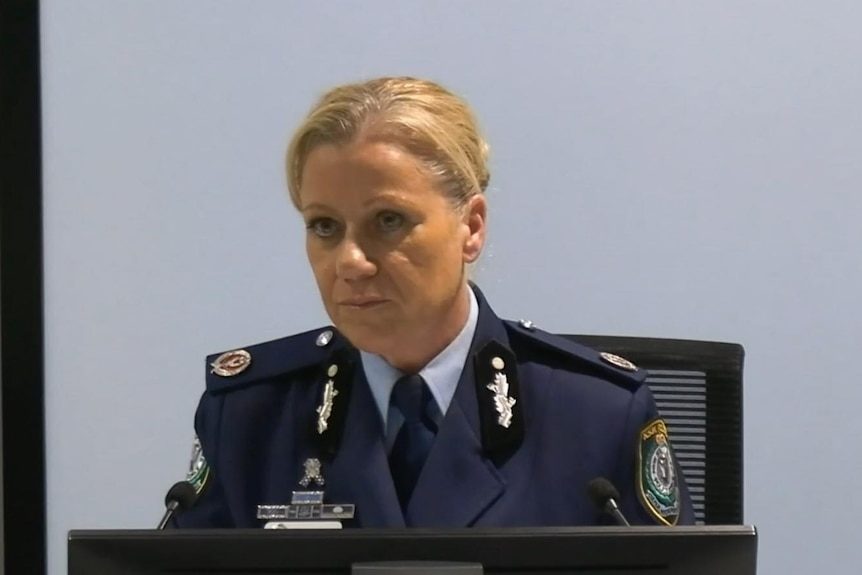
Leanne McCusker pictured at the royal commission in May. (ABC News)
NSW Police, relatives of individuals and others can make referrals to the disengagement program if they suspect a person may be at risk of being influenced by violent extremism.
Assistant Commissioner McCusker said the program had proved to be effective.
“The program does continue to grow with referrals,” she said.
“It is an effective program that we do continue to … enhance that with resources and continue to enhance that with intelligence capabilities.”
Assistant Commissioner McCusker said work was underway to raise awareness about the role of relatives, colleagues and friends in quickly identifying people at risk of becoming radicalised.
She said people who regularly interacted with at-risk people were best placed to identify and report changes in behaviour to ensure early intervention could occur.
“I think relatives, family and friends would be far more comfortable of that report [of changes in behaviour] as opposed to [when] they think they’re reporting more of a criminal offence,” she said.
More on the royal commission