
Children at an increasingly young age are engaging with violent extremist material at a “disturbing” rate, Australia’s counter-terrorism coordinator says.
The Department of Home Affairs’ Brendan Dowling was appointed counter-terrorism coordinator earlier this year after the Royal Commission on Antisemitism and Social Cohesion recommended making the role full time.
Mr Dowling works in collaboration with federal, state and territory governments and law enforcement agencies to coordinate a nationally–consistent response to counter-terrorism and violent extremism threats.
The commission has previously heard children as young as 10 are eligible to be referred to voluntary countering violent extremism programs in some jurisdictions in response to current trends.

Mr Dowling says the trends are “disturbing”. (ABC News: Liam Patrick)
Fronting the royal commission on Tuesday, Mr Dowling said this was consistent with Department of Home Affairs data.
“The trends are disturbing,” he said.
“The rates of youth radicalisation … we see an increasing number of younger people engaging with extremist material.
“It’s often across a range of ideologies … whether it be neo-Nazi material, white supremacist material, anti-government material, jihadi material.”
Mr Dowling said the trends pointed to countering violent extremism programs as becoming “critically important” in addressing radicalisation in the community.
“When you are talking about a person at that [young], age a law enforcement response is sometimes going to be the right response but in many cases, a [countering violent extremism] intervention outside of the law enforcement domain might be a far more appropriate response for a child who is engaged in extremist material,” he said.
Mr Dowling was also quizzed about the decision to discontinue or consolidate a number of countering violent extremism programs in recent years.
This included the scrapping of the Safe and Together community grants program, which supported local grassroots early intervention activities.
Mr Dowling defended the decision, saying the department had since focused its efforts on targeted intervention for high-risk individuals.
“Community programs that address prejudice, hate, have their place and are merited, however, … the decision was effectively to target our efforts towards much more targeted programs that support at risk caseloads,” he said.
Risk of violent extremist material ‘very real’
The commission heard hundreds of people were referred to countering violent extremism programs each quarter, but a large proportion were assessed as better suited to other treatment and diversion initiatives such as those related to mental health interventions.
Mr Dowling said the Diversions Australia pilot program, which ran from January to May this year, was an example of how social media and gaming platforms could work alongside counter-terrorism agencies to disrupt a young person’s progression to radicalisation.
“[Social media platforms] are a vector for people being able to reach violent extremist material,” he said.
As part of the pilot, users who searched for or engaged with violent extremist content on TikTok were presented with a pop-up inviting them to connect with case managers who could help them disengage with that material and related ideologies.
The commission heard over the five-month pilot, more than 6,500 users connected to the pilot site and about 790 of those engaged with the pop-up.

The pilot ran on TikTok between January and May this year. (Reuters: Hollie Adams)
About 12 of those progressed to having conversations with case managers or practitioners.
Mr Dowling said the data was a “positive indicator of the reach of the program”, which he said he believed was a world-first.
“While it might seem like a small number are then engaging more deeply, if those people are higher risk individuals, then those are positive indicators of the types of people that are being picked up through that service,” he said.
“I’m not aware that this type of program has been tried anywhere else in the world.
“There is enough evidence there to indicate this is a worthwhile undertaking and that it is worth looking at expanding to further social media platforms.”
Mr Dowling said there were discussions underway with Roblox to expand the program to the popular gaming service.
“We know that as a platform where there is a lot of user-generated content, the risk of violent extremist material or communications is very real,” he said.
Intervention for young people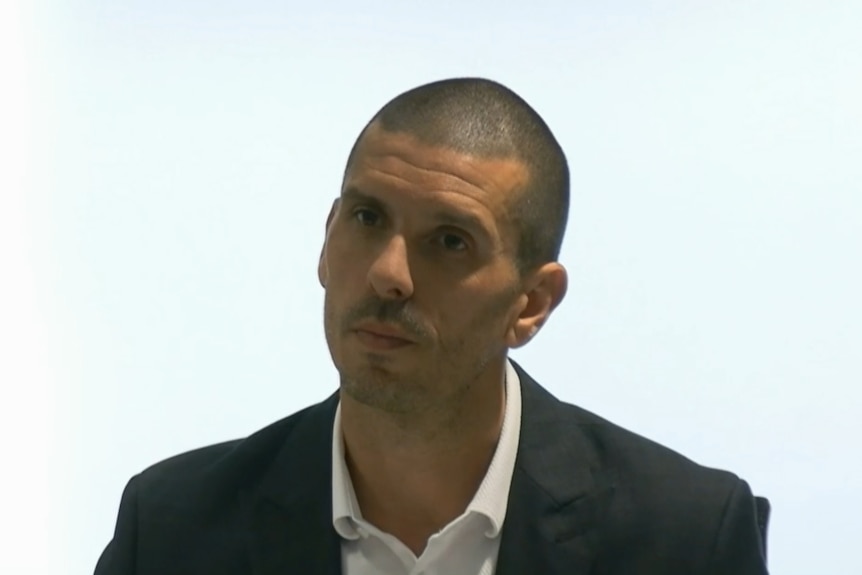
Dr Barracosa says it is “almost inevitable” young people will come across harmful content online. (ABC News)
Youth Justice NSW Unit senior manager Steve Barracosa also highlighted the role social media continued to play in youth radicalisation.
“It feels almost inevitable in the current climate that young people will cross paths with harmful and offensive content on the internet, whether we like it or not,” he said.
“[Extremist content online] appears to be more tailored for youth than we’ve seen before.”
Dr Barracosa said clinical and forensic psychologists attached to the unit’s countering violent extremism program conducted comprehensive risk assessments with young people at risk of radicalisation to help tailor interventions.
He said it also worked with participants’ families to identify the reasons behind a child’s engagement with extremist content and views.
“The literature of youth radicalisation is very clear that environmental challenges, instability and dysfunction are a very core component in understanding why young people are vulnerable to being exposed to and influenced by extremism,” he said.
“We’re conscious that intervening exclusively with the individual probably ignores the fact that there is work to be done on the broader environment wrapped around any young person.
Mr Dowling said the effectiveness of a now-discontinued social media campaign called Fearlessly Australian had been difficult to assess.
The commission heard many users engaged with the social media posts, which were aimed at promoting a sense of belonging.
But Mr Dowling said the nature of that engagement was impossible to measure.
“In some ways it’s a scattergun approach … Effectively you’re pushing out a message into the ether and hoping that the right people engage with it,” he said.
“You really don’t know whether you are hitting your target audience.
“And it’s arguable to say that the Australian government pushing out messages of positive engagement to someone who feels disconnected and isolated from their community, might have zero effect, might even be seen as a demonstration of the lack of literacy of government programs in youth culture.”
More on the royal commission