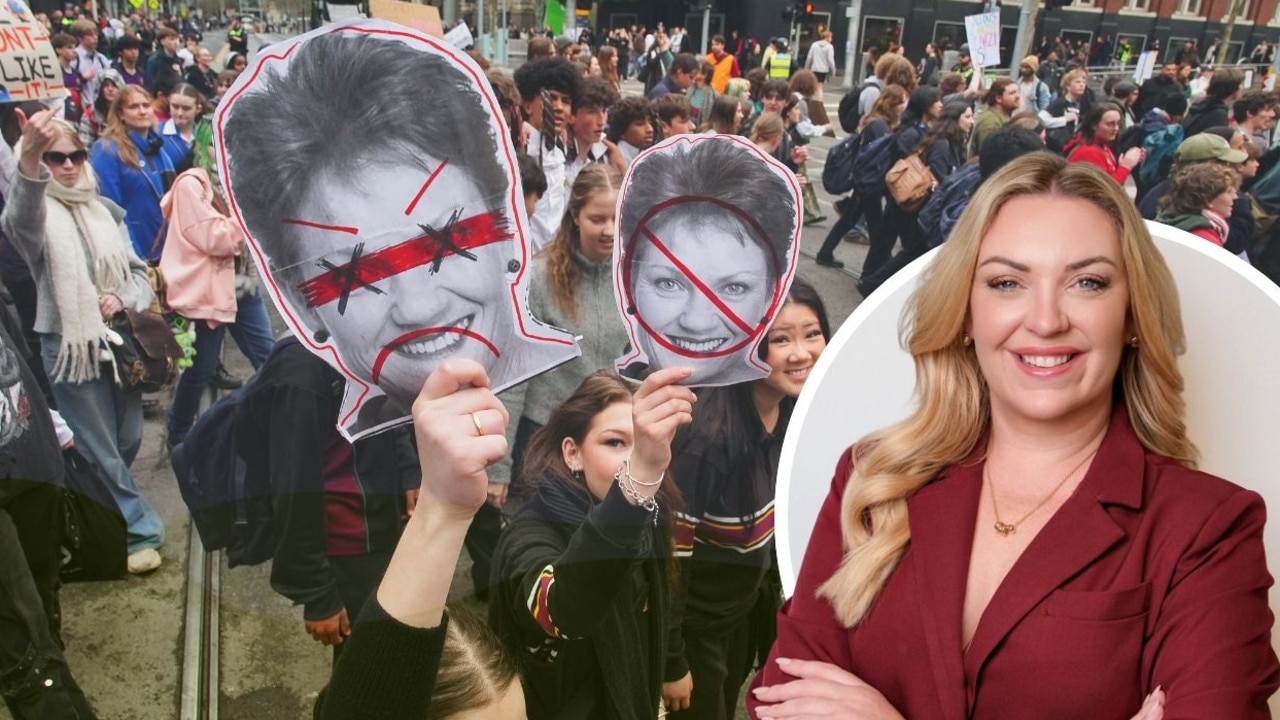
As Australia heads towards another cycle of elections and political campaigning, I suspect we’ve just had a glimpse of something we’re going to see a lot more of – teenagers being drawn into political activism.
Last week hundreds of Australian school students walked out of their classrooms to protest Pauline Hanson and One Nation.
With the Victorian election approaching and One Nation attracting renewed attention nationally, it would be surprising if this were the last time we saw young Australians mobilised around politics.
And I actually think young people being interested in politics is a good thing.
We should want teenagers to care about the country they are growing up in, understand how our democracy works and have opinions about its future.
I’d much rather see a generation engaged with the political process than completely indifferent to it.
But what happened last week raises a question that will become increasingly important if this kind of youth activism continues.
How committed are we, really, to young people developing political voices of their own?
Because supporting youth political engagement is easy when young people happen to agree with us.
Would the adults cheering these students on have been quite so enthusiastic if hundreds of school kids walked out of class for a pro-Israel rally?
What about a protest against the Labor government? An anti-abortion march? Or a rally against gender policies in schools?
Would we still be hearing about brave young people finding their political voice?
If the answer is no, then we’re not really encouraging young people to think politically.
We’re encouraging them to think like us.
As a psychologist, and someone who has spent most of my career working with children and teenagers, this is the part that concerns me.
Teenagers are idealistic.
They care deeply about fairness and injustice and they’re working out who they are, what they believe and where they belong.
They can become incredibly passionate about causes.
But it’s exactly why the adults around them have a responsibility to encourage curiosity and critical thinking, rather than simply recruit them to a cause.
And there were aspects of last week’s protests that looked uncomfortably like the latter.
The nationwide event was organised by the National Union of Students, with members of Socialist Alternative involved.
Material circulated by High School Anticapitalists gave students practical advice about recruiting classmates, organising within schools and walking out of class.
Students were even encouraged to wear their school uniforms because it would make them more identifiable to the media.
There is a big difference between a teenager independently becoming interested in politics and political organisations actively recruiting children into a political movement.
And if our aim is genuinely to develop politically engaged young Australians, surely we should be teaching them how to interrogate political ideas rather than simply giving them the slogans.
Some of what we saw last week wasn’t especially encouraging.
Hundreds of school students chanted and screamed obscenities about a democratically elected senator.
One student said: “I would slap the sh*t out of that f**king bitch.”
Another called for the guillotine for Hanson.
All while Hanson herself was being denounced as a fascist – the irony is difficult to miss.
You don’t have to like Pauline Hanson.
You can find her politics offensive, protest against her, campaign against her and, eventually, when you’re old enough, vote against her. That’s democracy.
But fantasising about violence against a political opponent while accusing them of fascism isn’t tolerance. And screaming abuse at people who disagree with you isn’t an especially convincing call for peace.
Political tolerance is easy when everyone around you agrees with you.
The harder lesson, and the one I would much rather we teach teenagers, is learning to live alongside people whose views you strongly dislike.
I’d also hope we’re asking them to think seriously about the political ideas they’re advocating.
There was something particularly strange about watching students openly advocate communism while exercising freedoms of speech, assembly and political dissent that communist regimes have historically been rather less enthusiastic about.
If teenagers are going to advocate an entirely different political and economic system, then I hope the adults educating them are also asking them to explain what that system means, where it has been tried and how they imagine it would work here.
Not because teenagers shouldn’t be allowed to support communism, but because they should understand what they’re supporting.
That’s the kind of political education I’d like to see more of – less telling young people what to think, and more asking them why they think it.
What exactly has Hanson proposed that you oppose?
What right do you believe is being taken away?
What’s the strongest argument made by the person on the other side?
And perhaps the most important question of all: what evidence would make you change your mind?
Being able to answer those questions is a much better indication of political maturity than being able to repeat a chant.
Then there’s the simpler issue of school.
South Australia’s Education Minister said it was ultimately a matter for parents whether students attended.
Of course parents make decisions for their children.
But surely an Education Minister should also be able to say something fairly uncontroversial: during school hours, kids should generally be at school.
There is nothing anti-democratic about that.
You want to protest Pauline Hanson? Go for it.
I just wonder how many students would have discovered quite the same passion for the cause if the rally had been held at 10am on Saturday rather than during maths.
Political participation sometimes costs you something.
If you genuinely believe in a cause, giving up your Saturday morning to support it isn’t a bad introduction to civic responsibility.
I want young Australians interested in politics.
Let them protest, disagree with their parents and criticise Hanson, Albanese and anyone else asking for their future vote.
Let them read Marx – just make sure they read Orwell too.
Most importantly, let them encounter ideas they don’t like and argue with those ideas.
Teach them the difference between disagreement and hatred, and to resist the increasingly common idea that people who hold objectionable political views must therefore be objectionable people.
If we only celebrate young people’s political voices when they’re saying what we want to hear, then it isn’t their independence we’re celebrating.
It’s their agreement with us.
Do you support students’ right to protest against Pauline Hanson? Take our poll, comment below or email us at education@news.com.au