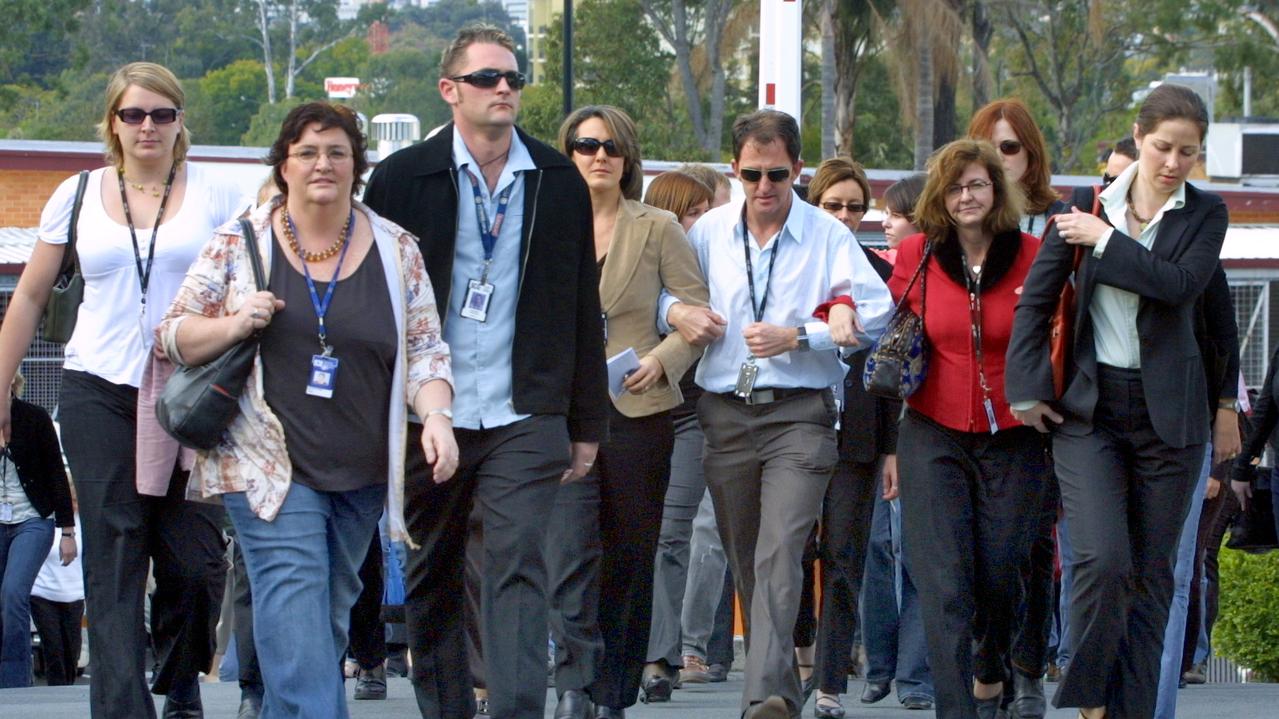
Twenty years ago, and only a few days into his role as the ABC’s managing director, Mark Scott stood in his Brisbane newsroom to face the staff who had come to believe that coming to work was slowly killing them.
For several years, women had quietly been disappearing from work to undergo chemotherapy and radiation treatment. The newsroom’s production desk in particular had been a revolving door of breast cancer diagnoses.
They believed something was poisoning them, creating abnormal cells to grow in their body, divide and spread.
They’d raised concerns, asked for an investigation. The investigation concluded their workplace was safe, that the empty desks were coincidence.
And so, one day, they walked off the job.
Scott, who’d had his feet under the desk for less than a week, had flown to Brisbane to listen to them.
In the crowd of concerned faces, he noticed one: a young woman, perhaps in her 20s. She’d looked frightened. And he thought: She thinks her job is killing her. And so months later, even though there’d not been any hint of a cause, he told them all to pack up their desks and leave.
Two luxury residential towers now sit on the inner-city riverfront land that was once home to the ABC.
In 2014, eight years after the public broadcaster’s 350 Brisbane-based staff abandoned their Toowong workplace, the buildings were razed and preparations began for a high-end residential development.
Today it is home to hundreds of people – including media and political identities – seemingly undeterred by the site’s checkered past, and willing to pay more than $3m for a three-bedroom apartment with access to a rooftop swimming pool, spa, sauna, gym, private dining rooms and spectacular river views.
In 1994, a young production assistant at the ABC’s Toowong newsroom found a lump in her breast and was diagnosed with cancer.
Doctors operated immediately and remarked on her poor luck. She was very young to have breast cancer, they said. They didn’t quite understand it. The following year another staff member was diagnosed.
There were four more cases in 1998, another in 1999 and in 2001, yet another. The 2001 case had been a news operations assistant, with 24 years at the Toowong site behind her. She’d woken one morning with a red, sore breast. Doctors initially thought little of it but then she’d taken an urgent phone call. It was cancer.
When a journalist was diagnosed the following year, they stopped believing in coincidence.
Nadia Farha was 35 at the time, with two young children. She’d have three operations, a mastectomy and six months of chemotherapy before returning to work. She hadn’t been sure she’d be around to see her children grow.
In 2003 and 2004, four more women were diagnosed. Weekend TV newsreader Lisa Backhouse was one.
“Am I going to die?” she’d asked her doctor.
She was 35, with two young boys.
The GP had leaned forward, patted her leg and said: “Everyone has to die.”
She had surgery a week later, followed by chemotherapy and then radiation.
Journalist Jo Stone had filled in for Backhouse reading the news but she’d been feeling increasingly uneasy about the growing number of women diagnosed with cancer.
She went to her doctor and asked for a mammogram. “You’re too young,” the doctor told her. She was 30, fit and healthy and with no family history. But the fear remained and soon yet another woman was diagnosed – a 41-year-old television producer.
Stone went to another doctor and pleaded her case. It would save her life.
“We’ll do it just for your peace of mind,” the doctor said. The scan showed tiny specs of calcification. A biopsy showed they were cancerous.
Doctors told her it would have been years before she’d have felt the lump, that cancerous cells would have divided and spread inside her body undetected.
Staff demanded answers from management. They felt there was something wrong with their workplace, that something was giving them cancer.
There was lots of electrical equipment in the newsroom and in the studio where many of the women worked. A large satellite dish was mounted on the roof of the Toowong building.
Both television and radio broadcasts were beamed around the country from their workplace. Was it electromagnetic radiation making them sick?
Or was it the soil or the water?
In early 2005, following agitation from staff, ABC management sent in an occupational physician to conduct an epidemiological survey of the women. He wrote a questionnaire to help him collate information about them, focusing on risk factors like health, lifestyle and family and reproductive history.
It upset them. Many refused to take part.
The occupational physician did not write a report as a result. At the same time, a company was commissioned to investigate electromagnetic radiation at the Toowong site.
Measurements were taken inside the building and near broadcasting vans over three days in April.
A month later staff were told the site had the all-clear – all tests had come within Australian Radiation and Nuclear Safety Agency reference levels.
That same month, staff approached Queensland Health. They wanted to know whether the rate of breast cancer at the ABC office was normal compared to the general population and whether their working environment might be behind the spate of diagnoses.
Backhouse had drawn them a map of the office, shown them the desk where seven of the women who had cancer had sat.
“Would you let your daughter sit in one of those seats?” she asked them.
The report came back in December, 2005. The investigation took into account eight recent cases and while it found “there was a likelihood of excess” instances of cancer, it could not say to what extent.
The investigation also found that there was no plausible explanation for that excess and so it was unlikely an environmental factor was to blame. The staff were disappointed, angry. Then, in 2006, another woman was diagnosed with cancer.
They called lawyers. They called the journalists’ union – the Media, Entertainment and Arts Alliance.
Then, on Friday, July 7, ABC staff walked off the job.
Professor Mark Scott – now the vice chancellor of Sydney University – recalls someone in those first few days of his appointment as ABC’s managing director coming to tell him about a woman in his Brisbane newsroom with breast cancer.
He noted it. Cancer was confronting, awful, but sadly common.
“Then people said to me, ‘No, no, you don’t understand, there are about a dozen.’ I think it was about a dozen at that point who had developed breast cancer,” Scott says. Even still, others were adamant there was nothing to be concerned about.
“I was told by some, ‘Look, there’s no such thing as a breast cancer cluster – there’s nothing in this,’” he says.
“I felt I just needed to get on the ground, meet with staff, talk with staff, have a better feeling and insight.
“I remember addressing a staff meeting and looking out and seeing a young woman from our newsroom. She would have been in her mid-20s. And I thought she looked very apprehensive and very frightened.
“And I realised, she thinks that she will develop breast cancer by coming to work.
“She loves her job but she was worried about her safety and wellbeing in going to that job. I realised just how deeply personal the impact of this is, not just about your own health, but the health of your friends and your colleagues and those you work side-by-side with.”
Scott says it “wasn’t satisfactory” that the broadcaster hadn’t gotten to the bottom of “what on earth was going on here”.
He decided to do just that – investigate the extent of the problem, rigorously, aggressively.
“My background was as a journalist. It’s an evidence-based profession. You seek out the truth and what I said to them was, when your loved ones are sick or unwell, you go and seek the best advice from the best experts you can find. And you trust their expertise.
“And that’s what we did,” he says.
He convened a panel of experts, led by Professor Bruce Armstrong – one of the nation’s leading experts in cancer and public health research. He was joined by Professor Joanne Aitken from The Cancer Council Queensland, Professor Malcolm Sim from the Monash Centre for Occupational and Environmental Health and the ABC’s Dr Norman Swan.
The team got to work that same month, reviewing scientific research, investigating the epidemiology, interviewing the affected women and examining the site for possible contamination or high levels of exposure to known environmental risk factors.
They went back through employment records to find every case of breast cancer in female staff at Toowong between January 1, 1994 and June 30, 2006. The team initially identified 13 women. Two were not working at the Toowong site at the time of their diagnosis and so the expert panel elected to exclude them.
The number of cases, however, would continue to rise beyond the study, with 18 women diagnosed by 2007.
Another woman’s breast cancer was not deemed invasive and so she was also excluded. They then looked at the total number of women employed at the ABC site during the study period to get an accurate picture of whether the instances of cancer were statistically normal.
They looked at risk factors for the 10 women. Was there a family history of breast cancer? They looked at general health, drinking or smoking habits, contraceptive use and history of pregnancies. Everything was normal.
They examined the site for asbestos, looked at exposure to tobacco smoke or pesticides. They sampled the water, looked at the airconditioners and the ceiling tiles. They looked at radiofrequency electromagnetic fields.
Backhouse had been waiting for the report. She and the other women who had undergone cancer treatment were still working in a building they felt was risking their lives.
“Lisa, how are you going to feel when the next woman gets sick?” Backhouse’s husband had asked her.
Backhouse loved her job. But she handed in her notice. “It’s been an incredible privilege to bring you the news over the past decade and I’d like to thank you all so very much for your support,” the newsreader said to her audience on her last day. Then, a few days later, she got a call. The report was finished.
Scott, answerable to the ABC board, had been talking to them about his plan should the panel find anything of note.
“And so I had said to them, I believed that if the report did not clear the site – if the report did not say a clean bill of health, nothing to worry about here – I could not see a pathway through where we could continue to operate out of Toowong,” he says.
The report was frustratingly inconclusive in relation to a cause.
They had found nothing to cause alarm.
But it was very conclusive about how unusual it was that so many women in the one workplace could develop breast cancer. Women working at the ABC, the panel found, were six times more likely to develop breast cancer. The risk increased the longer they worked there.
“The likelihood of this event occurring by chance is about one in a million,” the report noted. Scott thought he’d misheard Armstrong when he’d told him the figure.
“It was a moment where I really felt very strongly we couldn’t do a day more, really,” he says. “The only activity on that site (after receiving the report) was to empty that site.”
From there, it was a scramble. Radio operations were hastily moved to another building in Toowong. Channel 10 at Mt Coot-tha opened its doors for the ABC’s television arm, providing a temporary home that would last some years.
“There’s a line I like that says innovation loves constraints. How do you broadcast without a radio studio? And then people would say, but we do do that – when we cover the football, we broadcast without a studio,” Scott says.
“So we had these vans that we would take out to broadcast and, well, we just parked them in a garage and we did the broadcasting from there.
“Not great facilities, not terribly comfortable, but still the magic of broadcasting could happen from that.”
Scott says he has “enormous respect” for then-chief operating officer David Pendleton, whose job it was to move the entirety of the ABC and its technological requirements in a day.
“To not lose a day of broadcasting while building new television broadcasting centres, new radio stations (and) newsrooms to keep providing the service as we relocated all over Brisbane was a remarkable exercise in round-the-clock planning and delivery that put our audiences first,” he says.
In 2007, the National Breast Cancer Foundation provided funding for a group of researchers to examine the pathology and biology of the tumours of the ABC women in the hopes of providing them with an explanation.
It was led by Dr Glenn Francis, a pathologist and genomics expert who has conducted research in prognostic biomarkers in breast cancer, molecular biology and diagnostic oncology.
The team examined samples from the women’s tumours to look for common characteristics, as well as looking at whether the tumours were any different to what you would see in the general population.
“I don’t think we will ever know,” Francis says. “I think that’s what it comes down to. Technology has advanced and potentially you could do more (investigating) but that still may not give you a definite answer.
“I can’t guarantee they weren’t related to something that they were exposed to or there was something in the environment or the building … but at the same time I can’t say that it wasn’t purely coincidence.”
The problem, Francis explains, is that people can be exposed to a common carcinogen but tumours will develop differently in each person.
Alternatively, tumours may appear the same but further investigation can determine they are not.
“But no – we didn’t really find anything that would indicate a common cause,” he says. “You can certainly do more detailed studies looking at DNA mutations in tumours these days – which is actually pretty standard practice now.
“So, potentially you could go back and look. Whether that would find anything is difficult to know.”
He says Scott made the right decision to leave Toowong.
“Could it have been something there? Some interaction between environmental things there? Yes, it certainly could have been … and removing it therefore solved the problem,” Francis says.
Associate Professor Ken Karipidis from the Australian Radiation Protection and Nuclear Safety Agency recalls testing the levels of exposure to power frequency magnetic fields shortly before the Toowong site was abandoned.
“When we’re talking about a person’s exposure, what we are more interested in is what we call their background exposure – rather than certain spikes throughout the day,” he says.
For example, background exposure might be the electricity all around you as you move around the house. A spike might be the short amount of time you hold a hairdryer near your head.
“The safety guidelines stipulate a level of 2000 milligauss (mG) for members of the public,” Karipidis says.
Staff who wore monitors around the ABC buildings picked up levels mostly under 2mG. Karipidis says he took levels during various times – including early morning and late into the evening – but found nothing unusual.
He says there are some older scientific studies that link breast cancer to higher than normal exposure to ELF/EMF but “newer studies haven’t shown this association”. “I did the ELF testing but I had my pulse on a lot of the other testing … including microwaves, ionising radiation, chemicals … a wide range of things,” Karipidis says.
“Nothing was associated with being the cause.”
Professor Karen Walker-Bone is the head of Monash University’s Monash Centre for Occupational and Environmental Health.
She says there had been advancements in breast cancer research over the past 20 years, including in things like oncogenic viruses – a virus that has the potential to “switch on” cancer genes.
“It’s rare for any one thing to be associated with cancer because cancer is such a complex condition,” Walker-Bone says. “You’ve got a combination of the genetic makeup of the individual and then a host of environmental and lifestyle factors. If you think of it like a hand of cards, you almost need to be unlucky enough to be holding all the cards at the same time to get the disease.
“So when (a cluster) happens, you try to think about what that common factor is – which card are they all holding simultaneously that they’ve all got the disease now?
“And so far in history, we’ve not ever been very good at finding that answer … mainly because perhaps our investigative methods are not sensitive enough.
“We still struggle to differentiate and say well, here’s the genetic bit, here’s the environmental bit, here’s the diet bit, here’s the lifestyle bit and which is the bit that they’ve all got.”
In an episode of ABC’s Australian Story, which aired in 2007, members of the expert panel who investigated the cluster reflected on whether time and further research might provide clarity.
“It could have been a virus,” Dr Norman Swan speculated.
“Women were working around a single table developing breast cancer. So it is possible they’ve passed something between each other in the air, coffee cups, who knows what.”
In fact, Walker-Bone says new research has found links between four viruses and breast cancer. “And once the cancer has taken over, the virus particles are less visible,” Walker-Bone says.
“They don’t need to remain for the cancer to have then started its progress.”
But Walker-Bone stresses it was not the case that people can “catch” cancer like a cold. “It’s going back to that hand of cards. This is one of the cards,” she says.
“It’s not there in all humans that get breast cancer … but (one of the viruses) is there in five times more women who get breast cancer than healthy women who don’t get breast cancer.
“So there is a relationship.”
On April 19, 2012, Scott joined his Brisbane workforce in moving into the newly built ABC headquarters at South Bank.
“To have so many of those women who had been diagnosed be there … it was a vindication of their work, their advocacy, their campaigning and it was really a great result for everyone, but it had been a hard, sad, tough journey to get there,” he says.
And in answer to the question that still haunts those who worked there, Scott makes an apology for the contradictory response he’s about to give.
“I’d say two things – one is that statistical longshots still happen. Even a million-to-one shot happens one time in a million,” he says.
“But it’s a bewildering thought to think of so many – it was so many – and that so many of them were so young. That is a confounding finding if that’s the finding.”
His second point, influenced in part by his current role running a university, is that there remains a lot we don’t know or understand about cancer.
“And I am just hopeful – I’m confident – that the Toowong experience won’t be forgotten,” Scott says.
“And as researchers move on, as insight moves on – what is it that causes the body to create cancer cells, how do they spread, what are those triggering mechanisms – one day we might see an insight, a breakthrough, a test that gives us better answers to Toowong.”