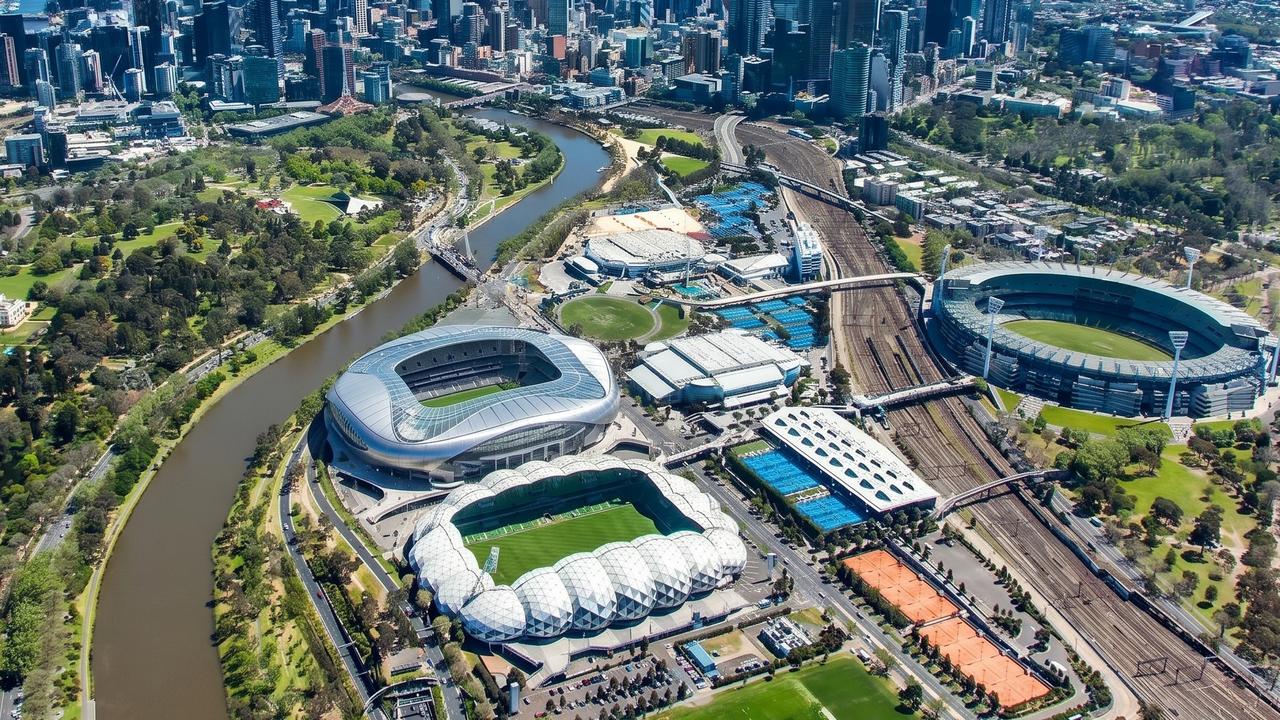
The president of Live Nation Australia and Tennis Australia’s former boss have led industry calls for a new 20,000-seat indoor arena in Melbourne.
“Melbourne has always been one of the strongest live entertainment cities in the world, and certainly Australia,’’ Live Nation Australia boss, Alex Klos, told the Herald Sun.
“We’ve been very strong advocates for a number of years now, for the need for a 20,000-seat arena in Melbourne.”
The call for the new arena was echoed by outgoing Tennis Australia chief executive, Craig Tiley.
Mr Tiley said a new roofed “multipurpose” arena should be at the top of Melbourne’s to-do list to ensure our city remains a world leader.
“It’s the next piece of build that needs to take place,’’ he said.
“An 18, 19, 20,000-seat venue would be ideal.”
Mr Tiley said the new arena should be built in the Melbourne and Olympic Parks precinct, in addition to venues already used for the Australian Open, NRL, NBL, A League and Super Netball matches.
Industry experts say the new arena would put Melbourne in the box seat to bid for more global major events such as NBA and NHL matches, UFC and boxing blockbusters.
It would also host indoor athletics, esports drawcards as well as concerts, helping the city reclaim its swagger and status as the nation’s sports and cultural capital.
Live Nation is the concert promotions giant behind world tours by Madonna, Beyonce, Coldplay, Oasis, Lady Gaga, Metallica, U2, The Weeknd, Travis Scott, Bruno Mars, and many more.
The city’s biggest indoor concert venue, the multipurpose Rod Laver Arena, opened in 1988 as the National Tennis Centre, and can host 15,000 concertgoers.
Margaret Court Arena holds 6500 people in concert mode, and John Cain Arena, 11,000.
Mr Klos said the number of arena shows by music artists has “easily doubled” since the pre-Covid era.
“The demand is there from fans, and the supply is there from an artist point of view,” Mr Klos said.
“But we are challenged on availability.
“As good as our precinct at Melbourne Park is, and Rod Laver Arena is a fantastic venue, it does have limitations around its capacity and functionality.
“From a scale point of view, we need a second arena, and it needs to be a bigger arena.
“We need that extra capacity to make the economics stack up more favourably for the promoter, and for the artist.
“A 20,000 seater arena is the sweet spot for a major international city.
“If you look at any developments around the world now, for major cities and new arenas, they’re all in that 20,000 seat capacity.”
Mr Klos said the concert promotion company is “not weathered to any one location” for a new arena in Melbourne.
“The first priority is, we need it. It’s important to our industry,” Mr Klos said.
“There are certainly a lot of benefits and synergies putting it into Melbourne Park precinct because you’ve got facilitating infrastructure like trains, access and proximity to the CBD.
“That precinct lends itself to putting a 20,000 cap arena there, but we’re flexible.
“There could be other locations.
“It’s all about ease of access. The fans need to get there easily to attend a show, and get home at the end of the night.”
Mr Klos said the best comparison of Melbourne’s need for a new arena is Manchester.
With a greater metropolitan population of around 2.9 million people, Manchester successfully supports both the AO Arena (21,000 capacity) and Co-op Live (23,500 capacity), located just four kilometres apart.
Together, those venues attracted about 1.8 million attendees in 2025, demonstrating how strong entertainment markets can sustain multiple major arenas while enticing a broad range of international touring, sporting and live entertainment content.
“Melbourne is definitely of the scale to support our belief that a second arena is absolutely warranted,” Mr Klos said.
“We’re not short of getting tier-one artists to perform in Melbourne at this point in time.
“But it’s become more challenging from the point of view that international competition is far more fierce now than it was five years ago.
“If you turn the clock back five years, the big touring markets were North America, Canada, UK, and Australia was probably number 4 on the list.
“Now you’ve got all these markets opening up in South America, the Middle East, Asia, and eastern Europe. Those markets are investing infrastructure, so there’s much more global competition to get the artists to come to Australia.”
He said touring acts consider several factors before committing to dates Down Under.
“They look at things like, ‘Are there fans, or demand in that market, and will I sell tickets?’ “Clearly, Australia ticks those boxes. Then they look at distance and costs to get here. That’s where Australia is challenged compared to these other markets.
“Then they look at infrastructure, the venues, and how those venues will allow them to maximise their earnings.”
Mr Klos added: “If you’ve only got a venue that can hold 14,000 or 15,000 people at best, compared to markets that have 20,000 or greater capacity venues, you do the economics: you can sell an extra 5000 tickets at every show you do. At an average ticket price, there is quite a lot of extra money for the artist to make that show more attractive.”
Promoter Paul Dainty, who has toured the Rolling Stones, Katy Perry, Eminem and Paul McCartney, supported the call for another arena. But he raised concerns about the cost.
“Who would pay for it in the current economic climate?” Mr Dainty asked.
Mr Klos said Live Nation is “open” to investing in a new 20,000-seat arena in Melbourne.
“We’re very vocal about our ambitions around that,” he said.
“It is a global priority to invest in venues because they are critical to continue to grow and drive the industry. But what we’ve always said is, the first priority for Melbourne, and for Australia more broadly, is we need more infrastructure.
“Someone has to make that investment, and typically, you would expect the government to fund social infrastructure. That’s the traditional model; government funds these assets and builds them.
“But governments don’t always have the money and capacity to do that. We’ve certainly said we’re happy to take the baton and do the heavy lifting, and make that investment to bring it to life because they are critical pieces of infrastructure that creates jobs, and brings economic benefits from venues that attract entertainment.
“We’re certainly open to investing if there’s an opportunity, but we’re also happy if the government wants to build it,” Mr Klos said.
“The thing is, if you push the button on a new arena today, it would take four or five years to bring it to life.”
Mr Klos said consideration should be given to a music-centric arena.
He added: “All of our venues in Australia have been built with a focus on sport. What we’d love to see is that model flipped the other way around; to build it for music, but it would cater for sport as well.”
Tennis boss Tiley said a new arena should tap into changing consumer habits, as well as technology such as AI and robotics.
“We’ve got to adapt that with our infrastructure and our infrastructure gets old really quickly,’’ Mr Tiley said.
“If you have a new arena, you’ve got look at not just a new seat … but how is that seat completely interacted with the needs of that consumer. You’ve gotta have connectivity.
“You’ve got to think of a modern design and a modern way of delivering it because the moment you start building it and you have people in the first time, it’s going to be dated.’’
He added: “If we build a 20,000 seat stadium today, if we build it for today’s needs, that’d be a mistake. You’ve got to build it full for the future needs.’’
Lord Mayor Nick Reece backed in the need for a speciality 20,000-seat arena to ensure the city remained a world leader in live events.
“We definitely need to be having a look at this,” Mr Reece told ABC Melbourne on Mondy
“We do need to keep up with other cities as the market for these sports and big entertainment gigs moves.”
Mr Reece highlighted the Fishermans Bend urban renewal project as a potential location for a new stadium, as opposed to the “well-used” Olympic Boulevard strip.
Victorian Premier Ben Carroll said Melbourne needed to remain a major events capital, but noted he was focused on delivering the basics.
“I want to be a premier that focuses on doing the essentials and the basics really well,” he said on Monday.
“Schools, breakfast programs, fixing potholes and filling them, not admiring them, making sure health and education are front and centre.
“Big, complex, costly projects will always have their role, and in relation to Melbourne Park, they should always be considering what is the next best thing and big thing for Melbourne and Victoria as a major events capital … But my focus right now is doing the basics.”