
After 13 years in the Royal Australian Navy, Emily Pyke realised if she encountered a fire her bra could catch alight beneath her protective uniform.
“When we think about a commercial bra … they were never designed to be worn in these conditions,” she said.
“Even though we’re wearing a protective layer on the outside, once that’s breached … a synthetic bra can actually melt under the outer protective wear.”
When she looked around to other industries, she saw her experience mirrored by women working as firefighters, electricians, miners and construction workers.

Emily Pyke left the navy last year to pursue her vision of creating fire-resistant underwear for women in frontline services. (Supplied: Austrade)
“I continued to see the same gap,” she said.
“Women are wearing everyday commercial, synthetic, highly flammable products into these high-risk environments.”
It was not just bras she thought about either, but her own and other women’s menstrual needs.
“We’re sometimes wearing [uniforms] for many, many hours,” she said.
“Think about Border Force, conducting boardings. They’re on another vessel away from their main platform.
“There’s really nowhere to go to the bathroom when you’re thinking about a woman who needs to change.”
These realisations ignited a passion in Ms Pyke that led her to leave the navy a year ago and pursue her mission of making women on the frontlines safer.

The Irish and UK defence forces have also been trialling the fire-resistant underwear. (Supplied: Austrade)
“As someone who was the user for 13 years, I never got asked what could be done better to make me more comfortable,” she said.
“The fit, feel and function of something can be life-changing to a woman in a high-risk role that’s physically demanding.”The tech behind the idea
Ms Pyke started developing fabrics with a Sydney manufacturer that avoided highly flammable fibres like polyester and nylon.
What they achieved was a modacrylic fabric blended with other materials that was certified not to drip or melt when exposed to fire.
“Anything will burn at a high enough radiant heat or fire level,” she said.
“But when it catches on fire, it doesn’t melt to your skin, and there’s a point where it can self-extinguish if it’s a smaller flame that it’s been exposed to.”
The company has also been working to remove parts of a typically made bra that could be hazardous in fire environments.
“The wire, the foam, the excess elastic, the metal clips on the straps, because a lot of those are pressure points as well,” Ms Pyke said.
An engineer at the University of NSW, Imrana Kabir has been developing and testing the garments with Ms Pyke.
The senior lecturer specialises in fire retardant and defence-related materials, and said the technical underwear was filling a critical gap in Personal Protective Equipment (PPE) for frontline women.

Imrana Kabir in the University of New South Wales testing lab with the fire-resistant garments. (Supplied: Imrana Kabir)
“Even if you wear [outer] fire garments, the fire can actually affect your inner part of the body as well,” Dr Kabir said.
“You can get bruises and your skin can get affected.
“What we are developing is for women’s safety, so they are protected from beneath, rather than getting blisters and stuff.”
The company has been granted $200,000 from the NSW government to develop a second iteration of the fire-safe period undies and bras.
Dr Kabir said those garments would be tested by putting the underwear on a mannequin and putting fire resistant PPE over the top.
“We will heat up the area with fire, and then [flames] will eject from the fire placement and it will light up in fire the overcoat,” she said.
“We don’t know the result yet but most probably the bra and undergarment won’t be burned.”
Dr Kabir said her family has a defence background, which made the project profoundly personal.

Imrana Kabir says a mannequin will be dressed in the underwear and PPE before being exposed to fire. (Supplied: Imrana Kabir)
“Working on this especially [for] people who are risking their lives to save lives, and I am contributing to some of it, means a big deal to me.”Trial with firefighters and defence force personnel
The company tested its first versions of the fire-safe underwear with firefighters in Australia, and with Irish and UK defence forces.
It is now about to be sent to fire services in Western Australia and Victoria.
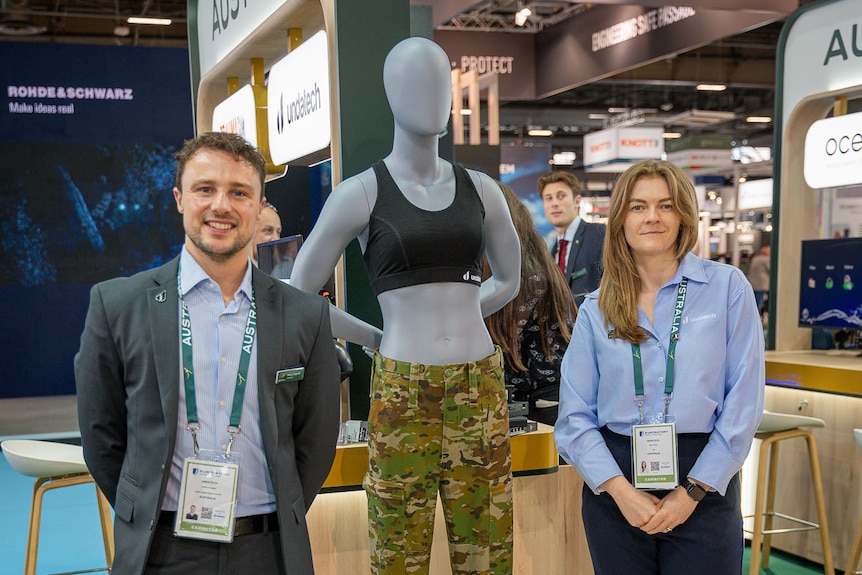
The second generation of the fire safe period brief and bras are being developed after a $200,000 grant from the NSW government. (Supplied: Austrade)
Ms Pyke said she was also discussing trialling the garments with mines and construction companies.
“We’ve really got to focus on getting these products right so that we start to recruit more women into these roles [and] retain more women,” she said.
“It’s nice to actually turn up to work and know that your uniform will fit, your safety equipment will fit, and you can comfortably and safely do your job.”