
Factory workers who helped make a Chinese-brand of camera glasses appear to have been unknowingly filmed by the devices in accidental videos.
7.30 bought a pair of budget glasses made by Shenzhen-based company Oho Sunshine online and found footage already on the device, which appears to be from inside the factory.
The collection of four short videos, dated last year, shows a number of workers sitting at their desks inspecting the glasses, while listening to jaunty electronic music.

Video appears to have been filmed inside a factory while the glasses were being made. (ABC News)
One video clearly identifies a worker lifting a pair and shaking them vigorously.
Another three videos, up to 10 minutes long and dated this year, show only black with atmospheric audio, suggesting the glasses were activated while inside a case or box.
The shoot button on the side of the frames is sensitive and easily switched on.

The workers appear to be filmed unknowingly by the glasses. (ABC News)
7.30 approached Oho Sunshine, with questions about the apparent privacy breach but received no response.
Oho Sunshine was founded in 2009 in the Chinese city of Shenzhen in Guandong province, north of Hong Kong, as a smart wearable technologies manufacturer, according to the company’s website.
The accidental leak perhaps proves not even the workers who make camera glasses are safe from being filmed and provides a rare insight into the globalised production chain.
Do you know more about this story?
Contact Jason Om at Om.Jason@abc.net.au.
Rise of camera glasses
7.30 reporter Jason Om wearing the Oho Sunshine camera glasses that already had footage on them. (ABC News: Craig Hansen)
Camera glasses are enjoying a surge in popularity as cheap brands flood the market. Oho is just one of numerous companies manufacturing similar devices.
They look like ordinary glasses and allow you to record video and audio, largely without people knowing.
While some models have a built-in light to indicate filming, there are now services that remove the indicator cheaply.

A pair of Ray-Ban Meta glasses. (ABC News: Shaun Kingma)
The glasses can play music and make calls, with more high-tech versions allowing users to live-stream or swipe through messages on a display in the lenses.
Meta’s fashionable Ray-Ban smart glasses can cost up to $700 a pair, but basic versions can be bought online for as little as $40.
Kmart Australia’s $89 Anko brand of camera glasses recently sold out, prompting an online petition to stop their sale amid concerns about privacy and their use by male content creators recording women without their knowledge and uploading the videos to potentially millions of followers.
While filming in public places is generally legal, the devices have raised new concerns around privacy.
Filmed without consent on ‘rizz cam’
Beth Knight was filmed with camera glasses at a train station and later found the video of herself online. (ABC News: Daniel Ioh)
Beth Knight, 18, found herself the subject of lurid commentary from online users after a man filmed her with camera glasses and uploaded it to social media without her knowledge.
At the time of the incident late last year, she was 17 and by herself at London’s busy Waterloo station.
“I’d missed my train, so I had 40 minutes to wait in the station,” Ms Knight told 7.30.
“Then pretty much immediately a man approached me and opened with, ‘I’ve seen you, I found you attractive,’ and I immediately shut him down, and I said I had a boyfriend.”
She discovered that their conversation had been turned into content after she heard about other cases.
“I started looking up buzzwords. I was looking up, “picking up girls”, “Meta Glasses”, “Waterloo”, all of those into the TikTok search bar, and that’s when I found his page.”
She saw a video of her interaction titled, “POV: You approach her instead of walking by”.

Beth Knight says she asked the content creator to remove the video of her and he blocked her. (Instagram)
“It was framed as a successful pick-up, like a win, when I know in the moment I was incredibly uncomfortable … because it was a strange man refusing to accept my soft hint of a no,” she said.
“He had very much framed it as, ‘Look, I’ve picked her up, I got her Instagram, I’ve won here,’ and over the top of the video he was instructing men watching that when girls say they have a boyfriend they’re lying.”
Ms Knight was not lying and thought the man would get the message and leave.
The man is a content creator who touts himself as a pick-up artist and advertises male coaching on his social media account.
Digital extremism researcher Milica Stilinovic, from Sydney University, said such content was known as “rizz cam” — rizz being slang for charisma — where women are sometimes filmed without their consent.
“I would find it horrendous to be treated that way and then subjected to a global audience,” she told 7.30.
Ms Stilinovic led a study that reviewed more than 350 Instagram videos filmed with camera glasses.

Milica Stilinovic is concerned about the use of camera glasses. (ABC News: Shaun Kingma)
“Pick-up artists are adjacent to the manosphere, or part of the manosphere, and they have a dual purpose to exist,” she said.
“One is to build the self-confidence of men, supposedly through the subjugation of women, and the second part is to sell male coaching, which is basically like a multi-level marketing scheme.
“Some of the worst examples included underage girls. Some of [the filmers] approached women who were inebriated. Some of them approached women who were semi-nude at beaches.”
Ms Knight said her experience left her feeling angry.
“It’s weird to watch it back,” she said.
“But the anger definitely came from the fact that it was spun so heavily to look good on his part.
“I went home and sobbed to my parents.”
She said she asked the content creator to take the video down, but he blocked her.
7.30 has contacted the creator for comment, but he did not respond.
Is it legal?
According to Australia’s Privacy Commissioner, Carly Kind, the use of camera glasses in public is largely legal, with laws varying across states.
“Wearing smart glasses in public to capture images of things that happen in public is generally not illegal under Australian law,” Ms Kind told 7.30.
“[But] when you are in a private premises or a private space, and that might include a private home, a vehicle, or potentially a semi-private space like a gym or a workplace, for example, then you’re likely going to run up against laws that do prohibit the use of surveillance devices.”

Carly Kind is worried about the use of camera glasses in workplaces and around “vulnerable groups”. (ABC News: Scott Kyle)
In Victoria, where filming inside a private business is generally allowed, one content creator known as “The Latte Bloke” uses camera glasses to review coffee around Melbourne.
He is not a pick-up artist, but his videos feature staff and customers.

“The Latte Bloke” uses camera glasses as he reviews coffee around Melbourne. (Instagram)
One 19-year-old cafe worker said she did not consent to being filmed while serving him.
Her aunt, Tara Venn, told 7.30 her niece was upset after seeing herself in a video online.
She was new in the job.
“It was a bit affronting [for her],” Ms Venn said.
She said content creators should consider the ethics of filming someone.
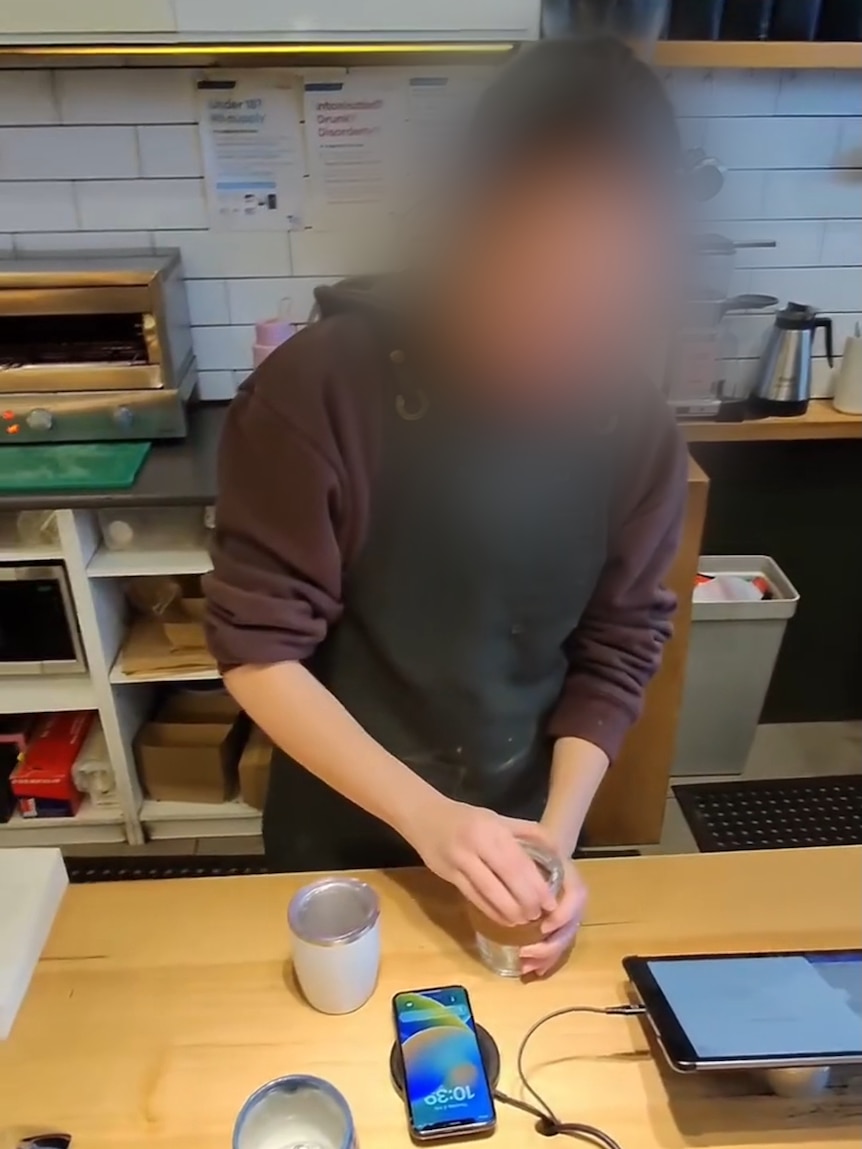
This cafe worker says she did not give consent to be filmed by The Latte Bloke. (Instagram)
“Common sense says you are polite and you ask if you are going to invade a person’s privacy by filming them without them knowing,” Ms Venn said.
“I just want people to think and to actually use good manners and decency.”
The content creator declined to be interviewed but told 7.30:
“Latte Bloke is all about filming the latte experience and having a bit of fun reviewing the coffee. The focus has never been on the staff or customers, and I’d never intentionally want to make anyone feel uncomfortable.”
Potential real-world consequences
Attorney-General Michelle Rowland has asked Australia’s Privacy Commissioner to make recommendations about camera glasses in Australia.
Ms Kind says she was already worried about them.

The Albanese government has asked the Privacy Commissioner to make recommendations about camera glasses. (ABC News: Shaun Kingma)
“If you think about their use in workplaces, there’s a high likelihood that corporate espionage could be permitted through these kinds of glasses without proper control,” Ms Kind said.
“I think the theft of personal information through the use of the glasses is also a potential offence that we could see spiralling out here, and [there are] obviously real risks around vulnerable groups, women and children.”
In New South Wales it is illegal to create or share sexually explicit videos or audio of someone without their consent.
Last year, new federal privacy laws made serious invasions of privacy an offence; however, the commissioner told 7.30 there was a high bar to prove it was intentional and caused harm.
In the UK, some pubs and restaurants have reportedly banned the devices, while in Germany, rights advocacy group HateAid has lodged a complaint to German prosecutors against Meta and other companies, claiming such devices breach the country’s covert recording laws.
Ms Stilinovic wants camera glasses temporarily banned in Australia.
“I would suggest that we stop the rollout of smart glasses until regulation and policymakers have caught up to keep societies safe,” she said.
Watch 7.30, Mondays to Thursdays at 7:30pm on ABC iview and ABC TV
Contact 7.30
Do you know more about this story? Get in touch with 7.30 here.