13 hours ago.
Updated 6 minutes ago
The Aboriginal corporation funded to support Alice Springs town camps and provide broader Indigenous safety and community programs spends more on employee costs than the entire Alice Springs council, which serves about 30,000 people in the Central Australian town.
As further evidence of dire town camp living conditions is published today, and demands grow for greater accountability on funding arrangements, The Australian can reveal the Tangentyere Council Aboriginal Corporation spent $24m on staff costs, its 2025 financial statement shows, while the Alice Springs Town Council, which services about 11,000 households, outlaid $22m in the same period. Both have a similar number of employees.
Tangentyere is funded to provide a range of employment, youth and domestic violence services as well as repairs and maintenance to the town camps, which contain about 256 homes for 1055 residents recorded in the 2021 Census. This figure is likely to be conservative and does not account for the fluctuating number of people travelling in from remote communities, which can lead to severe overcrowding.
Conditions across the estimated 16 town camps range from basic to unsanitary and some community leaders and residents are demanding to know where the $27m in government grants to Tangentyere last financial year is being spent.
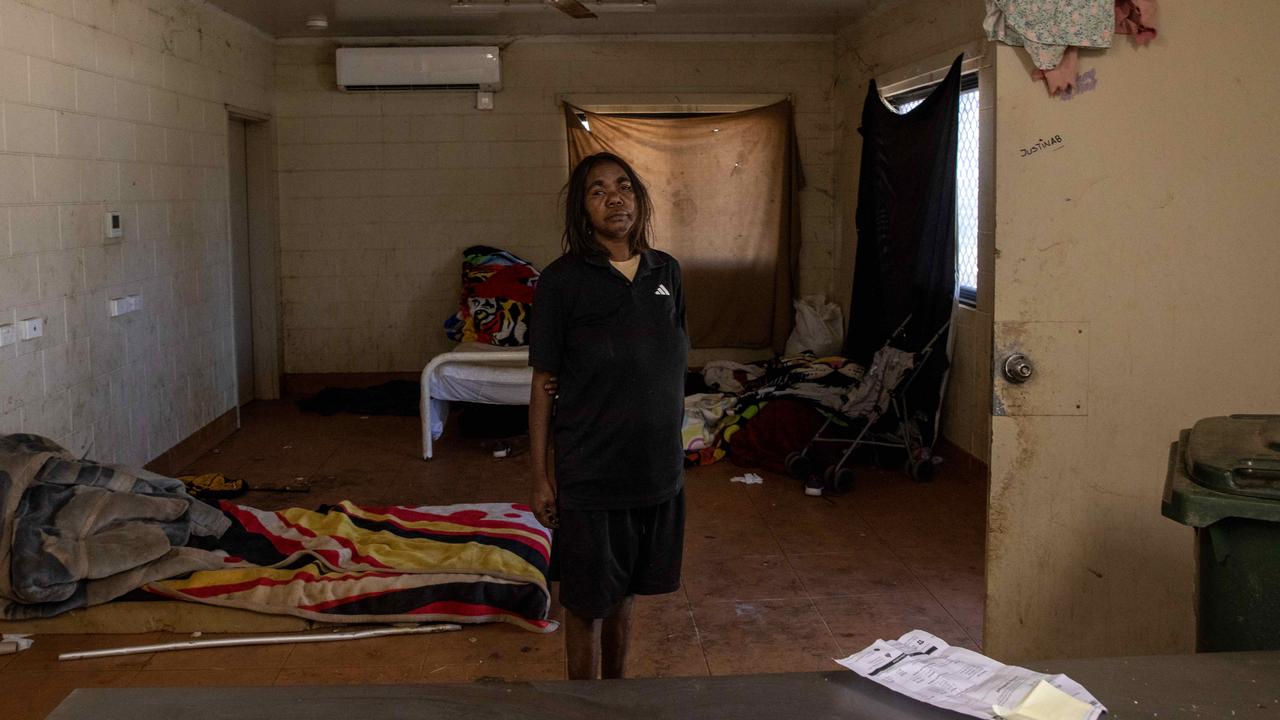
In the Karnte town camp, about five kilometres south of Alice Springs, resident Rhonda Bob, 37, told The Australian on Sunday that the shower and cooktop in the house she shared with her brother hadn’t worked for years, but her main worry was safety. She requires renal dialysis and is concerned an intruder may enter the house at night because the door cannot be locked.
“I don’t want anyone to come in … I need safety,” she said. “I’m worrying about this one,” she said as she pointed at a door with a non-existent latch.
Ms Rob said calls to Tangentyere had gone unanswered.
“When we called Tangentyere, they didn’t come and fix this,” she said as she pointed at the door. “I was waiting, waiting, waiting, waiting.”
She said they agreed they would attend: “But nothing, we didn’t see that Tangentyere mob come.”
In the bathroom, she held up the handle of a tap that was detached from the wall.
“I told them many years (ago) for this one. I was helping my brother, too, telling (them) to put new stove in, but that’s from long, long time.”
A senior Alice Springs elder, speaking on the condition of anonymity, said it was “concerning for everyone” that payroll costs for Tangentyere were $2m higher than the town council’s while the conditions in many of the overcrowded town camp homes were “unliveable”.
The elder, who branded Tangentyere “really secretive”, called for a change in leadership.
“It fell apart because there’s a lack of accountability, lack of responsibility. It needs a changing of guard. They’ve had the same cohort of people in there in charge since forever, and they’re not winning the game,” the elder said.
He said he “wouldn’t have a clue” where the millions of dollars in funding poured into the organisation were going.
The dire living standards in town camps have been in the national spotlight following the alleged abduction and murder of five-year-old Kumanjayi Little Baby, who was living in the Old Timers settlement on the edge of Alice Springs.
Federal Liberal senators Jacinta Nampijinpa Price and Kerrynne Liddle, both Aboriginal women who grew up in Alice Springs, have been demanding greater clarity on the opaque funding streams and more accountability from service providers, with calls for full external audits.
Senator Liddle said she had been unable to get detailed performance breakdowns from Tangentyere despite persistent probing.
“The problem is that all the money goes in there for programs, but if you look at their reporting of outcomes, it is rubbish; it’s all glossy pictures,” she said.
“They are supposed to be there for the community but then don’t provide any information to the community on what they are doing. The money just keeps pouring in and nothing comes out.”
Tangentyere, which has not published an annual report on its website since 2018, could not be contacted for comment on Sunday. Its financial statements are available through the Office of the Registrar of Indigenous Corporations and the Australian Charities and Not-for-Profits Commission.
Tangentyere says on its website that it offers services to more than 10,000 people across Central Australia, but many people who spoke to The Australian said they understood its primary functions were town camp services and community programs in Alice Springs.
The Northern Territory government is responsible for funding the town camps’ infrastructure and housing.
The National Indigenous Australians Agency, which leads commonwealth programs for Aboriginal communities, said in a statement that Tangentyere had met all its reporting requirements.
It said funding was distributed to the organisation for a range of services, including skills training and job opportunities, child and youth activities and community safety and wellbeing programs, including night and youth patrols. The Tangentyere website says it is also responsible for municipal and essential services, repairs and maintenance in town camps.
“For more than 40 years we have been a proud Aboriginal community-controlled organisation working with every household in the Alice Springs Town Camps,’’ it states.
Senators Liddle and Price said the issue wasn’t about building more houses. However, the National Commissioner for Aboriginal and Torres Strait Islander Children and Young People,
Sue-Anne Hunter, is leading calls for more funding for housing. She said there needed to be an “immediate investment into safe and secure housing delivered through Aboriginal community-controlled housing organisations”.
“Appropriate housing isn’t just a support service that aids in child safety; it’s a human right,” she said.
A Deloitte report into the Territory’s town camps in 2017 found that continuing to invest in town camps that offered “impossible economic integration” was pointless. “Quite simply this is investing in continued disadvantage,’’ it said.
It recommended incentivising and enabling town camp residents to transition, over time, to economic centres with employment opportunities.
Tangentyere criticised the findings. In its last published annual report it said the Deloitte report had portrayed Aboriginal community-controlled organisations in a negative light.
“TCAC disagrees with many of the qualitative assertions of the report which are heavily premised on the economic assumptions of the reviewer. In some cases, the assertions of the reviewer reflect a lack of context and a perspective that demonstrates non-Indigenous cultural relativism,’’ it said.