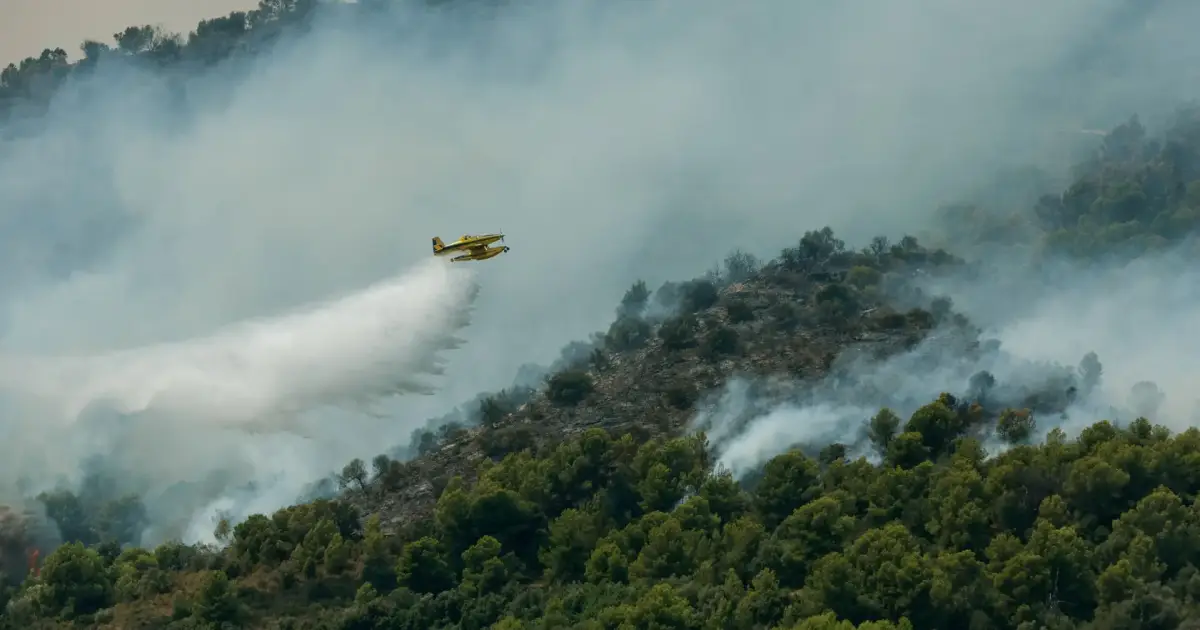
The European Commission has increased the number of aircraft mobilised to help fight the forest fires in Spain to six and has also deployed 134 firefighters and 41 vehicles from Portugal, as part of an expansion of the response activated last week at the request of the Spanish Government through the European Union Civil Protection Mechanism.
Last Friday, Brussels had sent four Canadair aircraft – two based in Greece and another two stationed in Italy – after Spain requested European assistance in view of the severity of the fires, particularly in the Community of Madrid and the province of Ávila, which have already ravaged more than 80,000 hectares across the country.
These resources have now been joined by two further aircraft from Turkey, bringing the total to six aircraft, as well as three Portuguese ground teams, according to a statement issued on Monday by the European Commission, which also specified that the Copernicus satellite emergency service is supporting operations on the ground and continues to assess how the situation is developing to determine whether additional resources need to be mobilised.
EU sources have clarified that extinguishing the fires is proving “particularly complex” due to the fires’ extensive perimeter and the fact that the flames are reaching residential and industrial areas – a situation that requires resources to be divided between directly tackling the fires, evacuating the population and protecting property and infrastructure.
They have also warned that, although the meteorological risk has fallen from the extreme levels recorded at the start of the incident, it has not decreased sufficiently to ease the burden on teams that have been working on the ground for several days.
“No country should have to face a disaster of this magnitude on its own,” said Hadja Lahbib, the European Commissioner for Preparedness, Crisis Management and Equality, who assured that the EU would maintain its support “until the fires are extinguished”.
In total, this summer the EU has deployed more than 770 firefighters from 14 countries to six states particularly vulnerable to wildfires – Spain, Portugal, France, Italy, Greece and Cyprus – as part of a preventative programme that ensures foreign personnel are on the ground before an emergency arises.
The Commission considers that the course of this season has been more severe than last year’s, both in terms of the intensity and the extent of the fires, although it warns that it is still too early to determine whether, by the end of the season, the area burnt will exceed that of 2025.
At the same time, the EU has mobilised seven aircraft and four helicopters from the Czech Republic, Croatia, Germany, Portugal, Slovakia, Sweden and Turkey, most of which form part of the European ‘rescEU’ fleet. A Commission liaison officer is also in Bordeaux to help the French authorities coordinate international assistance in tackling these fires, which have already spread across more than 42,000 hectares and remain out of control, according to the same sources.
France is also receiving bilateral support from Switzerland, outside the EU Civil Protection Mechanism, whilst Brussels is also maintaining an active operation in Tunisia, where an Italian Canadair based in Sicily is carrying out daily round-trip missions to support local teams.
In the meantime, Spain’s Ministry of the Interior will convene the autonomous communities, including the Balearics, this Wednesday to address the national emergency caused by the forest fires The PP-led communities will call for “greater coordination” and “more resources” from the Government
This was announced on Monday by the PP’s Deputy Secretary for Institutional Regeneration, Cuca Gamarra, at a press conference where she clarified that this meeting “is not new” and that “it was already planned”.
Gamarra noted that the autonomous communities governed by the Partido Popular will attend the meeting with the intention of calling on the Government for “greater coordination” and “more resources” to tackle the wave of fires, although she emphasised that they will do so “out of institutional loyalty” and with a willingness to “pull their weight”.
“We must overcome this national emergency. It is going to be a difficult summer,” warned Gamarra, who insisted on the need to strengthen cooperation between administrations to tackle the forest fires.