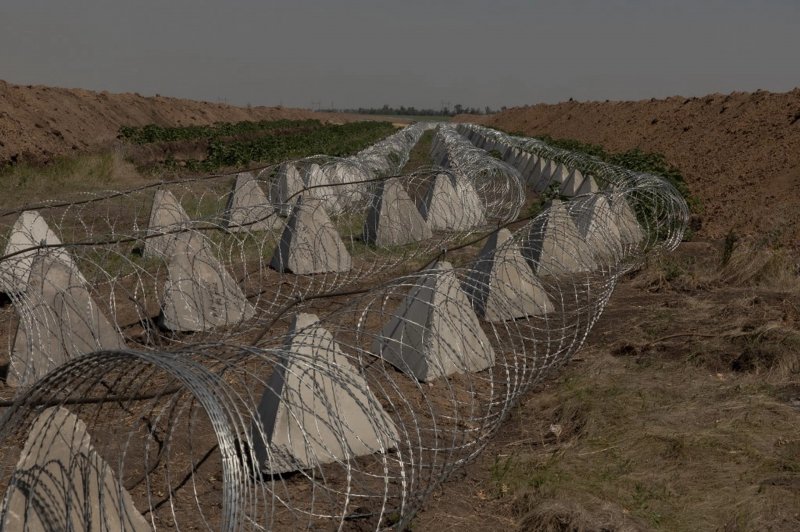
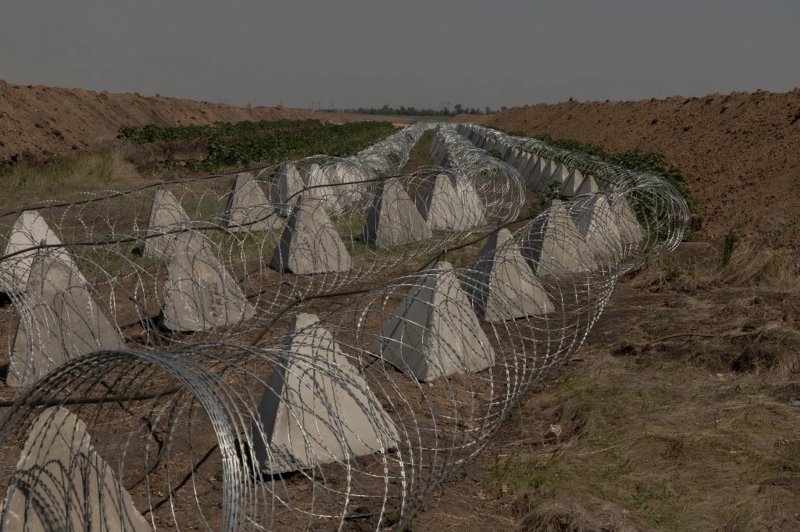
Illustrative photo. This photograph shows “dragon’s teeth” fortifications installed by the Ukrainian military, in the eastern Donetsk region, on July 9, 2025, amid the Russian invasion of Ukraine. (Photo by Roman PILIPEY / AF
In the Chernihiv Oblast region of Ukraine, border guards and engineers are constructing a defensive line along the border with Belarus, transforming forests and marshland into a layered system of wire, trenches, and anti-tank concrete obstacles designed to deter any potential surprise incursion.
Ukrinform spoke directly with the border post commander Yevhen, callsign “Nissan,” from the State Border Guard Service of Ukraine, in an on-site interview near the Ukrainian-Belarusian border in the Chernihiv region, News.Az reports, citing Kyiv Post.
“Engineering barriers consist of a complex of artificial and natural obstacles,” Nissan explained. “Artificial ones are low-visibility wire obstacles and ‘Egoza’ [registered trademark for a highly durable type of reinforced razor wire]. Natural ones are forest blockages,” he added.
“We use nature as an ally,” Nissan said. “A tree can be cut so that it falls at a certain angle and stays half-sawn. It simultaneously stands, overhangs, and seriously complicates movement for vehicles and infantry.”
Dragon’s teeth anti-tank barriers
“Dragon’s teeth” are concrete barriers that weigh around 1.5 tons, and are about 10 meters (33 feet) wide, designed to block likely routes for armored vehicles. In the Chernihiv region, they have been placed alongside the forest edge. Behind them, Ukrinform reports, lie deep anti-tank ditches with steep vertical walls – the result of weeks of excavator work in heavy, waterlogged soil.
Much of the defense system, however, remains almost invisible.
Thin, strong wire is strung low between the trees as a low-visibility obstacle, while belts of “Egoza” razor wire form continuous traps for soldiers and a critical hazard for vehicles.
Nissan notes that the local terrain helps greatly – dense forest limits enemy aerial reconnaissance, and off-road heavy equipment tends to bog down in the marshes, even as those same conditions make construction more demanding.
Building the border since 2022
The commander notes that they haven’t stopped building the defense layer since Russia’s initial advance through the area in 2022, when war had just begun.
“The build-up of engineering infrastructure goes on constantly,” Nissan said. “Compared to the first months after de-occupation, volumes have increased by about 500%. It’s a continuous, echeloned system that stretches for kilometers along all our land borders,” he added, explaining that there can’t be too many obstacles.
“To be sure 100% that even a bird will not fly through is impossible,” Nissan said. “But we are ready for any development.”
Behind those figures lies the daily work of digging and wiring. One excavator cuts up to about 200 meters (656 feet) of anti-tank ditch per day, depending on bucket size, and two soldiers can lay about 100 meters (328 feet) of “Egoza” wire in roughly four hours, with ten soldiers closing up to a kilometer in the same time.
On average, as per the report, a unit can prepare around 500 meters of reliable barrier in a day.