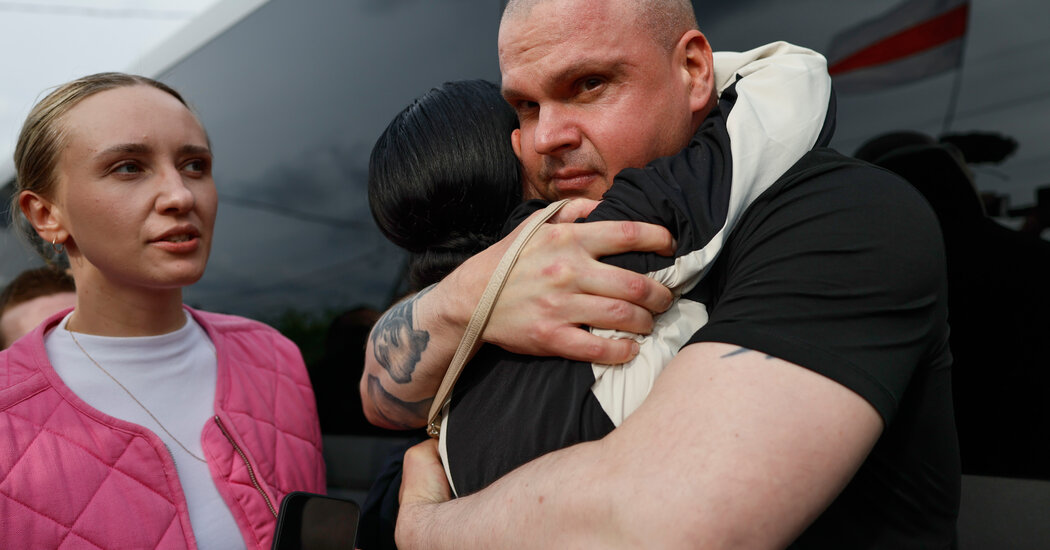
Belarus on Wednesday released 25 political prisoners after a visit from President Trump’s envoy, continuing a thaw in relations between the United States and the Eastern European nation’s autocratic leader, Aleksandr G. Lukashenko.
The prisoner release was the latest in a long series that began last year when the Trump administration, unlike the European Union, shifted away from sanctions against Belarus — Russia’s neighbor and closest ally — to embrace negotiations.
The United States had hoped to get 200 people released on Wednesday. Despite getting far fewer freed, the Trump administration appeared eager to push on with rapprochement, hoping that Mr. Lukashenko, a tough and cunning negotiator seasoned by years of dealing with the Kremlin, will release more later.
The prisoner release followed talks in the Belarusian capital, Minsk, between Mr. Lukashenko and the U.S. special envoy for Belarus, John Coale, a lawyer and friend of Mr. Trump’s with little previous government experience.
In a telephone interview, Mr. Coale said he was “almost positive” that a larger number of prisoners would be released “about a month from now.” Declaring his talks a success, he said, “We used what you would call Donald Trumpism — very friendly, but very direct — and we got a lot of things done.”
Brussels and Washington, which used to denounce Mr. Lukashenko as “Europe’s last dictator,” started imposing sanctions on Belarus decades ago over human rights violations and other issues. They sharply expanded these after Belarus let Russia use its territory as a staging ground for the full-scale invasion of Ukraine in February 2022.
While previous U.S. administrations believed that punishing Belarus would help push Mr. Lukashenko away from the Kremlin, that never happened. The Trump administration, which also wants Minsk to be less beholden to Moscow, sees Belarus as proof that its more transactional approach works, even if it has done little to loosen Mr. Lukashenko’s iron grip on the country.
This prisoners-for-sanctions relief deal was at least the fifth and followed the release of 250 prisoners in March in tandem with the removal of American sanctions on Belarus’ producers of potash fertilizer, the country’s largest source of export earnings.
Belarus’s state news agency, Belta, reported that, in exchange for the prisoners, Washington would lift sanctions on a state chemical company, Lakokraska, and a trading firm, Bellesbumprom.
Mr. Lukashenko, who has ruled Belarus since 1994, controls an expansive security apparatus that has arrested thousands of people since it began a brutal crackdown on dissent after nationwide street protests in 2020.
The protests followed implausible claims by Mr. Lukashenko to have won a landslide election victory, his sixth in a row, amid widespread reports of fraud. Last year, facing only phony regime-vetted candidates, he won yet another election, with more than 86 percent of the vote, an even bigger landslide.
Before Wednesday’s releases, a human rights group, Viasna, estimated that Belarusian jails held 916 political prisoners, down from 1,226 last February, the start of the U.S. rapprochement with Belarus.
In his talks with Mr. Coale, also attended by Ivan Tertel, the head of Belarus’ KGB security service, Mr. Lukashenko said his jails had no political prisoners, only criminals who broke the law. He urged the U.S. envoy not to believe “defectors spreading stories,” according to Belta.
Those released on Wednesday, including three rock musicians, journalists and advocates of a Belarusian cultural identity separate from Russia, left Belarus for neighboring Lithuania.
From the Belarusian capital, Mr. Coale traveled by car to Lithuania for talks with Prime Minister Mindaugas Sinkevicius that were expected to focus on the European Union’s continuing sanctions against Belarusian potash.
Belarus, which is landlocked, used to export much of its potash through the Lithuanian port of Klaipeda. The E.U. closed that route after the start of the full-scale invasion of Ukraine to punish Mr. Lukashenko for his support of Moscow and to force him to reconsider his close ties to the Kremlin.
Instead, the sanctions pushed him further into Russia’s orbit, as Belarus rerouted its exports through Russian ports.
Washington is hoping that the European Union will allow Belarus to resume potash shipments from Lithuania, which would help reduce global prices. “The potash deal is in very good shape to ship potash from Belarus to the U.S., which President Trump wants,” Mr. Coale said. “I met with the president of Lithuania today and am meeting the president of Latvia tomorrow to get everyone on the same page.”
Releasing prisoners has not only helped Mr. Lukashenko dampen criticism against him in Washington, but has also served his domestic political interests by undermining an exiled opposition movement led by Svetlana Tikhanovskaya, a former presidential candidate. She declared victory in the 2020 vote and then fled to Lithuania at the start of the post-election crackdown. She has since relocated to Warsaw.
Ms. Tikhanovskaya’s husband, Sergei, who was arrested before the vote to prevent him from running, was set free last year and has spent recent months feuding with his now-estranged wife and her aides over their use of grant money provided by foreign governments.
He has complained bitterly that opposition media outlets controlled by Ms. Tikhanovskaya’s office have denigrated former prisoners like himself and Maria Kolesnikova, a popular opposition figure who was released from prison in December. She is viewed by many Belarusians as a symbol of courage and resistance because of her refusal to leave Belarus when authorities tried to forcibly expel her in 2020.