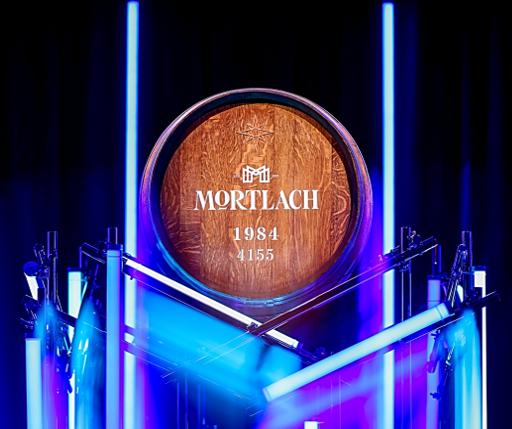
The 1984 Mortlach, one of the oldest Mortlach expressions ever bottled was among the stand out offerings in the 2025 Casks of Distinctions bottling.
Photo, courtesy Diageo
For decades, owning an entire cask of mature Scotch whisky was largely the preserve of distilleries, independent bottlers, and a handful of wealthy collectors. Today, private cask ownership has become one of the fastest-growing segments of the luxury whisky market. Yet as more producers enter the category, Diageo has deliberately positioned its Casks of Distinction program as something fundamentally different; not simply an opportunity to purchase whisky, but an invitation into one of the world’s most exclusive whisky communities.
Established in 2017, the invitation-only program sits at the summit of Diageo’s luxury whisky portfolio, offering fully mature single malt and single grain Scotch whiskies selected from the company’s inventory of more than ten million maturing casks. Unlike many private cask programs that offer relatively young whisky with the promise of future maturity, Casks of Distinction focuses exclusively on casks that Diageo’s master whisky makers believe have reached their optimal moment for release. That philosophy has helped transform the program into one of the most prestigious offerings in the ultra-premium spirits market.
Recently, I spoke with Tod Bradbury, Diageo’s Global Private Client & Commercial Director, about how the program has evolved, how the casks are selected, and why the company believes Casks of Distinction represents far more than another luxury whisky offering.
Bradbury is quick to resist describing the initiative as merely a sales platform. Instead, he sees it as a deliberately curated matchmaking service built around shared passions and long-term relationships. “The Casks of Distinction program was created to match up the rarest whiskies with like-minded collectors and connoisseurs,” he explained. Rather than simply offering whatever stock happens to be available, Diageo seeks to pair individual collectors with casks that reflect their personal preferences, whether those lie with heavily sherried Speyside malts, elegant Highland whiskies, maritime Island expressions, or increasingly scarce ghost distilleries.
Over time, that approach has created what Bradbury describes as “micro-communities” of owners who meet at distilleries and private events, sample one another’s whiskies, share stories, and celebrate the experience of stewardship. In that respect, ownership extends well beyond the acquisition of a rare cask and becomes participation in an exclusive community of enthusiasts.
Tod Bradbury, head, Global Private Client and Commercial Director
Photo, courtesy Diageo
Within Diageo’s luxury portfolio, Bradbury places Casks of Distinction alongside bespoke experiences such as the Johnnie Walker Vault blending program. Yet he is unequivocal about its position, describing it as “the pinnacle of Diageo Luxury Group’s bespoke offering.” That claim is supported by the extraordinary breadth of Diageo’s Scotch whisky inventory, which includes both celebrated active distilleries and some of Scotland’s most sought-after silent sites, including Brora, Port Ellen, Caledonian, and Pittyvaich. Few whisky companies possess comparable reserves of mature stock.
One of the defining characteristics of the program is that clients purchase whisky that has already reached full maturity. Bradbury emphasizes that these are “fully matured stock, selected at their peak by our Master Whisky Makers,” rather than speculative young casks that may not be bottled for decades. In an increasingly crowded private cask market, this distinction has become one of the program’s strongest points of differentiation. Collectors are not buying potential; they are buying whisky whose personality has already fully emerged after decades in wood.
The process by which those casks are selected is equally rigorous. Each year, Diageo’s master whisky makers devote more than 4,200 hours to evaluating mature inventory across the company’s warehouses. Bradbury describes them as the “gatekeepers of the program,” responsible for identifying those rare casks that represent a distillery at its absolute peak. Only after extensive discussion and unanimous agreement is a cask admitted to the Casks of Distinction collection.
Despite Diageo’s vast inventory, the number of casks released each year remains deliberately small. Bradbury insists that scarcity is not manufactured but inherent in the program’s philosophy. “This has never been a program about scale,” he said. Rather than maximizing sales, the objective is to identify the right owner for each individual cask. That approach is reflected in the annual Twelve release, in which just twelve exceptional casks are selected from millions of casks maturing throughout Scotland.
Ownership itself is designed to be an evolving experience rather than a simple commercial transaction. Purchasers may choose to continue maturing their casks for up to five additional years, provided the whisky’s strength and condition permit further aging. During that time, owners can visit Royal Lochnagar, where all Casks of Distinction casks are housed, request samples, personalize bottling and labeling, commission artwork for the cask ends, and participate in a range of private experiences across Diageo’s Scotch whisky portfolio. As Bradbury puts it, ownership is “not simply a transaction, but the start of a journey.”
That passage is underpinned by a firm emphasis on provenance. Every cask remains safely stored at Royal Lochnagar, where it is inspected, regauged, and monitored annually. Full documentation provides a transparent chain of ownership from acquisition through eventual bottling, an increasingly important consideration as private cask ownership expands internationally and collectors seek confidence in both authenticity as well as rarity.
While internationally recognized names such as Talisker and Mortlach continue to attract strong demand, Bradbury believes today’s collectors are becoming noticeably more adventurous. “There is growing interest from collectors for the lesser-known distilleries that may add a distinctive edge to their collections,” he observed. Ghost distilleries remain highly desirable, but experienced buyers are increasingly drawn to overlooked names such as Glenlossie, Glen Spey, Linkwood, and Knockando—distilleries whose production historically disappeared into blends but whose individual character has come to be increasingly appreciated by knowledgeable enthusiasts.
Viewed purely as a commercial initiative, Casks of Distinction undoubtedly ranks among the whisky industry’s most exclusive luxury offerings. Yet throughout our conversation, Bradbury consistently returned to another idea: relationships. Owners meet one another, visit distilleries together, share bottles from their collections, and watch their casks mature over time. In an increasingly online luxury marketplace, that emphasis on personal connection may prove to be the program’s greatest innovation.
As Bradbury concluded, the continuing appeal rests in “the experience of owning something unique and rare, of their own.” It is a proposition that goes beyond whisky itself, offering collectors not merely exceptional Scotch but also an experience of stewardship, provenance, and belonging that traditional luxury retail rarely provides.
With several casks from the 2025 collection still available and the 2026 Casks of Distinction release scheduled for autumn 2026, Diageo appears resolved to maintain the program’s carefully selected nature. Rather than simply selling rare whisky, the company is building a community of collectors connected by a common appreciation for some of the finest and rarest Scotch whiskies ever produced.