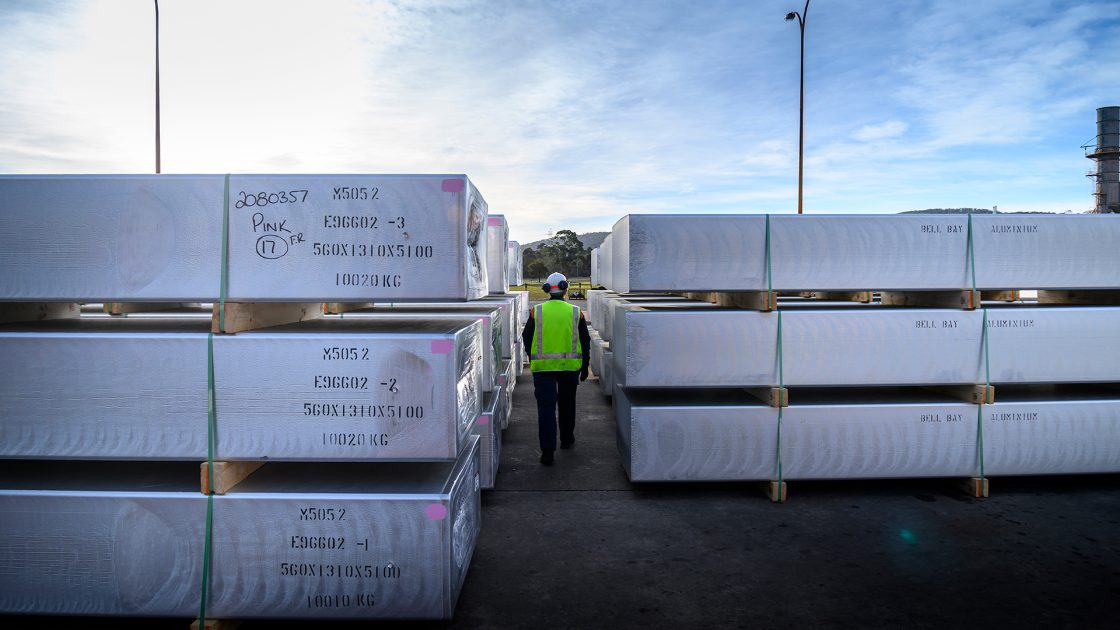
The future of mining giant Rio Tinto’s (ASX:RIO) Bell Bay aluminium smelter in Tasmania remains uncertain, amid negotiations over a new 10-year electricity agreement with Hydro Tasmania facing an estimated $60 million annual pricing gap.
Tasmania Energy Minister Nick Duigan says the difference is between the power price Rio Tinto says it needs to keep the smelter viable and the lowest price Hydro Tasmania can commercially offer.
According to the Shanghai Metals Market (SMM), the current power agreement, expiring on 31 December 2026, puts more than 550 direct jobs at risk if a new agreement cannot be reached.
The Tasmanian Government is calling for federal support to help bridge the gap, while uncertainty has emerged over Bell Bay’s access to Australia’s $2 billion Green Aluminium Production Credit Scheme. The Australian Government has indicated Bell Bay would be eligible, but recent comments suggest the credits are primarily intended for smelters transitioning from fossil fuel power to renewables, whereas Bell Bay already operates on hydroelectricity, as reported by SMM.
The uncertainty surrounding the Bell Bay smelter highlights a broader challenge for Australia’s ambitions to build a domestic green metals industry.
For aluminium-focused explorers, developers, and producers looking to move further downstream, access to competitively priced renewable power is becoming just as important as access to the underlying mineral resources.

Downstream opportunity near Bell Bay
The Bell Bay power negotiation is relevant to companies seeking to develop higher value products from Australia’s aluminium resources, particularly those operating within the broader Bell Bay industrial precinct.
For example, ABx Group (ASX:ABX), through its 83%-owned subsidiary ALCORE, is developing commercial hydrogen fluoride and aluminium fluoride plants near Bell Bay in Tasmania. ALCORE has achieved a maximum 97% fluorine recovery using a bath pilot batch reactor.
The pilot plant will show ALCORE’s world-first proprietary process for producing hydrogen fluoride from a by-product generated during aluminium smelting.
In mid July 2026, ABx began civil works for the construction of the pilot plant at the ALCORE Technology Centre. The company is focused on progressing civil construction works, the site power upgrade, manufacturing and delivery of major process modules, detailed balance-of-plant design, and pilot plant 3D modelling.
As this news service reported, CEO Mark Cooksey says that by producing hydrogen fluoride from aluminium smelter bath rather than imported fluorspar, ALCORE can improve domestic supply security.
“This view is supported by ALCORE’s ongoing engagement with participants across the global fluorine industry,” Cooksey notes.
The project provides an example of the downstream opportunities that can emerge around Tasmania’s existing aluminium infrastructure.
The juxtaposition of Rio Tinto’s negotiations with Hydro Tasmania and ABx’s plans near Bell Bay emphasises the same issue. Australia has the resources and renewable energy potential to build a more integrated aluminium industry, but the economics of converting those advantages into competitive downstream production will depend on access to reliable, affordable power.

Aluminium’s main ore
Rio Tinto’s challenge underscores the importance of securing reliable supplies of the raw materials underpinning Australia’s aluminium industry, beginning with bauxite.
Bauxite is the main ore used to make aluminium, and Australia is the world’s largest producer of the reddish clay-like rock. In 2024, the nation’s bauxite production totalled 100.20 million tonnes (Mt), exporting 42.60Mt of bauxite and the remainder converted to Australian alumina.
Australian alumina production totalled 17.54Mt in 2024, maintaining the country’s position as the second largest producer and the world’s largest exporter, with 14.73Mt exported the same year.
Metro Mining (ASX:MMI) is an Australian miner and explorer which owns the Bauxite Hills Mine in Queensland — a single operating mine which contains an estimated reserve of 77.7Mt and a total resource of 114.4Mt, as of December 2024.
The company continuously achieves record shipments, as in Q2 2026, Metro increased its bauxite shipments by 7% compared to the same period last year from the Bauxite Hills Mine.
In Q2 2026, 1.8 million wet metric tonnes of bauxite were shipped, alongside 779,000 wet metric tonnes in June alone, representing a 29% increase from May 2026.
CEO Simon Wensley says in June, the company showed proof-of-concept of its new integrated planning and operating system.
“I expect our focus on production reliability, grade control and planning to coincide with excellent mining and shipping conditions to deliver over 5Mt in the second half of 2026,” Wensley says.
“As most of our freight is fixed, this will deliver lower operating costs straight to the bottom line in likely strengthening market conditions, as Guinea producers seek to cover freight and diesel cost rises.”

A specialised product
As demand for lower carbon and higher value materials grow, attention is also shifting beyond conventional aluminium production towards specialised products such as high-purity alumina (HPA).
HPA is a synthetic, ultra-refined aluminium oxide, serving as a critical material in high-tech manufacturing. The material is used in semiconductors, lasers, LED lighting, sapphire glass, catalysts, and lithium-ion batteries.
According to the Commonwealth Scientific and Industrial Research Organisation (CSIRO), the global HPA market is projected to increase from US$4.63 billion in 2024 to over US$15 billion ($21.27 billion) by 2030, presenting an opportunity for Australian explorers and developers.
Impact Minerals (ASX:IPT) is focused on establishing itself as a key player in the HPA industry through project development, as well as rigorous technical and financial evaluation.
The company’s Lake Hope Project, located in Western Australia, hosts high-grade aluminous clays in salt lakes, with a reserve of 1.7Mt @ 26% for 450,000 tonnes and a resource estimate of 800,000 tonnes of aluminium oxide @ 25.1%.
In late July 2026, the company’s 50%-owned associate Alluminous completed the first technical milestone in a joint development program with New York-based battery technology company Charge CCCV (C4V).
The particle-engineering phase tested whether Alluminous’ HPA could be processed to meet the requirements of lithium-ion battery separator coatings without affecting its chemical purity.
C4V used its proprietary dry particle-engineering technology to produce material with the targeted particle size distribution and morphology. Analysis showed 90% of the particles measured less than 3 microns, while 10% were below 500 nanometres.
Testing found the HPA retained its purity during processing and was of the alpha crystal form. Both companies also prepared stable, sodium-free, water-based slurries for battery separator coating evaluation.
Managing Director Mike Jones says the company’s story “stands out” due to its innovative approach to HPA production.
“Which aims to deliver a more cost-effective and sustainable solution, as well as our exposure to commodities that are critical for the global energy transition,” Jones previously told this news service.
Ultimately, Rio Tinto’s Bell Bay smelter highlights a challenge extending beyond the single smelter itself. It highlights whether Australia can turn its bauxite resources and renewable energy advantage into a globally competitive aluminium and advanced materials industry.
For miners, developers, and explorers across the aluminium value chain — such as downstream processors like ABx Group, bauxite producers like Metro Mining and project developers like Impact Minerals — access to reliable and affordable power will be critical to capturing more value domestically.
The outcome of the Bell Bay negotiations could offer an important signal for the future of Australia’s green metals ambitions.
Bell Bay began operating in 1955 and has produced 187,000 tonnes of aluminium.
Australia produces around 1.58Mt of primary aluminium — making the country among the top 10 producers globally, as reported by the Australian Aluminium Council.
Write to Aaliyah Rogan at Mining.com.au
Images: Rio Tinto, ABx Group, Metro Mining, & Impact Minerals
Add to Watch List:ABx GroupAluminaMineral ResourcesImpact MineralsAustralian GovernmentCSIRORio TintoMetro MiningAluminiumAluminaBauxiteOther Minerals