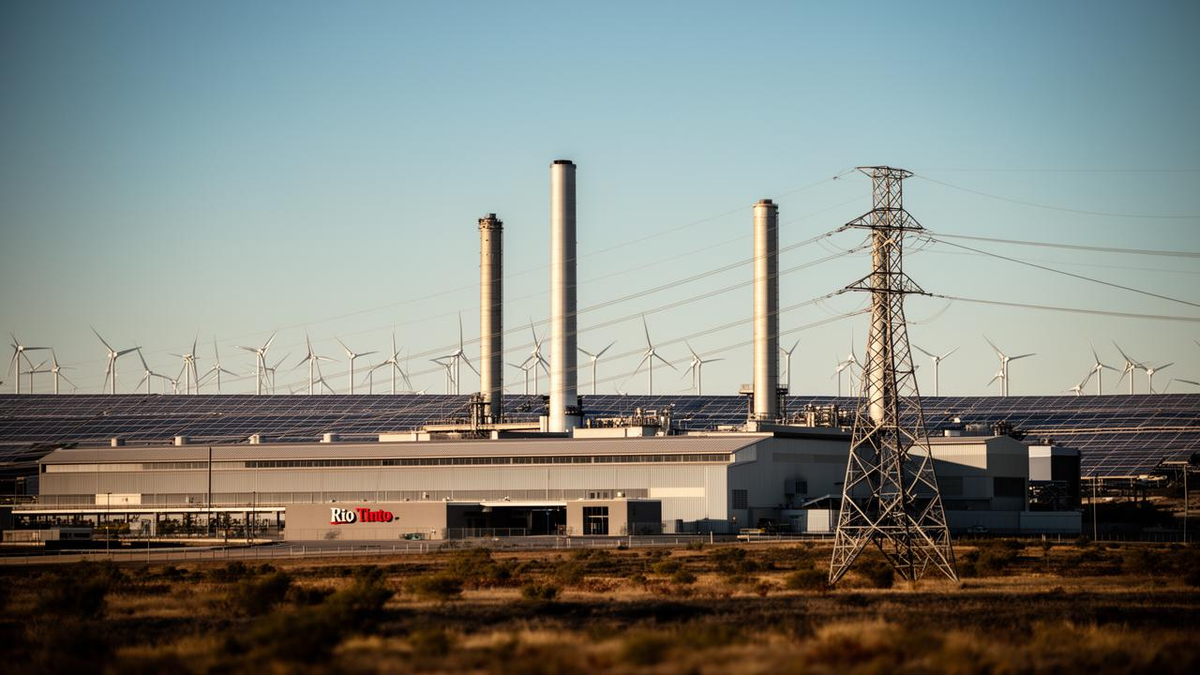
Australia’s federal government announced on the 13th that it will contribute A$2.5 billion (US$1.76 billion, approximately ¥280 billion) to secure cheaper and more stable power supply for the Tomago Aluminium smelter — the country’s largest aluminum smelter operated by mining giant Rio Tinto — ensuring its continued operation beyond 2028.
According to a government statement, the agreement will support 3 gigawatts of new generation capacity for the smelter. Funding will be jointly provided by the federal government and the New South Wales (NSW) state government.
As part of the agreement, Tomago Aluminium will invest at least A$1.1 billion in the facility from 2026 through 2038, with A$100 million of that earmarked for advancing decarbonization at the smelter.
Rio Tinto warned in October 2025 that the Tomago smelter — the country’s largest single electricity consumer — could be forced to close if it could not secure commercially viable power beyond 2028. The new agreement effectively removes one of the company’s biggest operational risks.
“This allows Australia to retain a key piece of its sovereign manufacturing capability, while also supporting Tomago Aluminium to continue competitively producing the aluminum needed for the global energy transition,” said Jérôme Pécresse, chief executive of Rio Tinto’s Aluminum and Lithium division.
Details of the agreement
Under the agreement, Tomago Aluminium will enter into a 10-year power purchase agreement (PPA) running through 2038. Power supply will switch to 100% renewable energy sources from 2033. The current power contract expires on December 31, 2028, so the new PPA will commence immediately thereafter.
The Tomago smelter is the largest electricity consumer in NSW and will continue to provide large-scale demand response capability under the arrangement. This mechanism reduces power usage during periods of grid stress, supporting grid reliability and greater integration of renewable energy.
Once Tomago’s power is supplied entirely from renewable sources from 2033, the smelter’s annual Scope 1 and Scope 2 operational carbon emissions are expected to fall by 7.1 million tonnes.
Ownership structure and employment
Tomago Aluminium is an independently operated joint venture, with Rio Tinto holding 51.55%, Gove Aluminium Finance holding 36.05%, and Norway’s Norsk Hydro holding 12.4%.
Established in 1983, Tomago Aluminium produces up to 590,000 tonnes of aluminum annually, accounting for roughly 40% of Australia’s annual aluminum output. The smelter is located in Tomago, approximately 13 kilometers west of Newcastle, and directly employs around 1,000 people, with approximately 200 full-time equivalent contractors and an estimated 5,000 indirect jobs supported.
Agreement follows Boyne smelter deal
The Tomago agreement follows the March 2026 deal between Rio Tinto and the federal and Queensland state governments to secure the long-term future of the Boyne aluminium smelter in Gladstone. That agreement also ensured the Boyne smelter would maintain international cost competitiveness beyond the expiry of its current power contract.
With both deals in place, Australia’s two largest aluminum smelters have now secured pathways to cost-competitive, low-carbon power well beyond the expiry of their current power contracts. The agreements also strengthen Rio Tinto’s integrated aluminum supply chain in eastern Australia — one of the world’s largest — spanning bauxite mines, alumina refineries, and aluminum smelters.
Rio Tinto has set a target of halving its Scope 1 and Scope 2 emissions by 2030 compared with 2018 levels, and says achieving that goal depends on the timely commissioning of renewable energy projects and the outcome of other commercial negotiations.
ItemDetailsGovernment supportA$2.5 billion (jointly funded by federal and NSW governments)New generation capacity3 gigawattsTomago investmentA$1.1 billion (A$100 million for decarbonization)PPA duration10 years (end of 2028–2038)100% renewable energyFrom 2033Annual CO2 reduction7.1 million tonnes (Scope 1 & 2)
Note: Amounts are nominal values. Tomago’s investment figure is on a real basis.
Market impact
Australia’s aluminum industry has faced existential questions amid soaring power costs and mounting decarbonization pressure. This government support is not merely a bailout of a single company’s smelter; it aligns with Australia’s stated policy objective of securing sovereign control over critical minerals and manufacturing supply chains.
Aluminum is an essential material for the global energy transition — used in electric vehicles, power grids, and renewable energy infrastructure — and Australia’s ability to maintain production capacity strengthens its strategic position in international markets.
On the other hand, large-scale government industrial support is expected to face parliamentary scrutiny from the perspective of taxpayer burden. Additionally, achieving the 100% renewable energy target by 2033 will require a substantial expansion of renewable generation capacity within NSW, making progress on infrastructure investment — including transmission network upgrades — a key focus going forward.