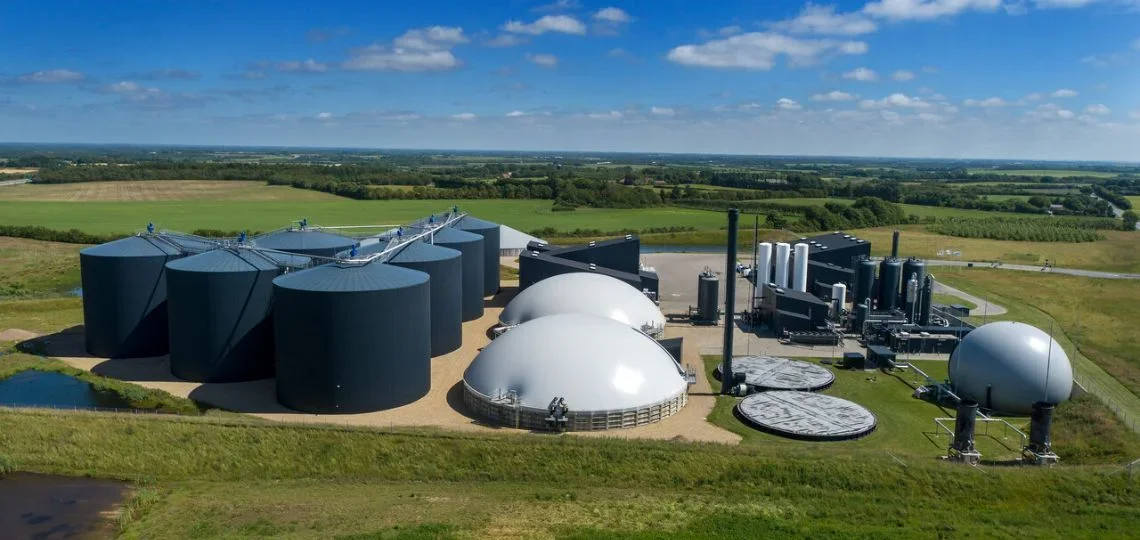
Gas Networks Ireland (GNI), the operator of Ireland’s national gas network, has directly connected Bia Energy’s anaerobic digestion plant in Huntstown, on the outskirts of Dublin, to its infrastructure. The connection, confirmed by GNI and announced on August 12, 2026, marks the first direct injection of biomethane into the Irish gas network, without any intermediate step. The operator presents the connection as a showcase for an industry the state has sought to develop since publishing its national biomethane strategy. Construction of the plant began in May 2024.
A national biomethane target still far from being met
The Irish government is targeting, by 2030, domestic biomethane production representing a significant share of national gas demand. Meeting that goal would require the construction of several dozen new anaerobic digestion plants across the country. Several industry players consider the current pace of deployment well behind the intended trajectory, a scepticism that echoes doubts expressed elsewhere about the achievability of gas targets, as highlighted in an analysis by Wood Mackenzie on Southeast Asia’s gas ambitions for 2030.
Natural gas plays a structural role in Ireland’s electricity mix, serving both as a direct source of generation and as a flexible backup when wind output declines. This contribution varies significantly from month to month depending on weather conditions and wind availability, with considerable differences between periods of strong wind generation and those where gas covers most of the supply. This reliance on gas to secure electricity supply contrasts with the opposite strategy seen across the Atlantic, where US tech giants are betting big on dedicated gas power plants to power their data centers. Authorities and the network operator present biomethane development as a way to reduce Ireland’s reliance on natural gas imports, without requiring any replacement of existing infrastructure or end-user equipment.
A plant built on food and agricultural waste valorisation
The Huntstown plant, operated by Bia Energy, processes short-dated food surplus from retail and hospitality, along with agricultural and agri-food residues, through an anaerobic digestion process. This process produces both biomethane, injected into the gas grid, and a residue called digestate, used as an organic fertiliser in place of chemical fertilisers. Sretaw, Bia Energy’s parent group, had acquired the site before fully reconfiguring it for this purpose.
The project falls under a capital grant scheme set up by the Department of Agriculture to support the construction and modernisation of anaerobic digestion facilities. The scheme, funded through the EU’s Recovery and Resilience mechanism, caps support at a share of eligible investment costs, with a maximum amount per project. Bia Energy is among the beneficiaries of this first round of payments, alongside a small number of other project developers spread across several counties. Minister for Agriculture, Food and the Marine Martin Heydon, along with Karen Doyle, Head of Business Development at GNI, took part in the announcement.
A change of leadership at Gas Networks Ireland
The announcement comes as Gas Networks Ireland has undergone a change in senior leadership. David Kelly has led the company since February 2026, following an interim period overseen by GNI’s chief financial officer. He succeeds Cathal Marley, chief executive between 2020 and April 2025, who left to lead electricity transmission operator EirGrid. Brendan Traynor, chief executive of Bia Energy, oversaw the development of the Huntstown site from the start of construction through to its connection to the national grid.