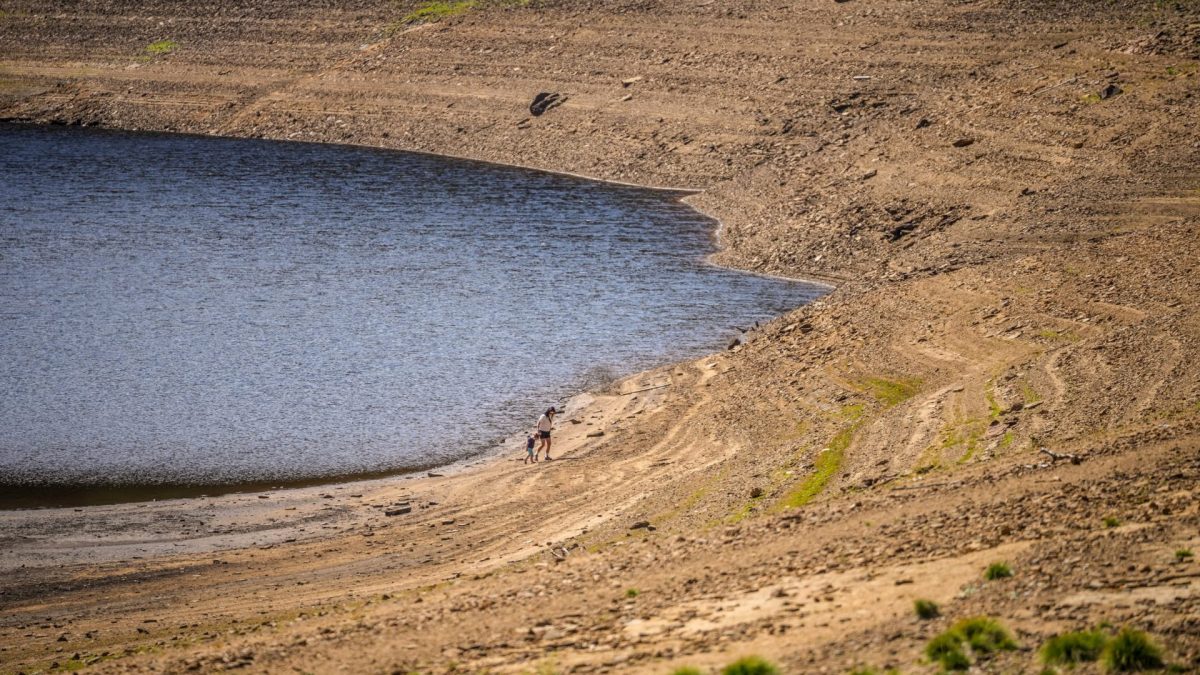
Nearly 25 million households are facing extra bill hikes from water firms that have been losing more than a billion litres of water a day to leaks, analysis by The i Paper has found.
Five suppliers – Severn Trent Water, Southern Water, Thames Water, Wessex Water and South East Water – are set to be given the green light to increase bills by an additional £3.4bn between them in the coming years.
Analysis by The i Paper has found that these companies have lost 1.2 billion litres of water a day to leaks between them, sparking anger from campaigners over the prospect of further bill hikes.
Shorts
Scroll to previous short
Scroll to next short

WORLD NEWS
What record Ebola outbreak tells us about a future pandemic
 Caption: People in protective gear lower into a grave the coffin containing the remains of Jacques Lobo Dhena, who died of Ebola, during a burial service in Bunia, Ituri province, eastern Congo, Wednesday, Aug. 12, 2026. (AP Photo/Dieudonne Dirole)
Photographer: Dieudonne Dirole
Provider: AP Photo/Dieudonne Dirole
Source: AP
Copyright: Copyright 2026 The Associated Press. All rights reserved.

Hard to believe it, but a few years on from the worst global pandemic in more than a century, our world is ignoring an Ebola outbreak in the Democratic Republic of Congo (DRC) that is breaking records by the week.
What’s the situation?
 Caption: FILE PHOTO: Congolese medical workers dressed in personal protective equipment (PPE) carry children tested and cleared off from Ebola from Saint Nicholas orphanage, at the Centre Medical Evangelique (CME) within the secured Ebola response zone, as aid agencies intensify efforts to contain the Ebola outbreak involving the Bundibugyo strain, in Hoho commune of Bunia town, Ituri province, Democratic Republic of Congo, June 9, 2026. REUTERS/Gradel Muyisa Mumbere/File Photo
Photographer: Gradel Muyisa Mumbere
Provider: REUTERS
Source: REUTERS
This week, the director-general of the World Health Organisation (WHO) said it was on track to become the deadliest ever outbreak of the disease.
It has already killed more than 2,000 people and is caused by the rare Bundibugyo strain of the virus – for which there is no vaccine or treatment.

1
Dire warnings from experts
“What’s terrifying is that the virus is way ahead of us,” one UN source said. “We are chasing the virus.”
 Caption: A priest leads a burial service for Jeannine Katusabe, who died of Ebola, in Bunia, Ituri province, eastern Congo, Tuesday, Aug. 11, 2026. (AP Photo/Dieudonne Dirole)
Photographer: Dieudonne Dirole
Provider: AP Photo/Dieudonne Dirole
Source: AP
 Caption: Wiza Bondele, a health worker on the prevention and control team, seen at work in Ituri province, eastern Congo, Wednesday, Aug 5, 2026. (AP Photo/Dieudonne Dirole)
Photographer: Dieudonne Dirole
Provider: AP Photo/Dieudonne Dirole
Source: AP
Alan Doss, British head of the UN’s Peacekeeping mission in Congo, said: “The world seems to have forgotten that the first human infections of HIV/Aids occurred in Congo, but years later it became such a defining issue for Western public health. “
Aid cuts hinder response
A source from the WHO said: “From the closure by Trump of the giant USAID, to the reduction in Europe of aid programmes too, you know we are looking at a world shutting its eyes to a catastrophe in the making.”
The UK government is cutting development assistance to the DRC by 29 per cent.
 Caption: (FILES) A child returning from school stops to look at Ebola awareness illustrations displayed on the signboards of the Ebola Treatment Center (ETC) in Munigi on June 2, 2026. An Ebola outbreak in the Democratic Republic of Congo has killed 2,011 people out of 4,381 confirmed cases of the virus, Congolese officials said on Tuesday. The latest toll for the disease, which has hit the DRC’s conflict-plagued eastern and northeastern regions, puts it close behind the country’s deadliest Ebola outbreak in 2018 to 2020 when nearly 2,300 people died. (Photo by Jospin Mwisha / AFP via Getty Images)
Photographer: JOSPIN MWISHA
Provider: AFP via Getty Images
Source: AFP
Copyright: AFP or licensors
 Caption: Relatives of Ang??le Muyumba Nsimire, a university student who died of Ebola, react at the Citadelle Clinic as health workers prepare her body for burial in Bunia, Congo, Friday, June 12, 2026. (AP Photo/Moses Sawasawa)
Photographer: Moses Sawasawa
Provider: AP Photo/Moses Sawasawa
Source: AP
POLITICS
What Clacton voters think as Farage re-elected
 Locals in Clacton-on-Sea town centre where Nigel Farage was re-elected after yesterday’s by-election (Photo: Dan Kitwood/Getty)

From spoiled ballots to voting for a bin, there is a palpable frustration and exasperation with the state of British politics.
‘This is England – it’s how it should stay’
 Jane Smith voted for Nigel Farage because ‘he’s trying to get people out who shouldn’t be here’ (Photo: Celine Marshall/The i Paper)
Farage supporter Jane Smith tells The i Paper she cast her ballot for him because “he’s trying to get people out who shouldn’t be here”.
“A lot of people are for Farage,” she said. “Because he’s going to his best to get the immigrants out.”

4
‘There are better ways to spend that money’
Nicola Lott, 51, abstained from voting – but on reflection wishes she had spoiled her ballot. She works in recruitment for a care company, is positive about immigration and says “we wouldn’t have an NHS” without it.
The money spent on the by-election could have been better used to tackle “areas of deprivation”, Nicola added.
 Nicola Lott, 51, from Frinton, abstained from voting in the by-election but now wishes she had spoiled her ballot (Photo: Celine Marshall/The i Paper)

3
‘I voted for somebody with a tin on their head’
Dan Casey, 87, said “lots of people didn’t vote because they just thought it was a total farce”.
Casey added, incredulous: “I’ve never ever known anybody not to turn up to the count. It’s his election, he called it, and he doesn’t even turn up for the count.”
 Caption: Candidate Count Binface poses for the media during the Clacton by-election count at the Leisure Centre in Clacton on Sea, England, Friday, Aug. 14, 2026.(AP Photo/Richard Pelham)
Photographer: Richard Pelham
Provider: AP Photo/Richard Pelham
Source: AP
Copyright: Copyright 2026 The Associated Press. All rights reserved
 Caption: Dan Casey (Photo: Celine Marshall/The i Paper)
Photographer: Celine Marshall
Count Binface said he was “the winning candidate of the candidates who bothered to turn up for the results”.
What asylum seekers are entitled to after entering the UK
Reform UK has accused Vodafone of “facilitating the invasion of Britain” by giving out free SIM cards to Channel migrants.

SIMs for asylum seekers
Reform UK’s home affairs spokesperson, Zia Yusuf, said he wrote to the Vodafone board, threatening the company’s leadership with jail time under a future Reform government, after learning it issues free SIMs to charities supporting migrants.
The company is reported to have supplied refugee charity Care4Calais with more than 2,000 SIMs.
 Caption: TOPSHOT – Migrants aboard a smugglers’ boat attempt to cross the English Channel off the beach of Gravelines, northern France, on July 29, 2026. (Photo by Francois LO PRESTI / AFP via Getty Images)
Photographer: FRANCOIS LO PRESTI
Provider: AFP via Getty Images
Source: AFP
Copyright: AFP or licensors
 Caption: St George’s Cross flags, the national flag of England, fly from a fence near a sign for a hotel, believed to be housing asylum seekers, in Stanwell, west London on August 27, 2025. St George’s Cross and Union flags, along with red crosses painted onto roundabouts and at junctions, have begun to appear in towns and villages across England in recent weeks, with some being raised as a sign of patriotism, and others as a sign they are against immigration. More than 50,000 people have crossed the Channel in small boats from northern France since Labour’s Keir Starmer became prime minister just over a year ago, despite his pledge to “smash the gangs” enabling the crossings. (Photo by JUSTIN TALLIS / AFP) (Photo by JUSTIN TALLIS/AFP via Getty Images)
Photographer: JUSTIN TALLIS
Provider: AFP via Getty Images
Source: AFP
Copyright: AFP or licensors
What are asylum seekers actually entitled to?
Asylum seekers are entitled to accommodation, which could be in a flat, house, a hotel or a hostel, or bed and breakfast.
At the end of March, 97,519 people were receiving asylum support. Of these, 72,768 were in non-hotel accommodation.
People receiving asylum support get £49.18 per week to cover essential expenses. This works out at £7.02 per day.

Explained
2
Healthcare and employment
Asylum seekers may receive free healthcare on the NHS if they need to see a doctor or get hospital treatment. They are also entitled to free prescriptions for medicine, free NHS dental care, free eyesight tests, and help towards the cost of glasses.
 Caption: A photograph taken on March 29, 2023 shows a board reading “Stop Asylum centre” at the entrance of the village of Wethersfield where the British government is planing to house asylum seekers at a former former RAF base located in the area. The UK plans to temporarily house asylum seekers in disused military bases and could use ferries and barges in the future in a bid to reduce hotel bills, immigration minister Robert Jenrick announced on March 29, 2023. He told MPs that the government planned to house “several thousand” asylum seekers at repurposed barracks buildings and portable buildings at two former Royal Air Force bases in southeast and eastern England. (Photo by Daniel LEAL / AFP) (Photo by DANIEL LEAL/AFP via Getty Images)
Photographer: DANIEL LEAL
Provider: AFP via Getty Images
Source: AFP
Copyright: AFP or licensors
 Caption: File photo dated 03/10/14 of a hospital ward. NHS staff have been called “monkeys” and patients have refused to be treated by non-white staff amid a reported rise in racism across the health service, experts have said. The Society of Radiographers (SoR) said staff have reported a “noticeable” rise in racism from patients over the last 18 months, including patients calling staff “dirty foreigners” and talking about “people coming over here, taking our jobs”. Issue date: Tuesday August 4, 2026. PA Photo. Photo credit should read: Peter Byrne/PA Wire
Photographer: Peter Byrne
Provider: Peter Byrne/PA Wire
Source: PA
In most cases, people seeking asylum are banned from working while their claim is considered. Instead, they must access support through the Home Office.
Ofwat, the water regulator, had already given firms permission to charge their customers 36 per cent more for their services between 2025 and 2030.
Southern Water, whose customers face paying an extra £80 for the average bill by 2030, has lost up to 101.6 million litres a day to leaks, according to the latest official figures from the regulator.
One million of the company’s customers across Hampshire and the Isle of Wight are currently subject to a hosepipe ban due to drought conditions.
The Prime Minister criticised water companies on Thursday, saying customers “cannot be treated as a blank cheque” and warning that firms seeking to pass unnecessary costs on to households would be challenged.
“The truth is, customers have been asked to pay more for years, yet serious pollution incidents are at record levels and the pipes are still leaking,” he added.
Activists, including Amy Fairman, River Action’s head of campaigns, have branded the decision to approve further bill rises “an insult” to water customers.
“For 30 years, where was the investment in our crumbling water infrastructure? Tens of billions went to investors while essential water and sewage works were neglected. We got leaks, pollution and soaring bills,” she added.
How much is your water bill rising?
The below increases will come on top of the pre-planned rises of 36 per cent approved by Ofwat for the 2025 to 2030 period.
Southern Water: Average annual bills will be £80 higher by 2030.
Wessex Water: Average annual bills will be £11 higher by 2030.
Thames Water: Average annual bills will be £8 higher by 2030.
Severn Trent Water: Average annual bills will be £8 higher by 2030.
South East Water: Average annual bills will be £1 higher by 2030.
Ofwat said the extra funding would help companies keep pace with rising demand from housebuilding and data centres, and address pollutants known as “forever chemicals”. Nearly a third of the money has been earmarked for maintaining water services, the regulator said. The decision is provisional with a final decision due in December.
The jump comes nearly two years after Ofwat gave water companies permission to hike bills by 36 per cent by 2030, with many households seeing an average rise of £123 last year. Bills have continued to increase this year, going up by 5.4 per cent on average, and adding around £33 to household costs.
Despite bills rising, water companies have been losing billions of litres of water a day to leaky pipes.
Thames Water lost the most to leaks, at 569.1 million litres a day, according to Ofwat’s most recent figures for 2024-2025.
A Thames Water spokesperson said leakage was now “15.1 per cent lower than our 2019-20 baseline”, adding that the improvement had been “delivered through sustained investment in our network, modernising our infrastructure, and using innovative technologies to identify and fix leaks”.
The company said it had replaced more than 100km of ageing clean water mains since April 2025 as part of its “biggest ever network upgrade”, and had committed to spend £3.3bn on tackling leakage between April 2025 and April 2030.
Severn Trent Water lost an estimated 335.1 million litres a day, its lowest figure on record. The company said it would replace 870 miles of water pipes as part of a £15bn investment package, as was using innovative technology alongside teams on the ground to find and fix leaks.
South East Water lost 104.8 million litres a day and Wessex Water 69.1 million litres.
A spokesperson for Southern Water said Ofwat’s decision “recognises that costs have risen as we work to deliver the improvements our customers want”.
“The additional funding reflects unavoidable increased costs and is needed if we’re to meet strict obligations to protect the environment and secure the long-term water supplies the population needs,” they added.
South East Water said: “Our priority remains delivering the critical infrastructure improvements needed to secure long-term water supplies, improve services for our customers and protect the environment, while keeping bills as affordable as possible.”
Robert Anthony-Scorse, the company’s head of leakage, said South East Water was “working flat out to reduce leakage across our network”, adding that it spends around £63m a year finding and fixing leaks and employs 400 staff on repairs.
Ofwat said it had rejected £752m of the £4.3bn in spending requests submitted, in some cases because companies had not delivered on previously funded work.
Helen Campbell, the regulator’s interim executive director, said: “We will track performance to ensure companies are delivering the expected improvements for customers and the environment. If they don’t, expenditure can be clawed back.”
Wessex Water was approached for comment.