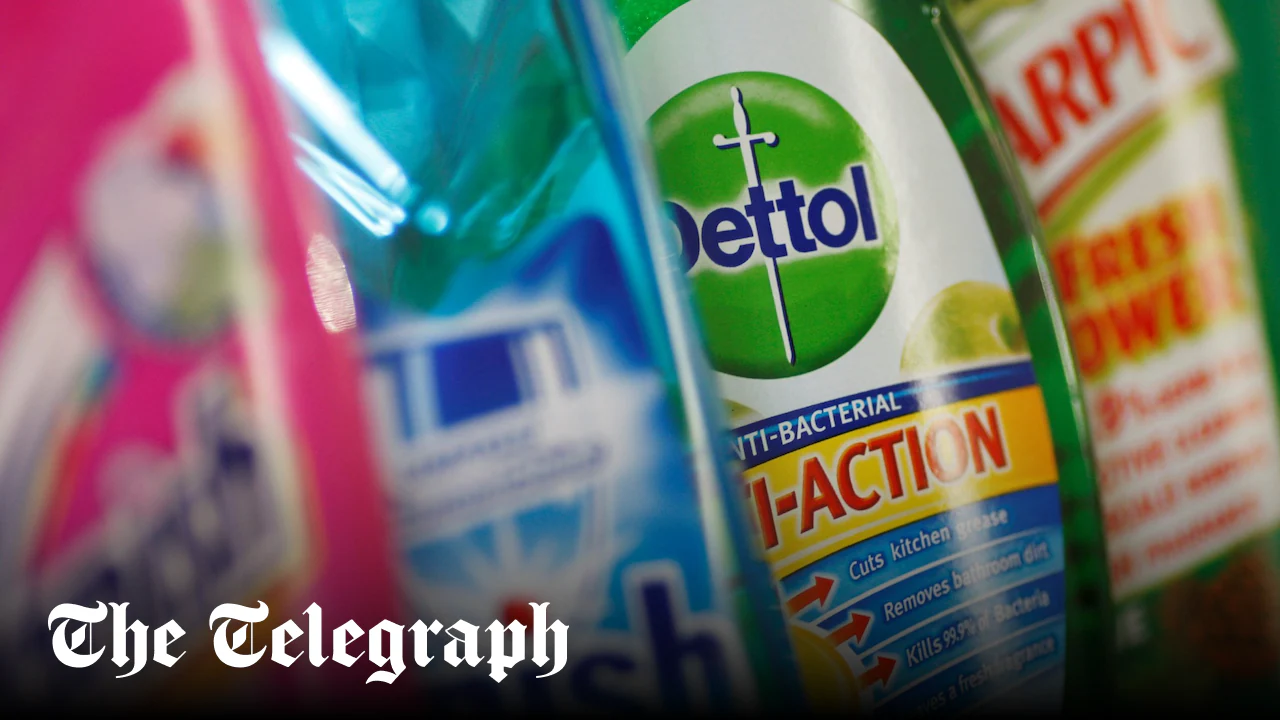
The maker of Dettol and Durex has sold off one of its two Russian businesses after falling foul of EU sanctions.
London-listed Reckitt Benckiser first pledged to quit Russia after Vladimir Putin’s invasion of Ukraine in February 2022.
Four years later, it has offloaded its Russia Hygiene business, which sold cleaning products such as Dettol and Finish, to local manufacturer Arnest Management, for an undisclosed sum.
But it has kept its other business, Russia Health, which imports, markets and sells Reckitt’s pharmaceutical products such as Gaviscon, Nurofen, Mucinex, Strepsils and Durex.
An EU sanctions package in February 2025 banned the export of cleaning products to Russia, which made Reckitt’s Russian cleaning products business unviable. It accounted for 1pc of the company’s total net revenue last year.
But Brussels has not put sanctions on medicines and pharmaceutical products, meaning that Reckitt’s Russian health business can continue to operate.
Further restrictions
The sale comes more than four years after Reckitt said it had first “begun a process aimed at transferring ownership of its Russian business” – ending an association with the country that began in 1994, as the country emerged from the Soviet Communist period.
The exit “may include a transfer to a third party or to our local employees”, the company said in April 2022.
But it appears the exit now applies only to the sanctioned part of the business. Reckitt has no plans to sell its health division in the country.
The Kremlin has made exiting Russia more painful for Western businesses, imposing exit taxes or other restrictions on extracting money from the country.
Reckitt said these “restrictions applicable to exits from the Russian market” would deal a £175m post-tax hit to the company’s bottom line this year.
Russian manufacturer Arnest, meanwhile, emerges from the deal with 400 new employees and a manufacturing facility at Klin, near Moscow.
Owned by industrialist Alexei Sagal, dubbed Russia’s “Hairspray King”, Arnest has been hoovering up the assets of Western firms as they flee Russia.
Last year it bought consumer-goods conglomerate Unilever’s local business for €520m (£440m). It has also acquired operations from Dutch brewer Heineken, American canning company Ball Corp and Swedish cosmetics maker Oriflame.
Dozens of major Western companies have left Russia since 2022. A Yale School of Management project, which tracks companies still operating in Russia, ranks businesses as either “withdrawn”, suspending operations, “scaling back”, “buying time” or “digging in”.
Reckitt is listed as “buying time”, meaning it is “postponing future planned investment/development/marketing while continuing substantive business”.
In the immediate aftermath of the war, Reckitt froze capital investment, advertising, sponsorships and promotions in Russia.
Without the sanctions, like-for-like revenue at Reckitt’s emerging-markets division in the first quarter of 2026 would have climbed 9.6pc year on year, rather than the reported 7.6pc.