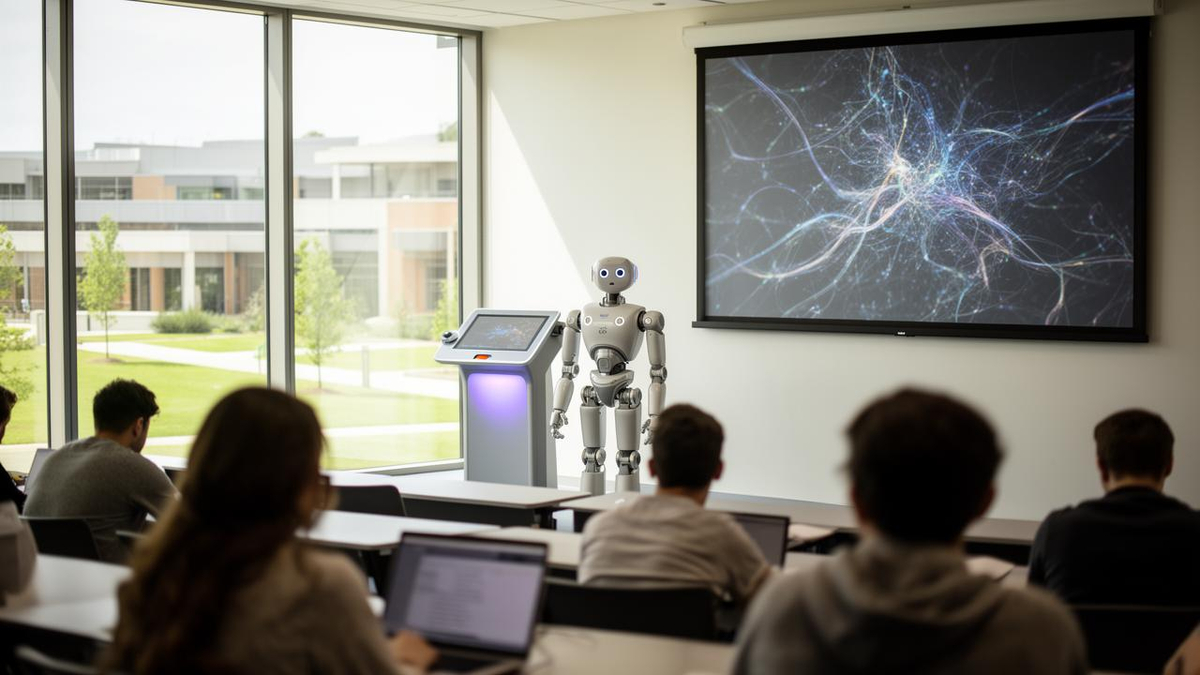
KAIST will comprehensively restructure all undergraduate and graduate courses into three tiers based on artificial intelligence (AI) utilization levels starting next March. President Bae Choong-sik unveiled his vision to make physical AI—including autonomous driving and robotics—the university’s key competitive arena in research, aiming for global No. 1 status through research density and sophistication rather than competing with China on scale.
At a press conference held in Seoul’s Jongno District on the 24th, President Bae said, “All lectures must fundamentally change to fit the AI era,” adding, “By next March, AI utilization levels will be defined not only for new students but for all courses taken by sophomores, juniors, seniors, and graduate students.” The plan is to complete the overhaul of all courses this semester and apply it simultaneously to undergraduate and graduate programs starting next March.
He cited “AI transformation of all courses” as the single most important change he wants to achieve during his tenure. “Within a few months, all 750 KAIST faculty members will become joint professors at the AI College,” he said, emphasizing, “No one will be left who is not working with AI.”
Three-Tier Course Classification… Humanities and Basic Sciences Strengthen ‘AI-Free Education’
KAIST is reorganizing all courses into three domains based on AI utilization levels. In humanities, social sciences, and basic sciences, the university will strengthen “AI-free education” where students read, write, and think directly without AI assistance. Most courses in engineering and applied sciences will shift to a format where students use AI to solve problems and compare and verify results. Courses that involve designing and developing AI itself will be classified as student-led AI domains.
President Bae explained, “In the AI era, if you lack the fundamental ability to ask questions and make judgments, you will be led around by AI,” adding, “In humanities, social sciences, and basic science courses, we will move away from the existing practice of students having AI do their homework, and instead have them read, write, and discuss directly with professors.”
However, AI will not be completely excluded. After students build foundational competencies, courses that use AI to create outputs and make comparisons will run in parallel. Specific operational plans for each course will be determined by the AI Education, Research, and Administration Innovation Committee to be formed this year.
KAIST is also moving away from the traditional lecture-assignment-midterm-final exam format, expanding discussion, presentation, and project-based courses. President Bae said, “If the format remains professors lecturing on what they know while students listen, students will turn away from lectures,” adding, “Change in university education is inevitable.”
The admissions system will also be revised in conjunction with the curriculum overhaul. “If we evaluate the competencies needed in the AI era through admissions, changes will also appear in middle and high school education,” he said, revealing that “discussions with the admissions office have already begun.”
G1 Through Physical AI… Expanding Joint Research with Daedeok Government-Funded Institutes
On the research front, President Bae identified physical AI as KAIST’s core competitive arena. “If we combine AI with South Korea’s manufacturing base, we can reach global No. 1 (G1) at least in physical AI,” he said, promising expanded research support including stronger linkages with government-funded research institutes within the Daedeok Research and Development Special Zone.
He emphasized, “South Korea has the advantage of possessing a full stack in the industrial system where AI can be applied,” adding, “KAIST’s role is to create national wealth through physical AI by advancing manufacturing capabilities while applying AI, making South Korea a strong nation.” The vision includes expanding physical AI research in autonomous driving, smart factories, robotics, and digital twins, while connecting the research capabilities of the Daedeok Research Complex by strategic technology to strengthen cooperation between KAIST and government-funded institutes.
Regarding competition strategy with China, he said, “Since China is larger in scale, we must conduct dense and sophisticated research,” adding, “Strengthening linkages within the research complex will allow us to produce results much more efficiently.”
Industry-academia collaboration will also be reorganized to reflect corporate demand from the research stage. In the “AI Autonomous Lab” built jointly with companies, AI will be applied to experimental design, execution, and data analysis to accelerate the application of research results in industrial settings. President Bae explained, “We aim to reflect corporate demand, build accordingly, and ensure that results from here can be immediately applied to companies.”
The AI College will take charge of core courses while existing departments will integrate AI into their respective majors. This overhaul concretizes the five major innovation strategies—the “Beyond Series”—that President Bae presented at his inauguration ceremony on the 10th. KAIST is also pursuing the construction of an “AI Native Campus” that applies AI across education, research, and administration, with related budgets currently being calculated.
KAIST will determine detailed tasks and priorities through the Innovation Committee this year and begin full-scale implementation across education, research, and entrepreneurship starting next year. The goal is to produce tangible results that members can feel by the 60th anniversary of the university’s founding in 2031. President Bae said, “The level of our faculty in each field is already aiming for global top status,” adding, “The goal is to bring these together into a major KAIST momentum to become the world’s best.”