Usually, when you spy a particular vehicle coming packed with a twin-turbocharged, 6.75-liter V12 under the hood, you’d be forgiven for thinking you’re about to deal with some sort of exotic supercar. Not so fast. Large power plants like these can do so much more than just kick out a ton of power and afford the vehicle they reside in an eye-opening top speed.
The engine in question is found in a Rolls-Royce, which signifies the opposite of tire-burning performance. The result is a cabin so quiet at highway speeds it makes a Toyota Camry sound like a construction site.
Indeed, this engine is built to cuddle its user, rather than scare them half to death.
Rolls-Royce’s Huge V12 Is A Lover, Not A Fighter

From the outset, any engine developed for use in anything sporting a Rolls-Royce badge needs to be smooth and quiet. Power and efficiency appear further down the priority list. A Rolls’ only job is to make those riding within it feel as relaxed and comfortable as possible, and achieving this goes far beyond crafting an exquisite cabin and throwing a great deal of sound-deadening material at every crevice you can find.
The engine and powertrain have a huge effect on how refined a car feels, and the Rolls V12 is one of the very best at illustrating this point. The latest variant of the V12, called the N74B68, was first introduced in 2017 for use in the then-recently released Phantom VIII. While it retained the same 6.75-liter displacement as its predecessor, it was drastically different in that it used twin-turbocharging technology rather than relying on a naturally aspirated design. This decision was taken in the interests of keeping the engine as quiet as possible, which is best achieved by keeping the revs nice and low.
The N74B68 achieves its peak torque figure at just 1,700 rpm, allowing the car to pick up speed quickly and efficiently without having to rev the car out to north of 4,000 rpm like most cars. This not only keeps the engine noise low and well clear of the cabin, it also decreases the amount of vibration and harshness emitted by an engine as it runs faster. That’s why a 12-cylinder configuration was chosen over a V8, for example, since it offers a better natural balance and more overlapping combustion strokes, which result in smoother operation.
This results in an engine that, while powerful, is more about achieving serenity than 0-60 times. Not that it can’t excel at the latter, though.
The N74B68 May Be Relaxing, But It’s Got Some Guts

2022 – 2025 Rolls-Royce Phantom exteriorRolls-Royce
While optimal refinement was prioritized with the new V12, it also needed to be powerful to shift along the huge Phantom, which tips the scales at comfortably over 5,000 lbs. There’s no point in fitting an engine that makes all its power low in the rev range if it’s too feeble to get the vehicle moving at a meaningful pace.
The twin-turbochargers came in handy by significantly increasing the level of firepower sent to the Phantom’s rear wheels, with peak horsepower rising from 453 hp to 563 hp. The level of available torque shot up as well, with the old machine’s 531 lb-ft leveling up to 664 lb-ft.
The increase in low-down torque was arguably the biggest upgrade between the two engines, with the Phantom VIII having 50% more of the stuff below 2,500 rpm than its predecessor. It didn’t hurt its 0-60 mph performance either, with the old car’s 5.8-second sprint being reduced to an impressively brisk 5.1 seconds with the revised Phantom.
Those numbers are impressive for any luxury sedan — but they only tell half the story of what makes this engine genuinely rare among its peers.
The Manufacturing Obsession That Makes The N74B68 Smoother Than Any Engine Has A Right to Be

2022 – 2025 Rolls-Royce Phantom exteriorRolls-Royce
Working with the V12 was the latest evolution of ZF’s eight-speed automatic transmission, which provides rapid and exceptionally smooth gear changes.
Beyond that, the transmission also uses clever satellite-aided technology, which enhances the operation of the unit by utilizing GPS signals. Essentially, the system tracks what road the car is on so that it can read what corners are coming up next, before then ordering the gearbox to pre-select whichever gear is best suited for the upcoming section. This ensures the car has the exact level of torque and gearing needed for wherever it’s heading, improving performance and the tranquility of the driving experience.
The likes of Rolls-Royce, as well as other luxury manufacturers like Bentley, Mercedes-Benz, and Toyota with its dependable units, have worked hard to develop ever smoother luxury-focused engines over the decades. Improvements have come in a range of different ways, from newly developed technology to simple improvements in the design and construction process of such units. A good example of this is the rapid improvement of engine electronics, which help control aspects like the fuel injection system, the idle speed, and also nailing the air-fuel ratio to ensure the engine runs well.
The improvement in this regard has allowed engines to run to ever more precise tolerances, affording not only more power and efficiency, but also extra smoothness by reducing vibration. Beyond that, there’s also the subject of significantly improving the way engines are produced and installed within the cars they call home.
Once again, enhanced simulation and computing technology allows designers to go into much more detail than ever before when it comes to designing engines. Due to being made up of thousands of different parts and systems that need to work in perfect harmony, it can be difficult to get everything running optimally. Being able to test a range of designs before having to build them not only reduces costs, but also the lead time on designing such power plants, drastically cutting the time it takes to arrive at an improved layout that reduces unnecessary noise and vibration.
The result is that internal components are better placed than in decades past, which further helps an engine to run as smoothly as possible. Rolls-Royce, and parent company BMW, are at the forefront of this technology, and it is the reason why the Phantom’s V12 is one of the smoothest and most refined engines in the world today.
The Price of Serenity: What Rolls-Royce’s V12 Engineering Actually Costs You

Starlight Headliner in a Rolls Royce PhantomRolls-Royce
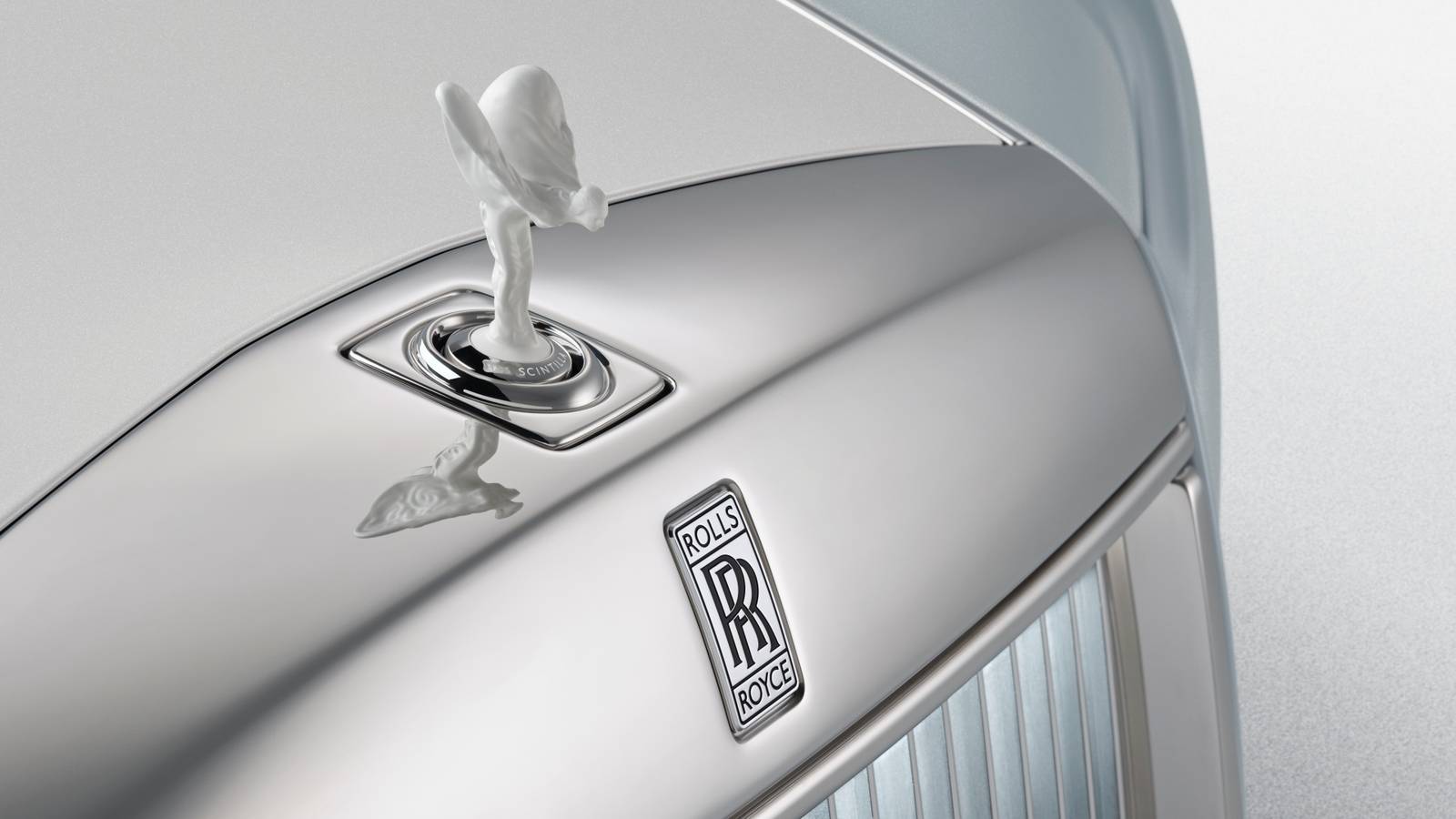
After reading all that, we wouldn’t blame you for wanting to own Rolls-Royce’s flagship luxury sedan. They are more than just a little expensive, as you would have likely assumed given the Spirit of Ecstasy adorning the vehicle’s hood. When it was brand-new in 2018, the car retailed for $417,825, and that was before you got stuck into the options menu. You’ll need to hand over a commanding $550,000 if you want a brand-new 2027 specimen.
As a result, opting for an earlier used car will be the best way of getting one for a smaller outlay. Even then, a used Phantom VIII from 2018 or 2019 with lower mileage — say, under 20,000 miles — will still command a price north of $300,000. Opting for a higher-mileage car with closer to 50,000 miles on the odometer will bring the price closer to the quarter-of-a-million-dollar mark. Perhaps better value can be found by opting for an older version of the Phantom instead.
Why The Phantom’s Cabin Is Quieter At 70 mph Than A Camry At A Standstill

Rolls-Royce Phantom anniversaryRolls-Royce
Despite having been developed to within an inch of its life over the last half century or so, Rolls-Royce’s V12 engine has always retained its 6.75-liter displacement, and that’s because the manufacturer found that it provided the best mechanical balance of any displacement. Wanting to maximize refinement, the brand’s engineers painstakingly experimented with different designs to determine which provided the smoothest operation, and the 6.75-liter design ultimately prevailed.
With the optimal natural balance found with this specific displacement being twinned with the V12 design, Rolls has simply continued to develop the powerplant over the past 60 years. The first 6.75-liter V12 arrived in 1965, and it remains in excellent health in 2026. At the end of the day, the engine is one of the primary reasons why the cabin in cars like the Phantom is so silent. For context, just 60 decibels are emitted within the cabin of a 2018 Phantom VIII at 70 mph, a full 10 fewer than a Toyota Camry of similar vintage.
There’s an old saying that you can’t improve on perfection. Rolls-Royce clearly disagrees with this stance, as it has continually enhanced it for the last six decades.
Sources: Rolls-Royce.