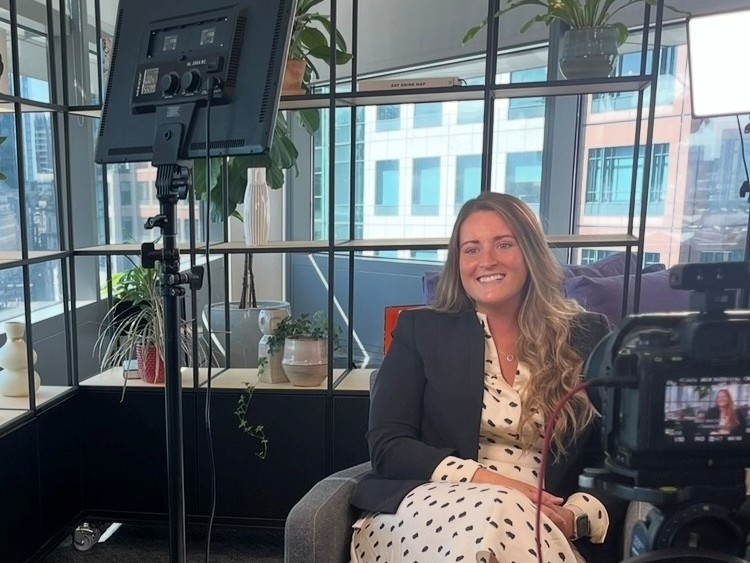
A month into her role as NatWest’s Head of Manufacturing and Construction, Ashleigh Dorrington-Harvey is taking a listening-first approach to understanding the challenges facing UK industry. She tells The Manufacturer why energy costs, skills, sustainability, supply-chain resilience and technology are reshaping the sector – and why banks need to offer manufacturers more than finance.
For Ashleigh Dorrington-Harvey, taking on NatWest’s Head of Manufacturing and Construction role is about asking questions rather than arriving with a fully formed strategy.
Four weeks into the job at the time of our interview, Ashleigh is in listening mode. Her priority is to get closer to manufacturers, colleagues and industry stakeholders across the UK before deciding where she and the bank can make a difference. It is an approach that reflects her understanding of the sector and her recognition that manufacturing is an industry that requires direct engagement.
“One of the things I’m most excited about in the manufacturing and construction role is, whilst every sector has its nuance, combining the lessons learnt from previous experience and taking it,” she said.
“Manufacturing and construction is a new sector for me. I’m not going to sit here today and pretend to know everything – I absolutely don’t. But I think that’s a great opportunity for a fresh pair of eyes.”
Those eyes will be supported by existing expertise within NatWest. Ashleigh points to more than 900 colleagues with a manufacturing and construction connection across the UK, while Experian data shows it works with one in four UK manufacturing businesses. Her plan is straightforward: get out and meet them.
“I’m going to spend time with them because they are the experts,” she said. “The priority is getting out and about on the road.”
A natural curiosity about how things work
Ashleigh has spent 14 years at NatWest in a variety of roles, most recently working in the bank’s healthcare corporate team. She says that experience, particularly the emphasis on understanding customer concerns and opportunities, has been the most relevant preparation for her new position. But her attraction to manufacturing is not purely professional.
“I think I’ve always had a natural curiosity as to how things work, and manufacturing sits right at the heart of that,” she said.
She also sees manufacturing as fundamental to the UK economy, driving innovation and skills while playing a role in international competitiveness.
The timing of her appointment is significant. UK manufacturers are navigating multiple transformations simultaneously: automation, digitisation, artificial intelligence, sustainability and supply-chain resilience, all against a backdrop of geopolitical uncertainty and changing global markets. For Ashleigh, that creates a role for a banking partner.
“I always say we should be an extended part of their leadership team, and that’s how we really add value,” she said.
There is also a personal connection to engineering and technology. Before joining banking, Ashleigh had ambitions of becoming an RAF pilot. A shoulder injury changed that career path, although it did not end her interest in flying. She subsequently obtained her private pilot’s licence and continues to fly recreationally.
Her interest in precision, engines and complex systems has found an outlet away from her professional life. Flying has also influenced how she thinks about leadership.
“It’s a disciplined activity that requires preparation, precision, good judgement, a constant awareness of changing conditions,” she said.
A principle taught in aviation, “aviate, navigate, communicate,” has resonance for her. So too does the need to maintain a wider perspective.
As she settles into the new role, Ashleigh says she will need to maintain that “helicopter view”, ensuring that the day-to-day activity of the organisation remains connected to its strategy.
Four challenges dominating the conversation
 Although she is cautious about making definitive judgements after four weeks in the role, Ashleigh says several themes are emerging consistently from her conversations with manufacturers and regional stakeholders.
The first is energy costs, which remain a concern for manufacturers, particularly when businesses compare their position with international competitors. For energy-intensive companies, this can impact competitiveness and investment decisions.
The second is the transition to net zero, which Ashleigh believes may have slipped down the agenda for some businesses in recent years, but argues that it is now returning to the conversation.
She says the reason a manufacturer chooses to act is less important than the fact that it does so. Whether the motivation is reducing costs, protecting the environment or making the business more attractive to employees, the result can still be positive.
She also points to the commercial implications of sustainability. In construction and across manufacturing supply chains, businesses are expected to understand and demonstrate their carbon footprint. For suppliers competing for work with larger organisations, sustainability is becoming a requirement of doing business rather than a matter of corporate responsibility.
The third challenge is the shortage of skills and labour. For Ashleigh, this is about more than recruitment. It is also a productivity issue that brings the adoption of new technologies into focus.
The fourth is supply-chain resilience. This is an area she says has become prominent in her early conversations within manufacturing. Geopolitical events have exposed the fragility of interconnected supply chains, while dependence on particular regions can leave businesses vulnerable to disruption.
Ashleigh believes the UK needs to strengthen its domestic manufacturing capabilities while becoming a better exporter. She points to aluminium as one example of the opportunity. Rather than simply considering how much new material the UK can produce, there is potential in making better use of material that already exists within the domestic economy.
Together, these four issues form the foundation of business resilience. The challenge for manufacturers is to consider them as interconnected strategic questions about the long-term future of the business.
Beyond the AI hype
Artificial intelligence (AI) sits across many of these conversations, but Ashleigh is wary of treating technology adoption as an objective in itself. The opportunity, she argues, is not to put AI into a business because others are doing so. It is to identify where the technology can solve a business problem. That is a distinction familiar to manufacturers.
The same principle applies to robotics and automation. Ashleigh points to the UK’s international position in robotics and productivity and sees potential for manufacturers to use technology to improve their performance. But adoption comes with a financial hurdle.
“You’re asking business leaders to make a huge expense when margins are tight already on something they’ve never used before from someone they’ve never spoken to before,” she said.
That is where she believes the wider manufacturing community has a role. Businesses need opportunities to learn from one another, understand what has worked in practice and gain confidence before making investments. For a bank, that creates a role that goes beyond providing the capital itself.
Ashleigh is already considering how NatWest’s asset finance business, Lombard, could support manufacturers investing in technologies such as robotics and automation.
The objective is to finance a machine and to help a manufacturer understand why that investment makes sense, what problem it is solving, and how it fits into the wider strategy of the business.
Is access to finance really the problem?
That leads to another issue familiar to many SME manufacturers: access to finance.
In previous research conducted by The Manufacturer, access to finance emerged repeatedly as a concern for smaller manufacturers, particularly businesses looking to invest in growth, innovation, or new technology. Ashleigh says she has heard similar concerns.
She believes there is a distinction between a lack of available finance and a lack of awareness about the finance that exists. “Sometimes it’s just a lack of knowledge or awareness of what is available,” she said.
Many businesses, she argues, instinctively think in terms of traditional lending products such as term debt and overdrafts. The range of potential financial tools is broader, including trade finance, working capital facilities, sustainability-related finance, invoice discounting and Government-backed schemes.
The challenge is partly about connecting manufacturers with the appropriate solution for the problem they are trying to solve. That is important as businesses face investment decisions that do not fit neatly into a traditional borrowing model, such as funding automation, managing working capital through a period of expansion, financing international trade, or investing in their sustainability transition.
For Ashleigh, understanding those different needs is central to the relationship she wants NatWest to have with its manufacturing customers.
From lender to strategic partner
The philosophy behind her new role is evident here. Banks will always provide finance. Ashleigh believes the opportunity is to make the relationship broader.
“I think many businesses understandably see a bank primarily as debt and finance,” she said. “But I’d argue that we are a relationship bank.”
Her ambition is for NatWest to use its position within the UK economy to share knowledge, identify trends, and connect businesses with relevant expertise and opportunities.
The bank’s scale is important to that proposition. Its relationships with thousands of businesses provide a view of emerging challenges and opportunities across different sectors and regions.
The challenge is turning that information into something useful for individual manufacturers. That means relationship managers understanding the language and nuances of manufacturing rather than approaching a company from a purely financial perspective.
“We will never pretend to know more about the sector than the clients that are in the sector themselves,” Ashleigh said. “They are the experts.”
Sector expertise within the bank can help create better conversations, while its wider network can connect businesses with specialist knowledge, growth opportunities, international trade support, and Government initiatives.
The ambition is to move the conversation away from the next loan or the next financial year and towards the future of the business.
“The most successful relationships are those that are broader strategic conversations about future businesses, not just the next lending and the next kind of year down the road.”
That is a proposition that also reflects the changing needs of manufacturers. As companies navigate decarbonisation, automation, skills shortages, geopolitical uncertainty, and complex supply chains, financial decisions are becoming inseparable from wider strategic decisions.
Creating football fans, not customers
Ashleigh has an analogy for the type of relationship she wants to build. She is an Arsenal supporter and says she thinks of customers more like football fans than customers. Like fans, customers are an extension of the team and work in collaboration to get the best result for the team.
That also fits with the way Ashleigh intends to approach the role herself. Rather than arriving with a predetermined list of priorities, she wants to listen first.
Her regional tour during the second half of the year is designed to expose her to different parts of the manufacturing ecosystem, from Catapults and industry groups to manufacturers themselves. Only then does she expect the strategy to fully take shape.
Listening before acting
Asked what she would hope to have achieved if The Manufacturer were to interview her again in three years, Ashleigh resists providing a long list of targets. Her first six months are about getting closer to customers, colleagues, and industry stakeholders and understanding where she can make the greatest difference.
“I think the best strategy is always built from listening before acting,” she said.
Ultimately, she would like to be able to point to one or two small areas where the bank has moved the dial. Those areas could involve supply-chain resilience, robotics, or something else that emerges from her conversations with industry.
Whatever the focus, her ambition is for NatWest’s manufacturing relationship teams to have greater access to insights, networks, and specialist expertise that can deliver value to customers.
That makes her immediate challenge less about defining the future of UK manufacturing than understanding the businesses that are already trying to build it.
Four weeks into the role, Ashleigh is not pretending to have all the answers. For a sector confronted by complex and interconnected challenges, that may be the point.
The first step, she argues, is to listen to the people who are on the factory floor, in the boardroom, and across the supply chain, and then work out where a banking partner can help them move forward.
For more articles like this, visit our Leadership channel