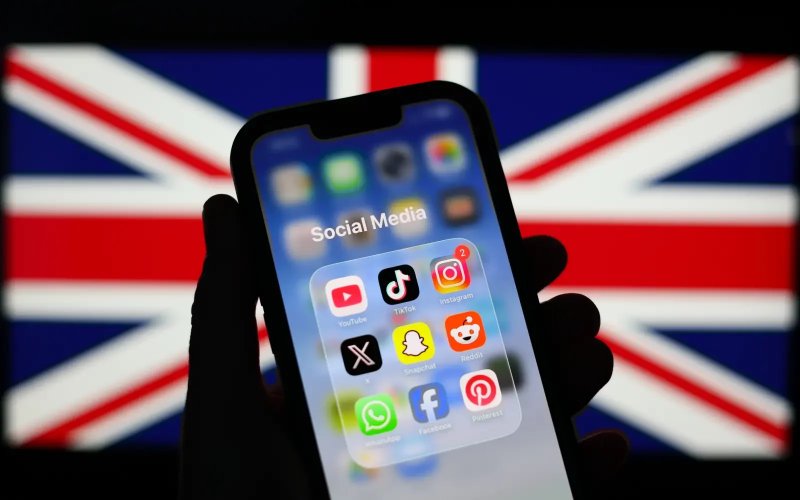
The number of people arrested in Britain over online posts, comments and messages has risen sharply. According to data collected by British journalists, police made more than 12,000 arrests in 2023 under laws covering malicious and offensive communications — more than 30 arrests every day.
Claims that fines have increased at a similarly dramatic rate, however, require clarification. The British government does not publish centralised statistics proving an increase in either the number or average size of fines imposed on individual social media users. In fact, the number of convictions under the relevant laws has declined over the past decade.
Nevertheless, actual court cases show that a single post or comment can result in a fine of several hundred pounds, a football banning order, community service, a suspended sentence or immediate imprisonment.
An increase of almost 58%
The two main legal provisions traditionally used by police in such cases have been Section 127 of the Communications Act 2003 and Section 1 of the Malicious Communications Act 1988.
The first criminalises messages sent through a public electronic communications network that are deemed “grossly offensive”, indecent, obscene or menacing. The second applies to communications sent with the intention of causing distress or anxiety.
According to figures obtained by The Times from police forces in England and Wales:
– 7,734 arrests were recorded in 2019;
– more than 12,000 arrests were recorded in 2023;
– the increase was almost 58%;
– police were making more than 30 such arrests every day.
The Metropolitan Police recorded the highest number, with 1,709 arrests. It was followed by West Yorkshire Police with 963 and Thames Valley Police with 939.
When adjusted for population, Leicestershire recorded the highest rate, with 83 arrests per 100,000 people. Cumbria followed with 58 and Northamptonshire with 50 per 100,000.
The figures were summarised by the House of Lords Library.

Credit: digitalrightsmonitor.pk
However, the data has several important limitations. It largely covers England and Wales rather than the entire United Kingdom. The legislation also applies not only to public posts on Facebook, X or Instagram, but to emails, text messages and other forms of digital communication.
Cases classified as malicious communications can also include serious domestic abuse, stalking and direct threats. It would therefore be inaccurate to claim that all 12,000 people were arrested simply for expressing political opinions.
Nevertheless, such a rapid increase in police intervention in online communications raises serious questions about freedom of expression and the proportionality of enforcement.
Why are arrests increasing while convictions decline?
The paradox in the British statistics is that the number of arrests is increasing while the number of convictions and sentences is falling.
An analysis of Ministry of Justice data showed that the number of people convicted under the two principal communications offences has declined dramatically over the past decade. One of the main reasons for cases being discontinued is evidential difficulty, including victims deciding not to support further action.
This means that many people may experience arrest, questioning, the seizure of their devices and reputational damage, only for their cases never to reach court or end in a conviction.
Civil liberties organisation Big Brother Watch described the trend as “seriously concerning” and warned against the heavy-handed application of vaguely worded communications offences.
Police forces, meanwhile, argue that rudeness or offensiveness alone does not constitute a criminal offence. To cross the legal threshold, a message must, for example, be “grossly offensive”, threatening or intended to cause serious distress.
In practice, determining the boundary between a lawful but offensive statement and a criminal communication can be difficult.
A £345 fine for a racist comment
One illustrative case involved 64-year-old football fan John Southwell.
He posted a racist comment under a social media post featuring a Chelsea footballer. During his police interview, Southwell said that he could not remember whether he had posted the comment, but he later pleaded guilty.
On 8 October 2024, Blackburn Magistrates’ Court fined him £345. The fine was increased to reflect the hate element of the offence. Southwell was also banned from attending football matches for three years.
He was convicted under Section 127 of the Communications Act for posting a grossly offensive message through a public communications network. (Crown Prosecution Service)
Arrest and £200 fne for an Instagram message

Credit: SOPA Images/Getty Images
Another case involved Connor Butler, who sent a racist message to Luton Town footballer Elijah Adebayo on Instagram.
Police identified the person behind the account and arrested Butler at his Sunderland home in February 2025. He was subsequently charged with sending an indecent or offensive communication.
In December 2025, the court imposed a £200 fine and ordered Butler to pay court costs. In February 2026, he was additionally banned from attending football matches for four years. The restrictions also prevent him from travelling abroad to attend international matches. (Northumbria Police)
The financial consequences of a conviction are therefore not always limited to the fine itself. Court costs, a statutory surcharge, compensation and additional restrictive orders may also be imposed.
£160 fine and community order for post following terrorist attack
On 2 October 2025, only hours after an attack on a Manchester synagogue, 20-year-old Aiden Stanley posted an antisemitic message on social media accompanied by a weapon emoji.
The post was reported to police, and Stanley was arrested the following day. During questioning, he admitted that the message referred to Jewish people but claimed he had posted it to impress others who might find it amusing.
The message was judged to be grossly offensive. In January 2026, Stanley received an 18-month community order, including 20 rehabilitation activity days, and a £160 fine. His sentence was increased to reflect the hate element of the offence. (Crown Prosecution Service)
More than a fine: Six-week suspended sentence
In March 2022, 27-year-old James Newton was convicted after posting racist and threatening comments in a local Facebook group.
In the posts, he suggested setting fire to accommodation established for asylum seekers and, according to prosecutors, appeared to encourage others to join him.
Newton was arrested and charged under Section 127 of the Communications Act. The court imposed a six-week prison sentence, suspended for 12 months. He was also ordered to pay £128 in court costs and £85 in prosecution costs, bringing his total financial liability to £213. (Crown Prosecution Service)
Posts that led to immediate imprisonment
In several cases, courts have imposed immediate prison sentences rather than fines, particularly following the disorder triggered by the murder of three children in Southport during the summer of 2024.
Jordan Parlour received a 20-month prison sentence for a Facebook post calling for an attack on a hotel housing asylum seekers. The court took into account that the post could reach approximately 1,500 Facebook friends and spread further because of the public settings on his account.
Tyler Kay was imprisoned over posts on X in which he called for hotels housing migrants to be set on fire and shared material encouraging violence against immigration lawyers. He was sentenced to 38 months for publishing material intended to stir up racial hatred.
Lucy Connolly also received a custodial sentence over a post calling for mass deportations and for hotels housing migrants to be set on fire. She was sentenced to 31 months in prison after admitting an offence involving the stirring up of racial hatred.
These cases, however, were not treated merely as examples of people expressing offensive opinions. The defendants were prosecuted for publishing material intended to stir up racial hatred and encourage violence. It would therefore be legally misleading to place these cases in the same category as ordinary criticism of the government. (UK Parliament evidence)
Suspended prison sentence for former footballer

Credit: Sky Sports
Former England and Premier League footballer Joey Barton was prosecuted over a series of posts on X targeting football pundits Eniola Aluko and Lucy Ward, as well as broadcaster Jeremy Vine.
The prosecution concerned 12 messages posted between January and March 2024. A jury convicted Barton on six counts and acquitted him on the remaining six.
In December 2025, the court sentenced him to six months in prison, suspended for 18 months. Prosecutors argued that the posts had gone beyond provocative jokes and amounted to grossly offensive communications intended to cause distress and anxiety. (Crown Prosecution Service)
What is the maximum fine?
Under Section 127 of the Communications Act 2003, a court may impose:
– an unlimited fine;
– up to six months’ imprisonment;
– or both penalties.
The sentencing range begins with a Band A fine and extends to 15 weeks in custody. The precise amount depends on the seriousness of the message, the offender’s intentions, the size and vulnerability of the audience, the consequences of the publication, previous convictions and the defendant’s financial circumstances. (Sentencing Council)
A Band A fine is normally calculated as a percentage of the convicted person’s relevant weekly income. There is therefore no fixed standard fine “per post”. In the cases examined above, individual fines ranged from £160 to £345, although courts have the power to impose considerably larger amounts.
Fines imposed on individual users must also be distinguished from regulatory penalties against online platforms. For example, in 2025, British regulator Ofcom fined the US-based forum 4chan £20,000 for failing to provide information required under the Online Safety Act. An additional daily penalty of £100 was also imposed for continued non-compliance.
That penalty was imposed on a company for breaching its regulatory obligations — not on an individual for the content of a social media post.
The tendency to combine platform penalties with punishments imposed on users may be one reason behind claims that Britain has dramatically increased fines for online speech.
Repressive trend or necessary response to threats?
Supporters of stricter enforcement argue that online posts can become instruments of harassment, racial hatred and real-world violence.
Following the Southport attack, false information and radical calls to action spread rapidly across social media, while some online incitement was followed by attacks and public disorder.
Critics respond that the vague concept of a “grossly offensive” message gives the police excessively broad discretion. A person may be arrested, questioned and subjected to a lengthy investigation even if no charges are ultimately brought.
One conclusion is firmly supported by the available evidence: arrests under communications legislation increased sharply — by almost 58% between 2019 and 2023. But it cannot be established that the number or average size of fines imposed on individual users rose at the same rate.
No comprehensive official national statistics support that claim. Published court cases show fines ranging from £160 to £345, excluding court costs and additional restrictions. In more serious cases, courts have avoided financial penalties altogether and instead imposed community orders, suspended sentences or immediate imprisonment.
Britain’s main trend, therefore, is not so much a dramatic increase in fines as a substantial expansion of police intervention in online communications.
The question now being asked with increasing frequency inside Britain itself is where the line should be drawn between the legitimate fight against threats and hatred and excessive criminal control over freedom of expression.