
 Image credits: Network Rail.
The train from London to Welwyn Garden City looks pretty much like any other commuter train. It often smells of damp coats and coffee, and most passengers are often on their phones or listening to music. When the train plunges into a tunnel, the GPS on every passenger’s phone dies. So too does the train’s GPS, because the technology just can’t work in tunnels.
But this particular train didn’t rely on GPS: it was testing a quantum navigation system that can tell exactly where it is without external input from satellites. This is the first time this technology has ever been tested for trains, and it’s absolutely unjammable.
We’re All Hooked on GPS
Most of us check our phone’s GPS several times a day, whether it’s when we drive or just walk around. We take it for granted, but this technology depends on your smartphone communicating with specialized satellites in Earth’s orbit. It’s not just personal use; every truck, car, airplane, everything uses GPS.
If GPS were to go down for a single day, it would cost a country like the UK or the US over $1 billion a day; and GPS going down isn’t that far-fetched.
Sure, the satellites work fine (we’ve been testing them for years), but a solar flare, a hostile jammer, or simply a thick concrete tunnel can all block GPS signal and cause the system to go down.
To solve this, a consortium led by the Imperial College London brought the quantum technology onto the train.
The Rail Quantum Inertial Navigation System (RQINS) is designed to create a self-contained positioning system for every train. By using ultra-cold atoms to measure motion with staggering precision, the system allows a locomotive to know its exact position down to the centimeter, even while hurtling through deep tunnels or dense urban “canyons” where GPS signals typically fail.
How the Quantum-ness Works
 The testing system inside the train. Image credits: Network Rail.
Inside the RQINS, lasers trap a cloud of atoms in a vacuum chamber. This is a Magneto-Optical Trap (MOT). These lasers pummel the atoms from six sides, slowing them down until they are almost perfectly still. In the world of atoms, temperature is defined by the speed of atomic motion. If an atom is slowed down, that also makes it very cold. We’re talking about temperatures colder than deep space.
×
Thank you! One more thing…
Please check your inbox and confirm your subscription.
When these atoms reach this ultra-cold state, they start to behave more like waves than particles. The system then uses a series of laser pulses as a sort of optical ruler. These pulses split the atomic wave into two, let them travel, and then recombine them. Any movement of the train, whether it’s a lateral tilt or a change of speed, affects how those waves overlap. This creates an interference pattern.
This interference pattern can help monitor how the train moves with centimeter-level precision. But there’s a catch.
Trains are shaky and violent. Quantum sensors are delicate. To make this work on a real train, engineers had to build a “hybrid stack.” Basically, they had to fit the quantum sensor itself with classical mechanical sensors (MEMS). The classical sensors handle the high-frequency jitters of the wheels, while the quantum sensor provides finessed measurements. It’s this partnership that allows the system to work in a real environment.
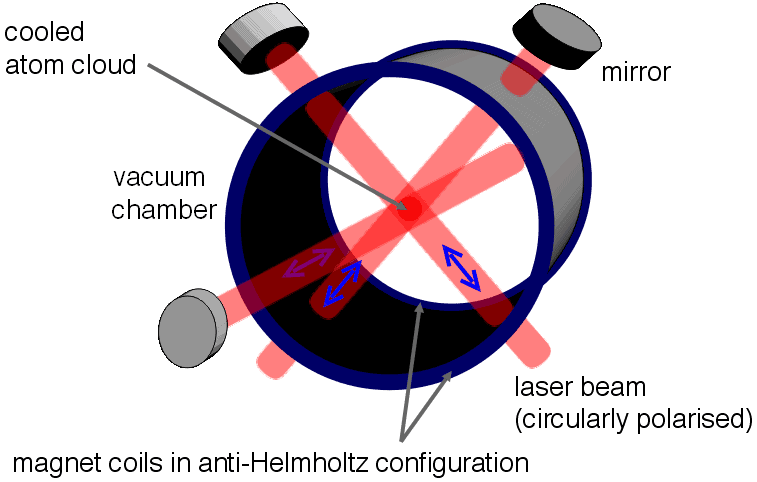 Example of a Magneto-Optical Trap. Image via Wiki Commons.
The Global Quantum Race
Quantum technology is being increasingly researched from practical applications, whether it’s quantum computers or sensors. Quantum positioning systems can become an important field.
The UK alone is betting $3.3 billion on its National Quantum Strategy, aiming to be a “quantum-enabled economy” by 2033. Other countries like the US and China are pursuing similar goals.
For now, this is the first time lab-grade quantum tech has survived the messy reality of a commute, and it worked even better than predicted. The system is still pretty rugged and expensive. The next step is to reduce the size and cost of these systems. The UK government has set 2030 as the target year to have these quantum sensors deployed on aircraft and heavy rail in specific, critical corridors.
By 2035, the vision is for quantum navigation to be a standard feature across all critical UK infrastructure.