
SSEN Transmission’s £1bn Orkney link project is connecting the archipelago to the GB electricity transmission network for the first time, with the remote project shaping the construction of two substations.
Orkney’s exposed location off the north coast of mainland Scotland has given it access to abundant renewable energy resources, in particular wind, wave and tidal.
Over the years, it has also become a hub for renewable energy innovation, as it hosted the UK’s first grid-connected wind turbine in 1951 and became home to the European Marine Energy Centre in 2003. The islands now have an established onshore wind presence and are also an important location for the next generation of renewable marine energy technologies.
However, until now, Orkney’s ability to export electricity has been constrained by limited transmission grid capacity. The under-construction Orkney-Caithness 220kV link is expected to change this.
The electricity transmission scheme involves a new high-voltage alternating current link between Finstown in Orkney and Dounreay in Caithness. It is also part of SSEN Transmission’s wider infrastructure investment programme in electricity transmission upgrades across the north of Scotland, representing around £29bn of investment.
“The transmission link will enable the connection of 220MW of new renewable energy, and importantly, extend the GB electricity transmission network to Orkney for the first time, making it the last of Scotland’s three main island groups to be connected to the transmission network,” says Conor Manning, SSEN Transmission interim project director on the Orkney link project.
The full scheme consists of a new-build substation at Finstown; approximately 14km of underground onshore cable from Finstown to the landfall site at Warebeth; approximately 53km of subsea cable crossing the Pentland Firth to Dounreay; and around 800m of underground cable from the Dounreay landfall to a second new-build substation at Dounreay West, alongside modifications to the existing Dounreay substation.
Ofgem confirmed the project’s Final Needs Case in July 2023, and by 2024, all planning consents were secured.
Contract specifics
In 2024, under a disaggregated contracting model, the Siemens Energy and Bam UK & Ireland joint venture (JV) was chosen to design and build the two substations, with support from various in-house design functions as well as BT Bell as a civil design partner.
RJ McLeod is responsible for the underground cable civil works and horizontal directional drilling landfall works, supported by fellow OCU Group firm McCormack Drilling, while Nexans is manufacturing and installing the cable system.
Orcadian businesses, including BDS, R S Merriman, Orkney Aggregates, Orkney Research Centre for Archaeology, Aquatera, Orkney Builders, Casey Construction and Leask Marine have been employed to help deliver crucial services to the project. At Dounreay, Global Infrastructure is leading the delivery of the civil engineering works, working with a range of local supply chain partners, including John Gunn & Sons and G&A Barnie.
On the substation side, the Siemens Energy and Bam JV is working under two separate contracts – one for Finstown and one for Dounreay – structured around a pre-construction phase (Part A) and a delivery phase (Part B).
“We’ve got a long-standing joint venture with Bam and partnership with SSEN Transmission, dating back to 2013. We tend to have a close relationship with SSEN Transmission, where we will do some early feasibility with them, almost like early contractor involvement (ECI) ‘light’,” says Arith Liyanage, head of operations for Siemens Energy’s substations business in the UK.
Bam project director Iain MacPherson adds: “Part A is effectively the ECI, where we develop design and procurement and support SSEN Transmission with planning-related deliverables, with a view to an early and successful start to Part B in terms of the construction phase. It’s all about landing in Part B with as much of the design in place as possible, as well as a whole host of project deliverables ranging from construction phase plans through to environmental plans.”
For Siemens Energy, Liyanage notes, the Orkney-Caithness link is also one of its largest substation contracts globally and is a “showpiece project” in the UK, drawing international attention.
The scheme consists of two new-build substations at Finstown and Dounreay West, alongside modifications to the existing Dounreay substation
Construction complexity
The Siemens Energy and Bam JV began main construction works on the substation sites in September 2024 at Dounreay and in October 2024 at Finstown.
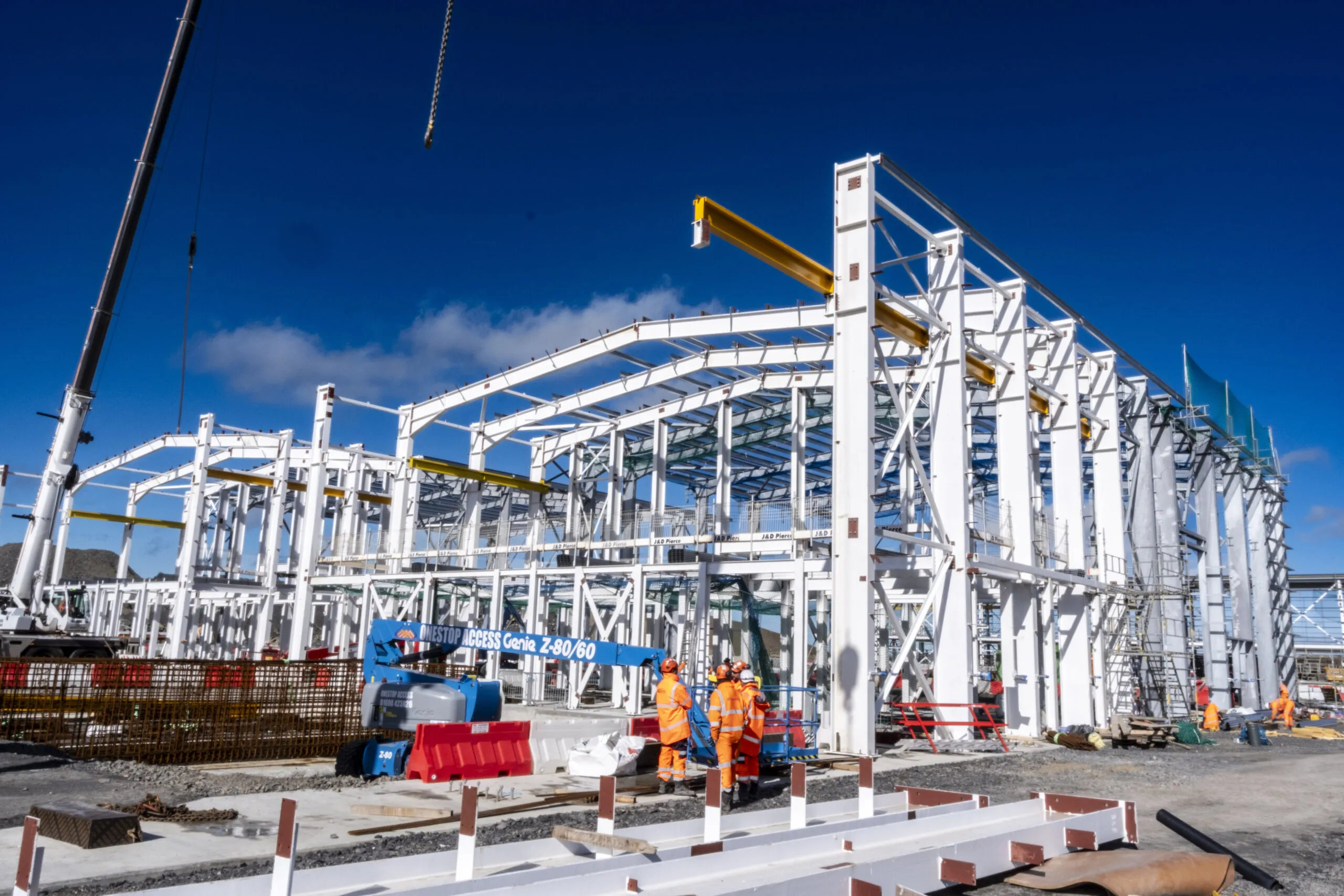
Both new substations are designed for a C5 coastal environment, classified as highly corrosive under ISO 12944, which sets out standards for corrosion protection. As a result, and to fit in with the existing agricultural structures in the area, the high voltage mechanical and electrical equipment supplied by Siemens Energy will be housed in a number of new buildings – eight at Finstown and five at the Dounreay West site, plus one at the existing Dounreay substation site.
“That’s quite different from a standard substation build, where a lot of this equipment would be outside,” MacPherson says. “The buildings cover a lot of space and constrain the way we’re allowed to build the substations, so it’s a more complex job.”
On Orkney, the ground engineering on the project has turned into quite a success story.
To accommodate the 250m-by-250m level substation platform at Finstown, the project team undertook significant earthworks, with drilling and blasting carried out by Bam Ground Engineering.
To reduce the visual impact of the substation, excavated and blasted material is being used to create additional landscaping and landform around the site.
At Finstown, approximately 260,000m³ of material was generated from the site, of which 85,000m³ comprised drilled and blasted rock. Around 92% of the blasted material has been reprocessed for reuse on site.
In addition to sustainability benefits, the reuse of material at Finstown has helped address local concerns. The team recognised that the island’s road network would face pressure from transporting large volumes of imported material, which could also have caused concerns during the public consultation process.
The same approach could not be replicated at Dounreay West, where the ground contained argillaceous material.
“At Dounreay, we’ve reused where we can in terms of landscaping bunds and tried to minimise the amount of that material going off-site, but it just unfortunately was not suitable for reuse,” MacPherson says.
The project team also tackled some initial issues with limited concrete supply capacity on Orkney and worked closely with Orkney Aggregates to overcome these prior to commencement of works on site.
“We helped them understand what our concrete requirements were, so that they could manage deliveries to the island,” MacPherson notes. “Their supply is coming across on the ferry, so we needed to be on the front foot in terms of
understanding what the whole-island requirements are, making sure we have enough cement on the island to satisfy our needs.”
The Siemens Energy and Bam JV considered lower-carbon concrete options, but the remote location made it difficult to secure and transport an alternative product. The team therefore opted for a standard ordinary Portland cement mix for the in-situ reinforced concrete foundations supporting most of the equipment and buildings. Some of the smaller bases, including those for CCTV and lighting columns, are built on precast concrete foundations.
From a design perspective, Siemens Energy technical project manager Jason Lewis says the building foundations required careful coordination.
“We cast ground-bearing ring beams directly on the rockhead which are deep enough to allow access for the numerous site services we have running across site, plus all of the HV cable entries,” he explains. “Making all those below-ground foundations and services work together has been a bit of a challenge within the design.”
According to MacPherson, some of the project’s most complex foundations are those for the two synchronous condensers (syncons) to be installed at Finstown, which have strict temperature-control requirements.
The syncons will play an important role in enhancing grid stability and represent a first for both the Siemens Energy and Bam JV and the SSEN Transmission system.
“From a technological point of view, it’s really innovative, but it also brings challenges. We’ve worked really closely with the Siemens Energy and Bam JV all the way through the design phase and will continue to do so up to delivery, installation and operation,” Manning adds.
Workforce logistics
Orkney has a population of only around 22,000 people. “At peak we could accommodate up to 300 people on the Finstown substation site. For a single project, that’s a notable increase relative to the local population,” says Manning.
The project has therefore invested in high-standard temporary accommodation and welfare facilities, which required significant planning and close collaboration with Orkney Islands Council before they could be installed. The resulting accommodation camp was a major undertaking during the early stages of the project. It includes a subsidised canteen, gym, reading room, recreational area, pool and games room, and even a cinema room.
“We’ve created almost a village on site. We’ve got around 200 people staying there at the moment and it’s fully catered, designed to almost hotel standards in terms of the regulations applied,” MacPherson says.
Travel has also required careful coordination with Loganair, which meant the project team did not need to charter dedicated aircraft.

The high voltage mechanical and electrical equipment will be housed in a number of new buildings – eight at Finstown and five at the Dounreay West site, plus one at the existing Dounreay substation site
Weather and environment
Orkney’s changeable weather conditions, while a boon from a renewable energy generation perspective, have also had an impact on the construction works.
“By the end of last year, we had all the steel frames up and had planned to continue with the internal reinforced concrete works within the buildings,” MacPherson recalls. “But we lost quite a lot of time at the start of the year because the weather made cladding very difficult through January and February. We decided to install the cladding prior to all the works being finished within the buildings.”
The team took advantage of every good weather window to get the cladding on. On days with poor weather, the fully clad buildings then offered protection to the workers.
“It took a bit of head-scratching in terms of the change in method, but it’s something we worked through with Siemens Energy, the designer and SSEN Transmission, and it’s worked well. The buildings are up now and clad in their entirety, and we’re just finishing off the last of the FRC [formwork, reinforcement and concrete] works inside. It was a very clear change in strategy,” MacPherson adds.
Environmental and heritage constraints have also shaped the project. Finstown is located close to the Heart of Neolithic Orkney World Heritage Site, which includes the Ring of Brodgar. Lowering the substation into the landscape and creating substantial landscape bunds were key considerations.
“At Finstown, we knew getting the location of the substation right was key to minimising visual impacts, taking into consideration the island’s unique landscape and World Heritage sites,” Manning says. “I think the landscaping solution that was arrived at in collaboration with Orkney Islands Council has been very well received. Various stakeholders have visited the site, and the feedback suggests that the landscaping bund does a great job in minimising visual impact from the site.”
At the Dounreay substation, cable route and landfall sites, proximity to the Dounreay nuclear power station, which is in the process of being decommissioned, added regulatory complexity.
“We have worked collaboratively with the Scottish Environment Protection Agency and other stakeholders, and we’ve secured the necessary permits for the project,” Manning explains. “There is a risk of radiological discoveries during construction, so we’ve ensured we have the appropriate permits and consents and related control measures and management plans in place. Our project team are managing this effectively and it’s now a business-as-usual activity in terms of us delivering the project.”
Project status
As of writing at end of August 2026, earthworks are complete at both sites, building frames are up, with structural foundations nearing completion, and internal reinforced concrete structures are largely in place.
Progress at the existing Dounreay site is slightly behind the two new-build sites due to the additional constraints of working within a live substation environment. This has also included the demolition of part of an existing building.
“The emphasis is very much on getting the buildings up, because the critical path revolves around allowing Siemens Energy to start with the installation of its equipment,” MacPherson highlights.
Siemens Energy is starting to ramp up activities on the sites. Once the civil works are completed by around April 2027, Bam is expected to effectively hand over running of the sites to Siemens Energy, and the focus will then shift predominantly to HV primary works.
The project is currently on track to energise in 2028.